 Add to Chrome
 Add to Firefox
 Add to Edge
CAAL: Confidence-Aware Active Learning for Heteroscedastic Atmospheric Regression
Feb 12, 2026
Quantifying the impacts of air pollution on health and climate relies on key atmospheric particle properties such as toxicity and hygroscopicity. However, these properties typically require complex observational techniques or expensive particle-resolved numerical simulations, limiting the availability of labeled data. We therefore estimate these hard-to-measure particle properties from routinely available observations (e.g., air pollutant concentrations and meteorological conditions). Because routine observations only indirectly reflect particle composition and structure, the mapping from routine observations to particle properties is noisy and input-dependent, yielding a heteroscedastic regression setting. With a limited and costly labeling budget, the central challenge is to select which samples to measure or simulate. While active learning is a natural approach, most acquisition strategies rely on predictive uncertainty. Under heteroscedastic noise, this signal conflates reducible epistemic uncertainty with irreducible aleatoric uncertainty, causing limited budgets to be wasted in noise-dominated regions. To address this challenge, we propose a confidence-aware active learning framework (CAAL) for efficient and robust sample selection in heteroscedastic settings. CAAL consists of two components: a decoupled uncertainty-aware training objective that separately optimises the predictive mean and noise level to stabilise uncertainty estimation, and a confidence-aware acquisition function that dynamically weights epistemic uncertainty using predicted aleatoric uncertainty as a reliability signal. Experiments on particle-resolved numerical simulations and real atmospheric observations show that CAAL consistently outperforms standard AL baselines. The proposed framework provides a practical and general solution for the efficient expansion of high-cost atmospheric particle property databases.

What can LLM tell us about cities?
Nov 25, 2024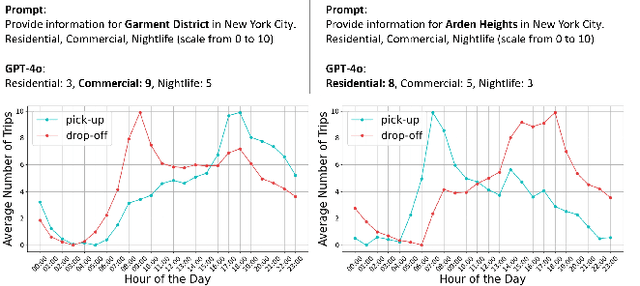
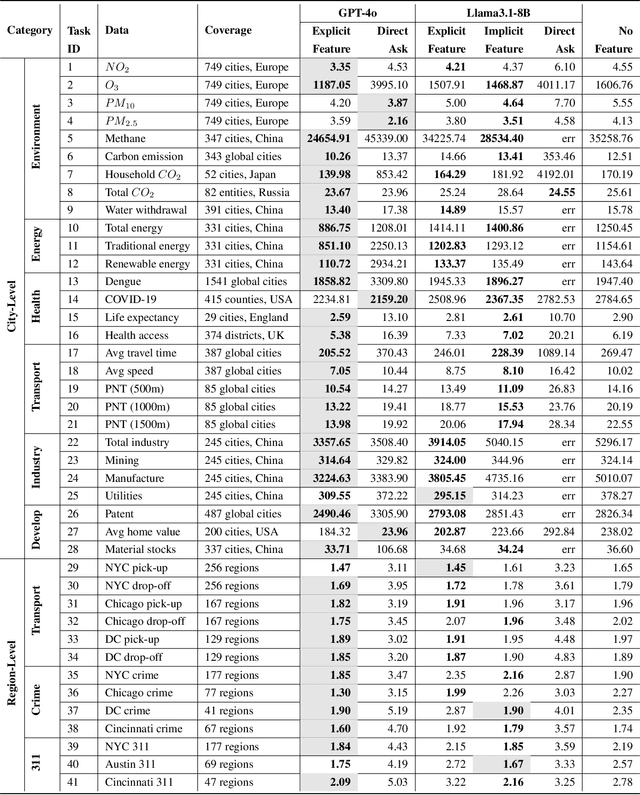
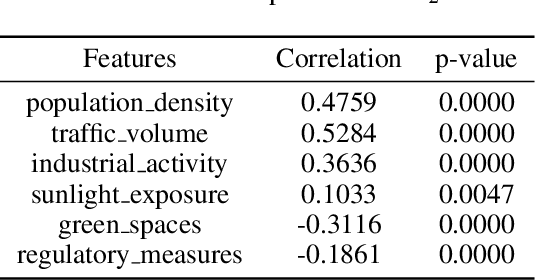
This study explores the capabilities of large language models (LLMs) in providing knowledge about cities and regions on a global scale. We employ two methods: directly querying the LLM for target variable values and extracting explicit and implicit features from the LLM correlated with the target variable. Our experiments reveal that LLMs embed a broad but varying degree of knowledge across global cities, with ML models trained on LLM-derived features consistently leading to improved predictive accuracy. Additionally, we observe that LLMs demonstrate a certain level of knowledge across global cities on all continents, but it is evident when they lack knowledge, as they tend to generate generic or random outputs for unfamiliar tasks. These findings suggest that LLMs can offer new opportunities for data-driven decision-making in the study of cities.