 Add to Chrome
 Add to Firefox
 Add to Edge
DINOv3 Visual Representations for Blueberry Perception Toward Robotic Harvesting
Mar 02, 2026
Vision Foundation Models trained via large-scale self-supervised learning have demonstrated strong generalization in visual perception; however, their practical role and performance limits in agricultural settings remain insufficiently understood. This work evaluates DINOv3 as a frozen backbone for blueberry robotic harvesting-related visual tasks, including fruit and bruise segmentation, as well as fruit and cluster detection. Under a unified protocol with lightweight decoders, segmentation benefits consistently from stable patch-level representations and scales with backbone size. In contrast, detection is constrained by target scale variation, patch discretization, and localization compatibility. The failure of cluster detection highlights limitations in modeling relational targets defined by spatial aggregation. Overall, DINOv3 is best viewed not as an end-to-end task model, but as a semantic backbone whose effectiveness depends on downstream spatial modeling aligned with fruit-scale and aggregation structures, providing guidance for blueberry robotic harvesting. Code and dataset will be available upon acceptance.

AGI for Agriculture
Apr 12, 2023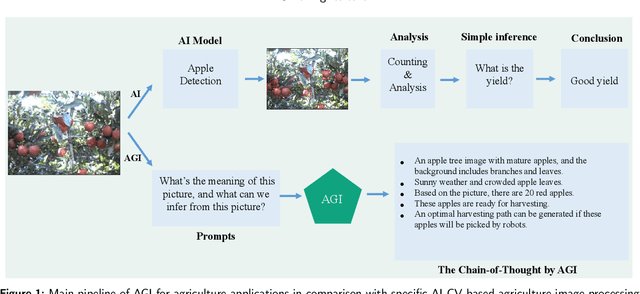
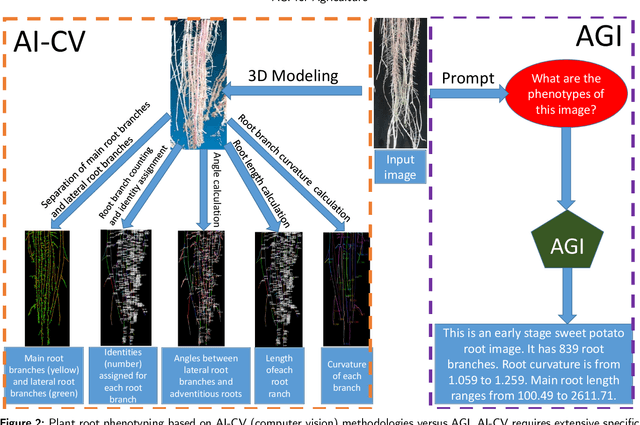
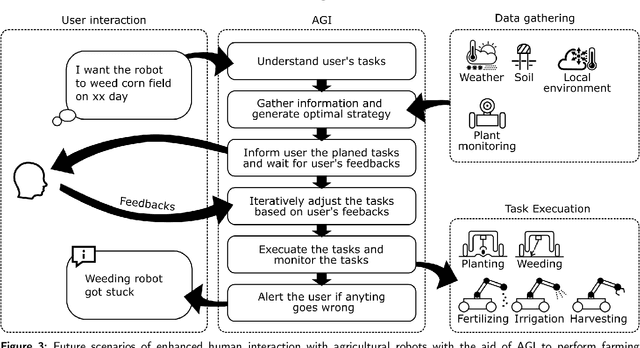
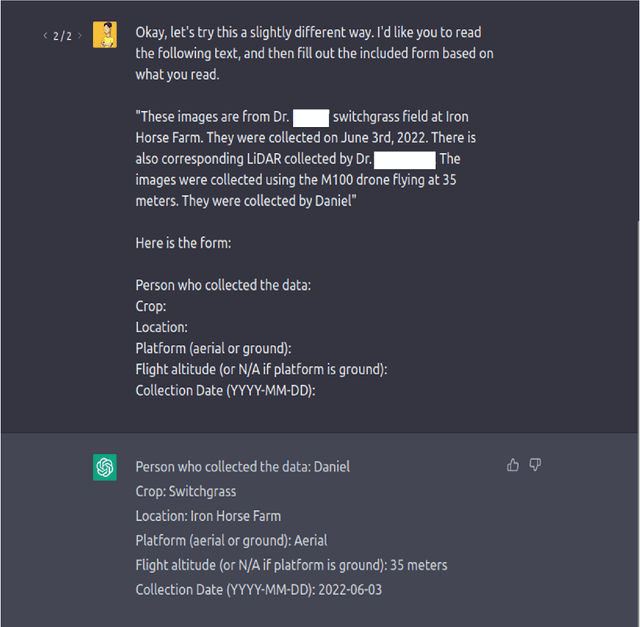
Artificial General Intelligence (AGI) is poised to revolutionize a variety of sectors, including healthcare, finance, transportation, and education. Within healthcare, AGI is being utilized to analyze clinical medical notes, recognize patterns in patient data, and aid in patient management. Agriculture is another critical sector that impacts the lives of individuals worldwide. It serves as a foundation for providing food, fiber, and fuel, yet faces several challenges, such as climate change, soil degradation, water scarcity, and food security. AGI has the potential to tackle these issues by enhancing crop yields, reducing waste, and promoting sustainable farming practices. It can also help farmers make informed decisions by leveraging real-time data, leading to more efficient and effective farm management. This paper delves into the potential future applications of AGI in agriculture, such as agriculture image processing, natural language processing (NLP), robotics, knowledge graphs, and infrastructure, and their impact on precision livestock and precision crops. By leveraging the power of AGI, these emerging technologies can provide farmers with actionable insights, allowing for optimized decision-making and increased productivity. The transformative potential of AGI in agriculture is vast, and this paper aims to highlight its potential to revolutionize the industry.