 Add to Chrome
 Add to Firefox
 Add to Edge
Geometric implicit neural representations for signed distance functions
Nov 10, 2025
\textit{Implicit neural representations} (INRs) have emerged as a promising framework for representing signals in low-dimensional spaces. This survey reviews the existing literature on the specialized INR problem of approximating \textit{signed distance functions} (SDFs) for surface scenes, using either oriented point clouds or a set of posed images. We refer to neural SDFs that incorporate differential geometry tools, such as normals and curvatures, in their loss functions as \textit{geometric} INRs. The key idea behind this 3D reconstruction approach is to include additional \textit{regularization} terms in the loss function, ensuring that the INR satisfies certain global properties that the function should hold -- such as having unit gradient in the case of SDFs. We explore key methodological components, including the definition of INR, the construction of geometric loss functions, and sampling schemes from a differential geometry perspective. Our review highlights the significant advancements enabled by geometric INRs in surface reconstruction from oriented point clouds and posed images.

High-Resolution Detection of Earth Structural Heterogeneities from Seismic Amplitudes using Convolutional Neural Networks with Attention layers
Apr 15, 2024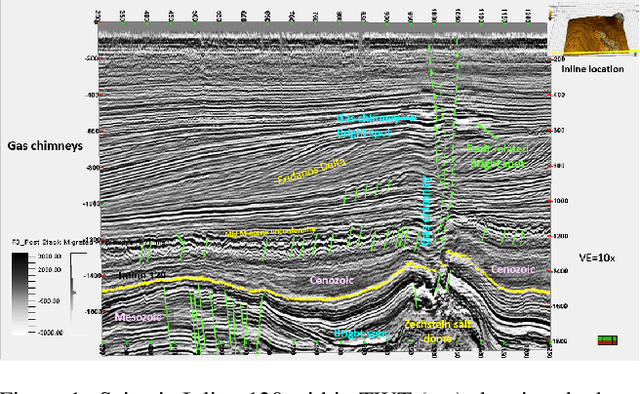
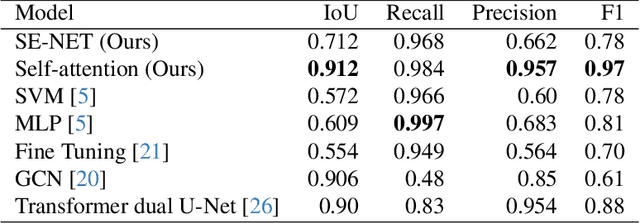
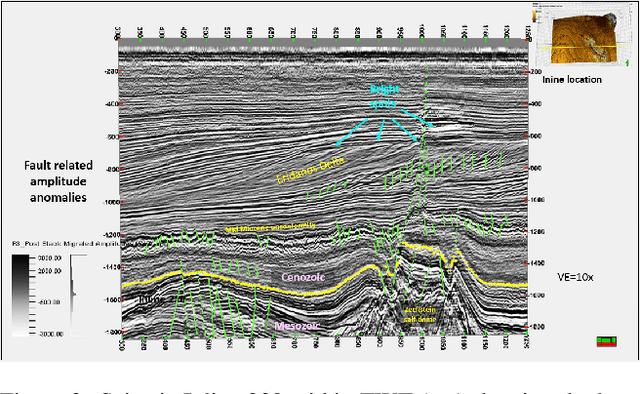
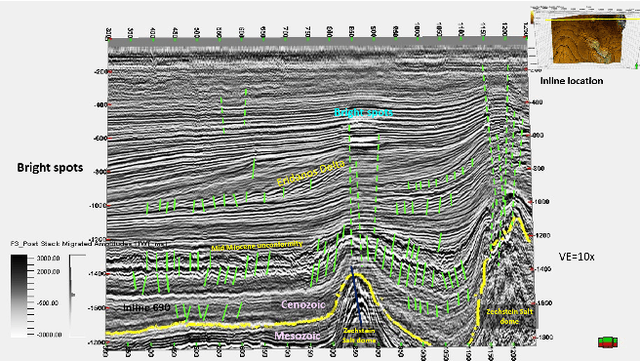
Earth structural heterogeneities have a remarkable role in the petroleum economy for both exploration and production projects. Automatic detection of detailed structural heterogeneities is challenging when considering modern machine learning techniques like deep neural networks. Typically, these techniques can be an excellent tool for assisted interpretation of such heterogeneities, but it heavily depends on the amount of data to be trained. We propose an efficient and cost-effective architecture for detecting seismic structural heterogeneities using Convolutional Neural Networks (CNNs) combined with Attention layers. The attention mechanism reduces costs and enhances accuracy, even in cases with relatively noisy data. Our model has half the parameters compared to the state-of-the-art, and it outperforms previous methods in terms of Intersection over Union (IoU) by 0.6% and precision by 0.4%. By leveraging synthetic data, we apply transfer learning to train and fine-tune the model, addressing the challenge of limited annotated data availability.