 Add to Chrome
 Add to Firefox
 Add to Edge
Elicitation without Backpropagation: Steering Model Behavior by Optimizing the Latent Posterior
Jul 21, 2026
In the \emph{latent posterior model} of transformer behavior, the next-token distribution arises from a posterior over latent predictive models conditioned on the context, mixed to generate continuations. We exploit this model in settings where it is exact, namely Bayes-filtered transformers (BFTs) meta-learned on sequences from a hierarchical prior, to introduce \textbf{Posterior Prefix Tuning (PPT)}, a new method for \emph{eliciting} behavior from a transformer: given a utility function on continuations, find a prompt under which the transformer generates continuations of high expected utility. For a BFT, the elicitation objective factors through the latent posterior, and the gradient of this objective can be estimated from samples of the prior alone. PPT optimizes the parameters of a distribution over hard prompts: it draws prior samples once from the BFT via predictive Monte Carlo (PMC), then estimates the gradient by importance sampling against them. The optimization performs no transformer forward passes and no backpropagation through the transformer, and the prior samples are utility-independent, so a single set of samples drives elicitation against any number of utilities at negligible marginal cost. We validate PPT on Beta--Bernoulli and reinforced urn BFTs across three utility families (reverse cross-entropy, frequency matching, Dyck validity).

Patterning: The Dual of Interpretability
Jan 20, 2026Mechanistic interpretability aims to understand how neural networks generalize beyond their training data by reverse-engineering their internal structures. We introduce patterning as the dual problem: given a desired form of generalization, determine what training data produces it. Our approach is based on susceptibilities, which measure how posterior expectation values of observables respond to infinitesimal shifts in the data distribution. Inverting this linear response relationship yields the data intervention that steers the model toward a target internal configuration. We demonstrate patterning in a small language model, showing that re-weighting training data along principal susceptibility directions can accelerate or delay the formation of structure, such as the induction circuit. In a synthetic parentheses balancing task where multiple algorithms achieve perfect training accuracy, we show that patterning can select which algorithm the model learns by targeting the local learning coefficient of each solution. These results establish that the same mathematical framework used to read internal structure can be inverted to write it.
Towards Spectroscopy: Susceptibility Clusters in Language Models
Jan 19, 2026Spectroscopy infers the internal structure of physical systems by measuring their response to perturbations. We apply this principle to neural networks: perturbing the data distribution by upweighting a token $y$ in context $x$, we measure the model's response via susceptibilities $χ_{xy}$, which are covariances between component-level observables and the perturbation computed over a localized Gibbs posterior via stochastic gradient Langevin dynamics (SGLD). Theoretically, we show that susceptibilities decompose as a sum over modes of the data distribution, explaining why tokens that follow their contexts "for similar reasons" cluster together in susceptibility space. Empirically, we apply this methodology to Pythia-14M, developing a conductance-based clustering algorithm that identifies 510 interpretable clusters ranging from grammatical patterns to code structure to mathematical notation. Comparing to sparse autoencoders, 50% of our clusters match SAE features, validating that both methods recover similar structure.
Stagewise Reinforcement Learning and the Geometry of the Regret Landscape
Jan 12, 2026Singular learning theory characterizes Bayesian learning as an evolving tradeoff between accuracy and complexity, with transitions between qualitatively different solutions as sample size increases. We extend this theory to deep reinforcement learning, proving that the concentration of the generalized posterior over policies is governed by the local learning coefficient (LLC), an invariant of the geometry of the regret function. This theory predicts that Bayesian phase transitions in reinforcement learning should proceed from simple policies with high regret to complex policies with low regret. We verify this prediction empirically in a gridworld environment exhibiting stagewise policy development: phase transitions over SGD training manifest as "opposing staircases" where regret decreases sharply while the LLC increases. Notably, the LLC detects phase transitions even when estimated on a subset of states where the policies appear identical in terms of regret, suggesting it captures changes in the underlying algorithm rather than just performance.
Embryology of a Language Model
Aug 01, 2025Understanding how language models develop their internal computational structure is a central problem in the science of deep learning. While susceptibilities, drawn from statistical physics, offer a promising analytical tool, their full potential for visualizing network organization remains untapped. In this work, we introduce an embryological approach, applying UMAP to the susceptibility matrix to visualize the model's structural development over training. Our visualizations reveal the emergence of a clear ``body plan,'' charting the formation of known features like the induction circuit and discovering previously unknown structures, such as a ``spacing fin'' dedicated to counting space tokens. This work demonstrates that susceptibility analysis can move beyond validation to uncover novel mechanisms, providing a powerful, holistic lens for studying the developmental principles of complex neural networks.
Modes of Sequence Models and Learning Coefficients
Apr 25, 2025We develop a geometric account of sequence modelling that links patterns in the data to measurable properties of the loss landscape in transformer networks. First, we cast conditional sequence distributions into a Hilbert-space framework and apply tensor decompositions to identify their principal modes. Truncating the small-amplitude modes yields an effective data distribution that preserves dominant structure while discarding statistical detail. Second, we show theoretically that Local Learning Coefficient (LLC) estimates are insensitive to modes below a data-dependent threshold. Consequently, the LLC calculated in practice characterises the geometry of the effective rather than the true distribution. This insight clarifies why reliable LLC estimates can be obtained even when a network parameter is not a strict minimiser of the population loss, and it highlights how the inverse temperature in SGLD acts as a resolution dial on the landscape structure.
Studying Small Language Models with Susceptibilities
Apr 25, 2025We develop a linear response framework for interpretability that treats a neural network as a Bayesian statistical mechanical system. A small, controlled perturbation of the data distribution, for example shifting the Pile toward GitHub or legal text, induces a first-order change in the posterior expectation of an observable localized on a chosen component of the network. The resulting susceptibility can be estimated efficiently with local SGLD samples and factorizes into signed, per-token contributions that serve as attribution scores. Building a set of perturbations (probes) yields a response matrix whose low-rank structure separates functional modules such as multigram and induction heads in a 3M-parameter transformer. Susceptibilities link local learning coefficients from singular learning theory with linear-response theory, and quantify how local loss landscape geometry deforms under shifts in the data distribution.
Programs as Singularities
Apr 10, 2025We develop a correspondence between the structure of Turing machines and the structure of singularities of real analytic functions, based on connecting the Ehrhard-Regnier derivative from linear logic with the role of geometry in Watanabe's singular learning theory. The correspondence works by embedding ordinary (discrete) Turing machine codes into a family of noisy codes which form a smooth parameter space. On this parameter space we consider a potential function which has Turing machines as critical points. By relating the Taylor series expansion of this potential at such a critical point to combinatorics of error syndromes, we relate the local geometry to internal structure of the Turing machine. The potential in question is the negative log-likelihood for a statistical model, so that the structure of the Turing machine and its associated singularity is further related to Bayesian inference. Two algorithms that produce the same predictive function can nonetheless correspond to singularities with different geometries, which implies that the Bayesian posterior can discriminate between distinct algorithmic implementations, contrary to a purely functional view of inference. In the context of singular learning theory our results point to a more nuanced understanding of Occam's razor and the meaning of simplicity in inductive inference.
You Are What You Eat -- AI Alignment Requires Understanding How Data Shapes Structure and Generalisation
Feb 08, 2025In this position paper, we argue that understanding the relation between structure in the data distribution and structure in trained models is central to AI alignment. First, we discuss how two neural networks can have equivalent performance on the training set but compute their outputs in essentially different ways and thus generalise differently. For this reason, standard testing and evaluation are insufficient for obtaining assurances of safety for widely deployed generally intelligent systems. We argue that to progress beyond evaluation to a robust mathematical science of AI alignment, we need to develop statistical foundations for an understanding of the relation between structure in the data distribution, internal structure in models, and how these structures underlie generalisation.
Dynamics of Transient Structure in In-Context Linear Regression Transformers
Jan 31, 2025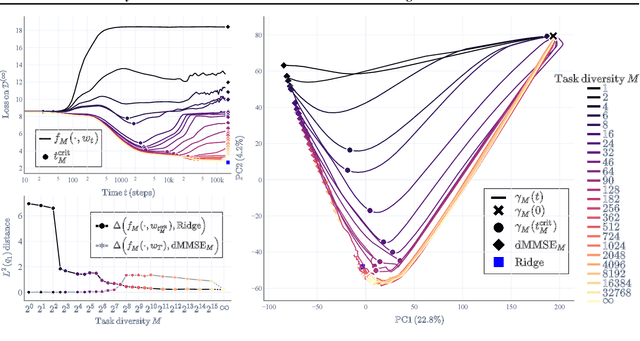
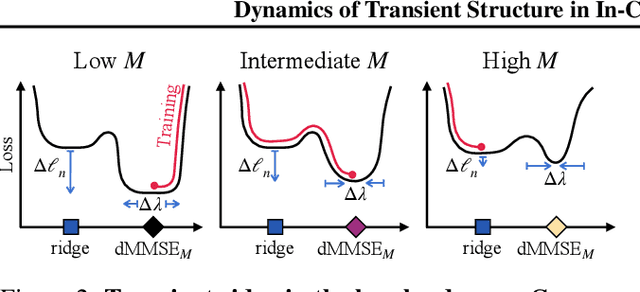
Modern deep neural networks display striking examples of rich internal computational structure. Uncovering principles governing the development of such structure is a priority for the science of deep learning. In this paper, we explore the transient ridge phenomenon: when transformers are trained on in-context linear regression tasks with intermediate task diversity, they initially behave like ridge regression before specializing to the tasks in their training distribution. This transition from a general solution to a specialized solution is revealed by joint trajectory principal component analysis. Further, we draw on the theory of Bayesian internal model selection to suggest a general explanation for the phenomena of transient structure in transformers, based on an evolving tradeoff between loss and complexity. We empirically validate this explanation by measuring the model complexity of our transformers as defined by the local learning coefficient.