 Add to Chrome
 Add to Firefox
 Add to Edge
Stagewise Reinforcement Learning and the Geometry of the Regret Landscape
Jan 12, 2026
Singular learning theory characterizes Bayesian learning as an evolving tradeoff between accuracy and complexity, with transitions between qualitatively different solutions as sample size increases. We extend this theory to deep reinforcement learning, proving that the concentration of the generalized posterior over policies is governed by the local learning coefficient (LLC), an invariant of the geometry of the regret function. This theory predicts that Bayesian phase transitions in reinforcement learning should proceed from simple policies with high regret to complex policies with low regret. We verify this prediction empirically in a gridworld environment exhibiting stagewise policy development: phase transitions over SGD training manifest as "opposing staircases" where regret decreases sharply while the LLC increases. Notably, the LLC detects phase transitions even when estimated on a subset of states where the policies appear identical in terms of regret, suggesting it captures changes in the underlying algorithm rather than just performance.

Structure Development in List-Sorting Transformers
Jan 30, 2025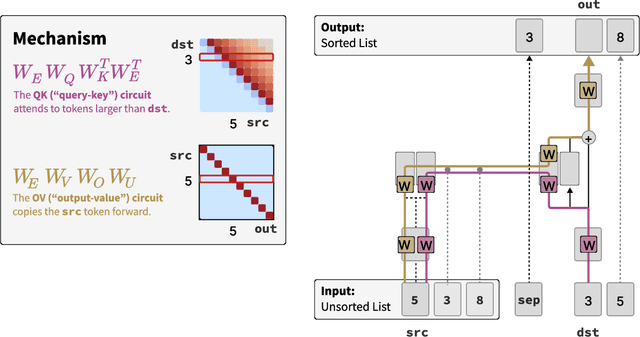
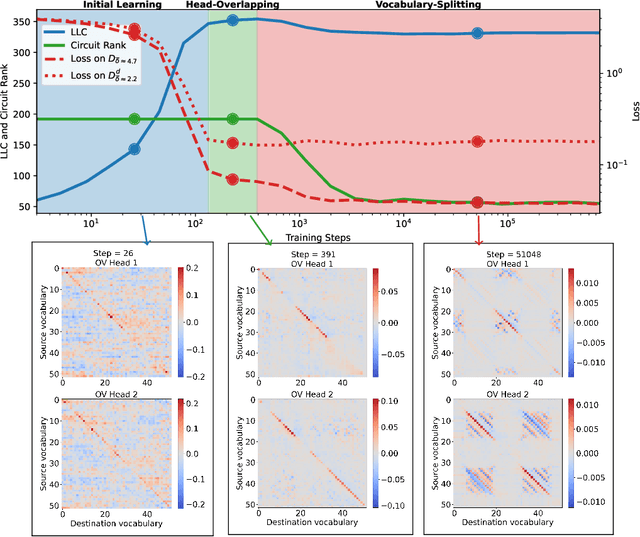

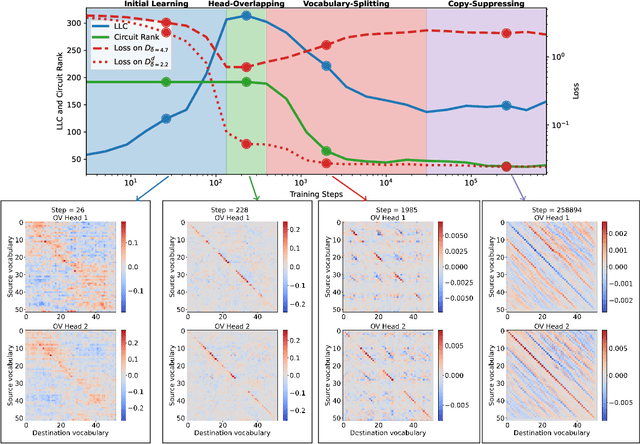
We study how a one-layer attention-only transformer develops relevant structures while learning to sort lists of numbers. At the end of training, the model organizes its attention heads in two main modes that we refer to as vocabulary-splitting and copy-suppression. Both represent simpler modes than having multiple heads handle overlapping ranges of numbers. Interestingly, vocabulary-splitting is present regardless of whether we use weight decay, a common regularization technique thought to drive simplification, supporting the thesis that neural networks naturally prefer simpler solutions. We relate copy-suppression to a mechanism in GPT-2 and investigate its functional role in our model. Guided by insights from a developmental analysis of the model, we identify features in the training data that drive the model's final acquired solution. This provides a concrete example of how the training data shape the internal organization of transformers, paving the way for future studies that could help us better understand how LLMs develop their internal structures.