 Add to Chrome
 Add to Firefox
 Add to Edge
What Are Tools Anyway? A Survey from the Language Model Perspective
Mar 18, 2024
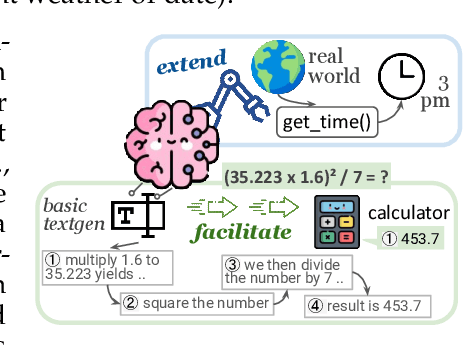
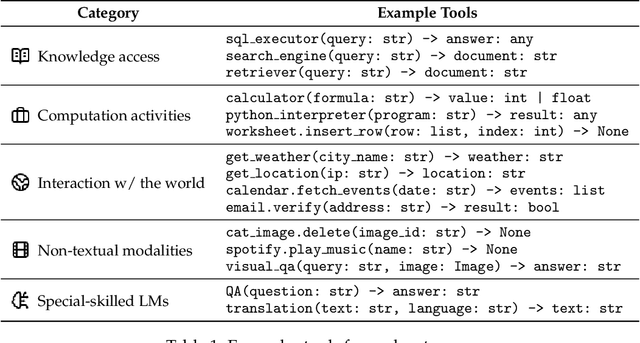
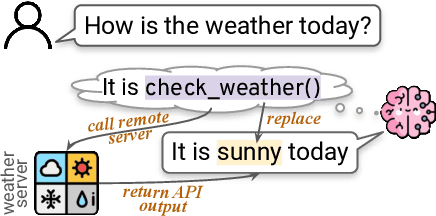
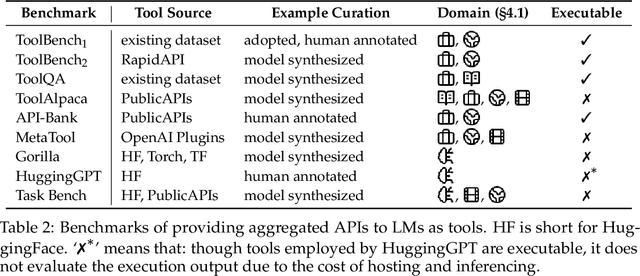
Language models (LMs) are powerful yet mostly for text generation tasks. Tools have substantially enhanced their performance for tasks that require complex skills. However, many works adopt the term "tool" in different ways, raising the question: What is a tool anyway? Subsequently, where and how do tools help LMs? In this survey, we provide a unified definition of tools as external programs used by LMs, and perform a systematic review of LM tooling scenarios and approaches. Grounded on this review, we empirically study the efficiency of various tooling methods by measuring their required compute and performance gains on various benchmarks, and highlight some challenges and potential future research in the field.

Repetition Improves Language Model Embeddings
Feb 23, 2024
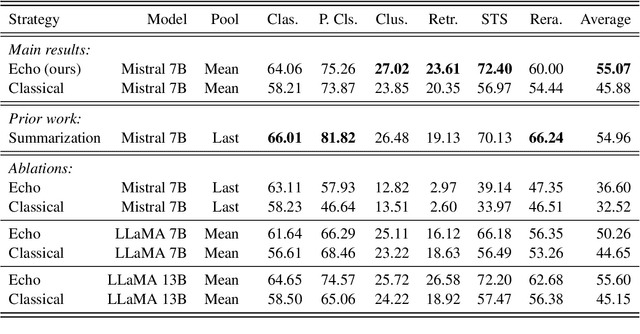


Recent approaches to improving the extraction of text embeddings from autoregressive large language models (LLMs) have largely focused on improvements to data, backbone pretrained language models, or improving task-differentiation via instructions. In this work, we address an architectural limitation of autoregressive models: token embeddings cannot contain information from tokens that appear later in the input. To address this limitation, we propose a simple approach, "echo embeddings," in which we repeat the input twice in context and extract embeddings from the second occurrence. We show that echo embeddings of early tokens can encode information about later tokens, allowing us to maximally leverage high-quality LLMs for embeddings. On the MTEB leaderboard, echo embeddings improve over classical embeddings by over 9% zero-shot and by around 0.7% when fine-tuned. Echo embeddings with a Mistral-7B model achieve state-of-the-art compared to prior open source models that do not leverage synthetic fine-tuning data.
VisualWebArena: Evaluating Multimodal Agents on Realistic Visual Web Tasks
Jan 24, 2024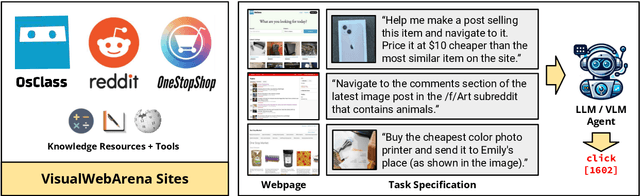
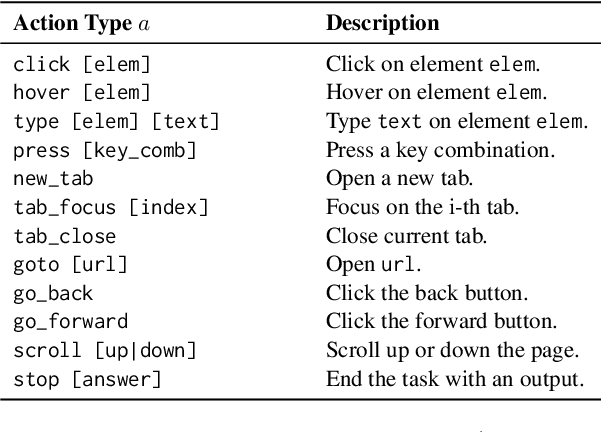
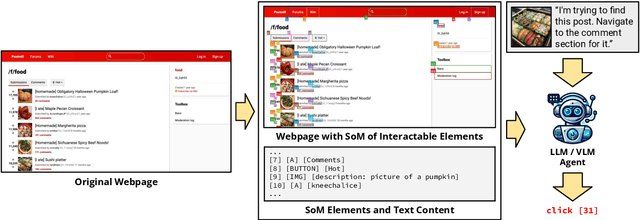
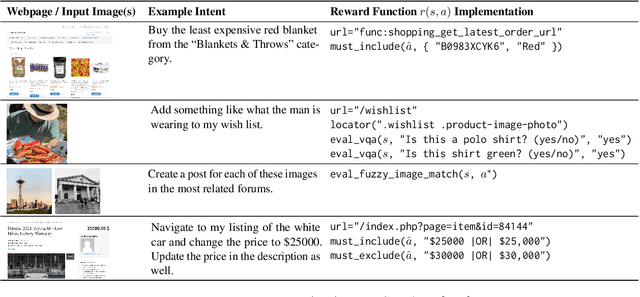
Autonomous agents capable of planning, reasoning, and executing actions on the web offer a promising avenue for automating computer tasks. However, the majority of existing benchmarks primarily focus on text-based agents, neglecting many natural tasks that require visual information to effectively solve. Given that most computer interfaces cater to human perception, visual information often augments textual data in ways that text-only models struggle to harness effectively. To bridge this gap, we introduce VisualWebArena, a benchmark designed to assess the performance of multimodal web agents on realistic \textit{visually grounded tasks}. VisualWebArena comprises of a set of diverse and complex web-based tasks that evaluate various capabilities of autonomous multimodal agents. To perform on this benchmark, agents need to accurately process image-text inputs, interpret natural language instructions, and execute actions on websites to accomplish user-defined objectives. We conduct an extensive evaluation of state-of-the-art LLM-based autonomous agents, including several multimodal models. Through extensive quantitative and qualitative analysis, we identify several limitations of text-only LLM agents, and reveal gaps in the capabilities of state-of-the-art multimodal language agents. VisualWebArena provides a framework for evaluating multimodal autonomous language agents, and offers insights towards building stronger autonomous agents for the web. Our code, baseline models, and data is publicly available at https://jykoh.com/vwa.
TroVE: Inducing Verifiable and Efficient Toolboxes for Solving Programmatic Tasks
Jan 23, 2024Language models (LMs) can solve tasks such as answering questions about tables or images by writing programs. However, using primitive functions often leads to verbose and error-prone programs, and higher-level functions require expert design. To enable better solutions without human labor, we ask code LMs to curate reusable high-level functions, and use them to write solutions. We present TROVE, a training-free method of inducing a verifiable and efficient toolbox of functions, by generating via using, growing, and periodically trimming the toolbox. On 11 datasets from math, table question answering, and image reasoning tasks, TROVE consistently yields simpler solutions with higher accuracy than baselines using CODELLAMA and previous methods using GPT, while using 79-98% smaller toolboxes. TROVE further enables 31% faster and 13% more accurate human verification than baselines. With the same pipeline, it creates diverse functions for varied tasks and datasets, providing insights into their individual characteristics.
Asking More Informative Questions for Grounded Retrieval
Nov 14, 2023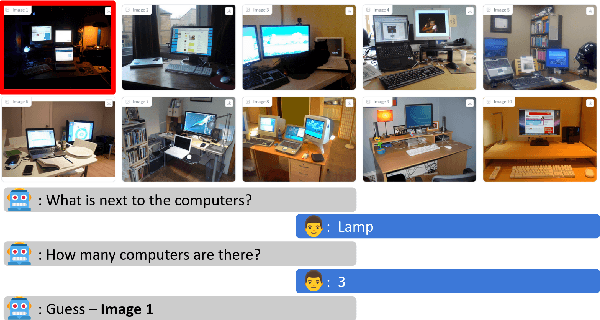

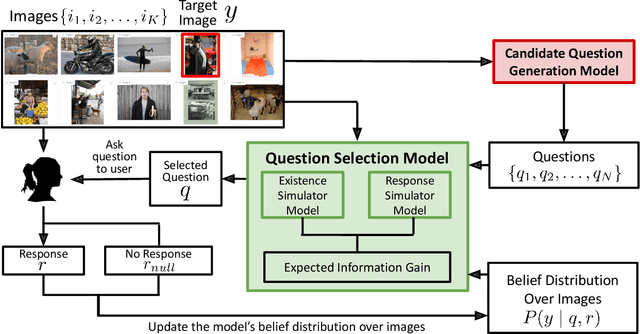
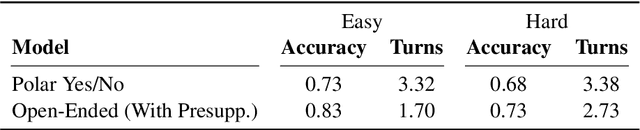
When a model is trying to gather information in an interactive setting, it benefits from asking informative questions. However, in the case of a grounded multi-turn image identification task, previous studies have been constrained to polar yes/no questions, limiting how much information the model can gain in a single turn. We present an approach that formulates more informative, open-ended questions. In doing so, we discover that off-the-shelf visual question answering (VQA) models often make presupposition errors, which standard information gain question selection methods fail to account for. To address this issue, we propose a method that can incorporate presupposition handling into both question selection and belief updates. Specifically, we use a two-stage process, where the model first filters out images which are irrelevant to a given question, then updates its beliefs about which image the user intends. Through self-play and human evaluations, we show that our method is successful in asking informative open-ended questions, increasing accuracy over the past state-of-the-art by 14%, while resulting in 48% more efficient games in human evaluations.
Generating Pragmatic Examples to Train Neural Program Synthesizers
Nov 09, 2023Programming-by-example is the task of synthesizing a program that is consistent with a set of user-provided input-output examples. As examples are often an under-specification of one's intent, a good synthesizer must choose the intended program from the many that are consistent with the given set of examples. Prior work frames program synthesis as a cooperative game between a listener (that synthesizes programs) and a speaker (a user choosing examples), and shows that models of computational pragmatic inference are effective in choosing the user intended programs. However, these models require counterfactual reasoning over a large set of programs and examples, which is infeasible in realistic program spaces. In this paper, we propose a novel way to amortize this search with neural networks. We sample pairs of programs and examples via self-play between listener and speaker models, and use pragmatic inference to choose informative training examples from this sample.We then use the informative dataset to train models to improve the synthesizer's ability to disambiguate user-provided examples without human supervision. We validate our method on the challenging task of synthesizing regular expressions from example strings, and find that our method (1) outperforms models trained without choosing pragmatic examples by 23% (a 51% relative increase) (2) matches the performance of supervised learning on a dataset of pragmatic examples provided by humans, despite using no human data in training.
Comparative Knowledge Distillation
Nov 03, 2023
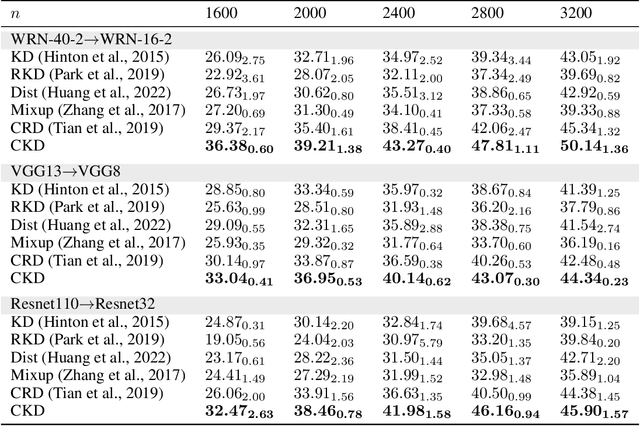

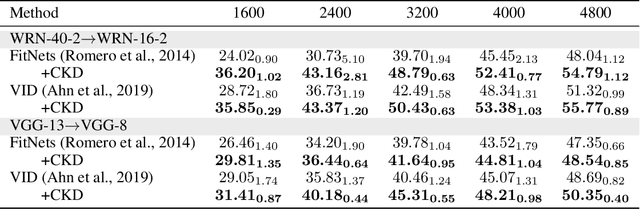
In the era of large scale pretrained models, Knowledge Distillation (KD) serves an important role in transferring the wisdom of computationally heavy teacher models to lightweight, efficient student models while preserving performance. Traditional KD paradigms, however, assume readily available access to teacher models for frequent inference -- a notion increasingly at odds with the realities of costly, often proprietary, large scale models. Addressing this gap, our paper considers how to minimize the dependency on teacher model inferences in KD in a setting we term Few Teacher Inference Knowledge Distillation (FTI KD). We observe that prevalent KD techniques and state of the art data augmentation strategies fall short in this constrained setting. Drawing inspiration from educational principles that emphasize learning through comparison, we propose Comparative Knowledge Distillation (CKD), which encourages student models to understand the nuanced differences in a teacher model's interpretations of samples. Critically, CKD provides additional learning signals to the student without making additional teacher calls. We also extend the principle of CKD to groups of samples, enabling even more efficient learning from limited teacher calls. Empirical evaluation across varied experimental settings indicates that CKD consistently outperforms state of the art data augmentation and KD techniques.
Data Augmentation for Code Translation with Comparable Corpora and Multiple References
Nov 01, 2023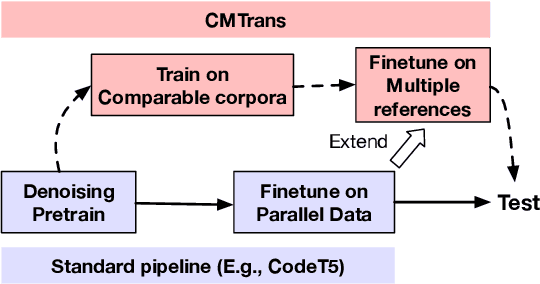
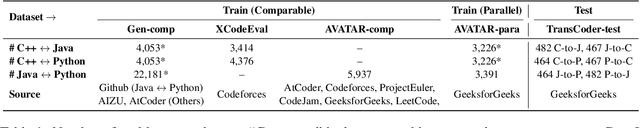
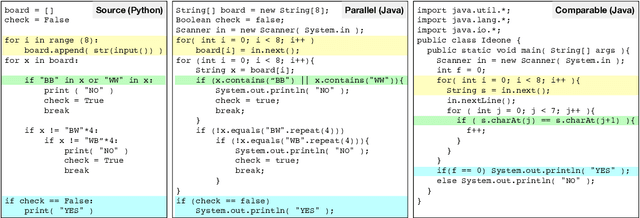
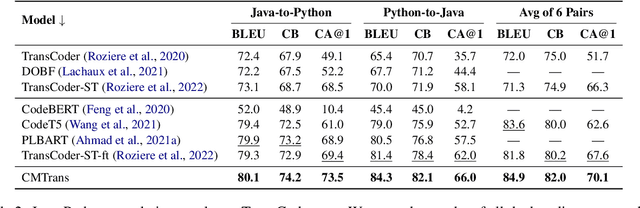
One major challenge of translating code between programming languages is that parallel training data is often limited. To overcome this challenge, we present two data augmentation techniques, one that builds comparable corpora (i.e., code pairs with similar functionality), and another that augments existing parallel data with multiple reference translations. Specifically, we build and analyze multiple types of comparable corpora, including programs generated from natural language documentation using a code generation model. Furthermore, to reduce overfitting to a single reference translation, we automatically generate additional translation references for available parallel data and filter the translations by unit tests, which increases variation in target translations. Experiments show that our data augmentation techniques significantly improve CodeT5 for translation between Java, Python, and C++ by an average of 7.5% Computational Accuracy (CA@1), which verifies the correctness of translations by execution. The code is available at https://github.com/Veronicium/CMTrans.
Symbolic Planning and Code Generation for Grounded Dialogue
Oct 26, 2023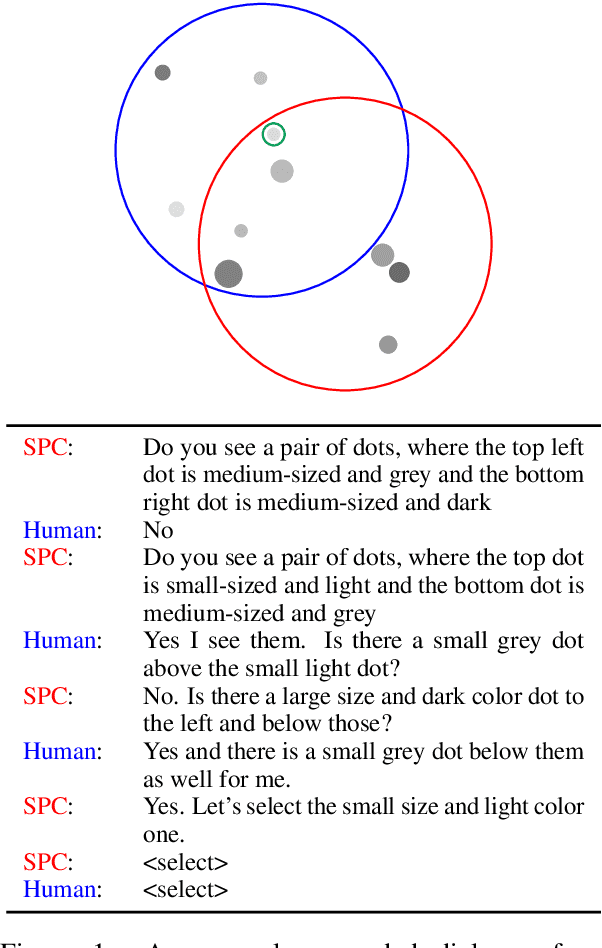

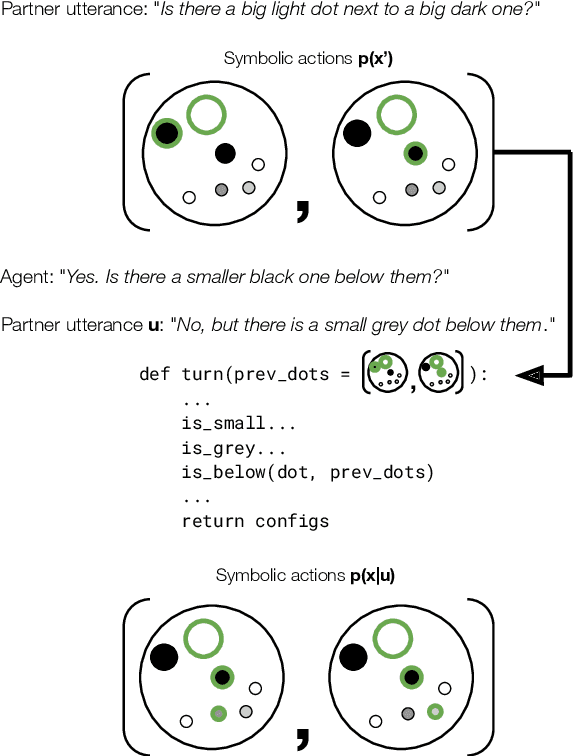

Large language models (LLMs) excel at processing and generating both text and code. However, LLMs have had limited applicability in grounded task-oriented dialogue as they are difficult to steer toward task objectives and fail to handle novel grounding. We present a modular and interpretable grounded dialogue system that addresses these shortcomings by composing LLMs with a symbolic planner and grounded code execution. Our system consists of a reader and planner: the reader leverages an LLM to convert partner utterances into executable code, calling functions that perform grounding. The translated code's output is stored to track dialogue state, while a symbolic planner determines the next appropriate response. We evaluate our system's performance on the demanding OneCommon dialogue task, involving collaborative reference resolution on abstract images of scattered dots. Our system substantially outperforms the previous state-of-the-art, including improving task success in human evaluations from 56% to 69% in the most challenging setting.
API-Assisted Code Generation for Question Answering on Varied Table Structures
Oct 23, 2023


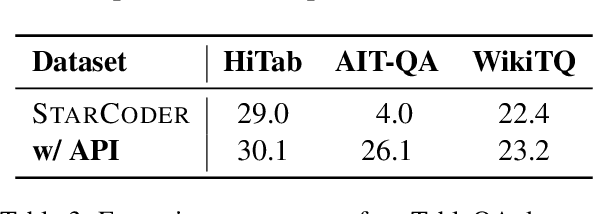
A persistent challenge to table question answering (TableQA) by generating executable programs has been adapting to varied table structures, typically requiring domain-specific logical forms. In response, this paper introduces a unified TableQA framework that: (1) provides a unified representation for structured tables as multi-index Pandas data frames, (2) uses Python as a powerful querying language, and (3) uses few-shot prompting to translate NL questions into Python programs, which are executable on Pandas data frames. Furthermore, to answer complex relational questions with extended program functionality and external knowledge, our framework allows customized APIs that Python programs can call. We experiment with four TableQA datasets that involve tables of different structures -- relational, multi-table, and hierarchical matrix shapes -- and achieve prominent improvements over past state-of-the-art systems. In ablation studies, we (1) show benefits from our multi-index representation and APIs over baselines that use only an LLM, and (2) demonstrate that our approach is modular and can incorporate additional APIs.