 Add to Chrome
 Add to Firefox
 Add to Edge
SPARC-Rad: A Multimodal Benchmark Dataset and Evaluation Pipeline for Spatial and Anatomical Reasoning in Radiology Vision-Language Models
Jul 30, 2026
Vision-language models (VLMs) are increasingly being evaluated for medical imaging, but many available benchmarks emphasize disease classification, report generation, or broad visual question answering rather than the spatial and anatomical reasoning required for radiology. We developed the Spatial Perception and Anatomical Reasoning in Clinical Radiology (SPARC-Rad) Benchmark, a manually curated multimodal benchmark dataset and evaluation pipeline for assessing these capabilities in radiology VLMs. SPARC-Rad includes 300 image-question pairs derived from healthy control imaging studies in The Cancer Imaging Archive (TCIA), spanning CT, MRI, and radiography across the abdomen, chest, breast, neuro, and musculoskeletal categories. Radiology trainees manually designed and annotated questions to evaluate anatomical identification, localization, laterality, regional recognition, device identification, and inter-structure spatial relationships. The evaluation pipeline supports standardized prompting, structured output collection, response normalization, LLM-as-judge grading, human quality review, binary correctness scoring, and subgroup analysis by modality, anatomy, and reasoning type. SPARC-Rad provides a reusable framework for evaluating whether VLMs can provide reasoning for radiologic anatomy as a spatial system, supporting future model development, failure-mode analysis, and pre-deployment assessment.

CoMMa: Contribution-Aware Medical Multi-Agents From A Game-Theoretic Perspective
Feb 09, 2026Recent multi-agent frameworks have broadened the ability to tackle oncology decision support tasks that require reasoning over dynamic, heterogeneous patient data. We propose Contribution-Aware Medical Multi-Agents (CoMMa), a decentralized LLM-agent framework in which specialists operate on partitioned evidence and coordinate through a game-theoretic objective for robust decision-making. In contrast to most agent architectures relying on stochastic narrative-based reasoning, CoMMa utilizes deterministic embedding projections to approximate contribution-aware credit assignment. This yields explicit evidence attribution by estimating each agent's marginal utility, producing interpretable and mathematically grounded decision pathways with improved stability. Evaluated on diverse oncology benchmarks, including a real-world multidisciplinary tumor board dataset, CoMMa achieves higher accuracy and more stable performance than data-centralized and role-based multi-agents baselines.
DBT-DINO: Towards Foundation model based analysis of Digital Breast Tomosynthesis
Dec 15, 2025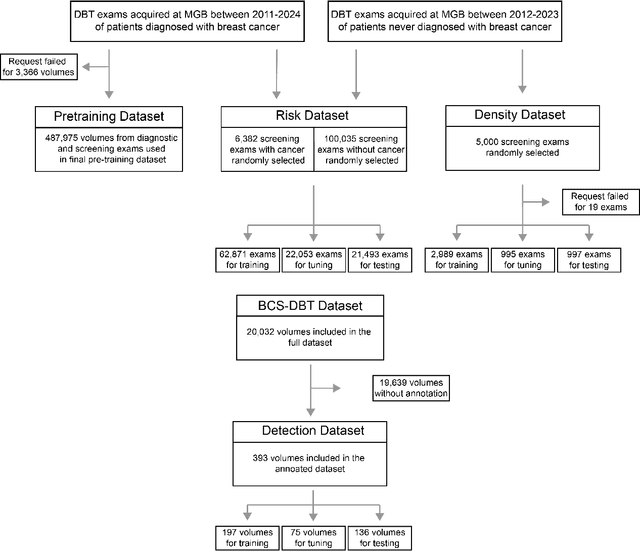
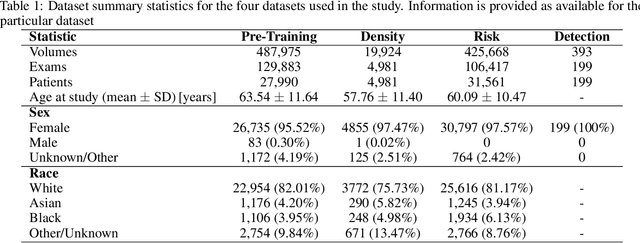
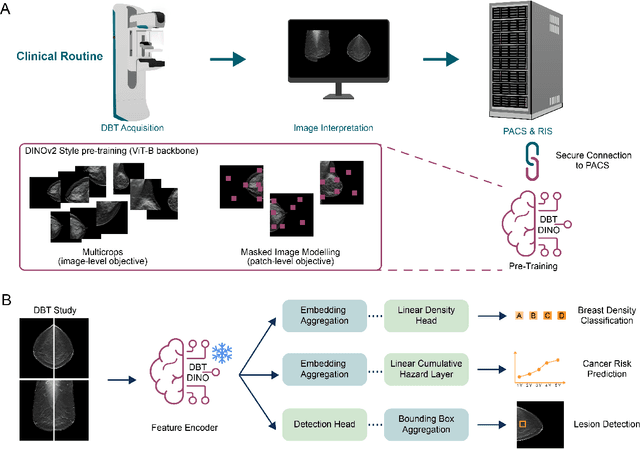

Foundation models have shown promise in medical imaging but remain underexplored for three-dimensional imaging modalities. No foundation model currently exists for Digital Breast Tomosynthesis (DBT), despite its use for breast cancer screening. To develop and evaluate a foundation model for DBT (DBT-DINO) across multiple clinical tasks and assess the impact of domain-specific pre-training. Self-supervised pre-training was performed using the DINOv2 methodology on over 25 million 2D slices from 487,975 DBT volumes from 27,990 patients. Three downstream tasks were evaluated: (1) breast density classification using 5,000 screening exams; (2) 5-year risk of developing breast cancer using 106,417 screening exams; and (3) lesion detection using 393 annotated volumes. For breast density classification, DBT-DINO achieved an accuracy of 0.79 (95\% CI: 0.76--0.81), outperforming both the MetaAI DINOv2 baseline (0.73, 95\% CI: 0.70--0.76, p<.001) and DenseNet-121 (0.74, 95\% CI: 0.71--0.76, p<.001). For 5-year breast cancer risk prediction, DBT-DINO achieved an AUROC of 0.78 (95\% CI: 0.76--0.80) compared to DINOv2's 0.76 (95\% CI: 0.74--0.78, p=.57). For lesion detection, DINOv2 achieved a higher average sensitivity of 0.67 (95\% CI: 0.60--0.74) compared to DBT-DINO with 0.62 (95\% CI: 0.53--0.71, p=.60). DBT-DINO demonstrated better performance on cancerous lesions specifically with a detection rate of 78.8\% compared to Dinov2's 77.3\%. Using a dataset of unprecedented size, we developed DBT-DINO, the first foundation model for DBT. DBT-DINO demonstrated strong performance on breast density classification and cancer risk prediction. However, domain-specific pre-training showed variable benefits on the detection task, with ImageNet baseline outperforming DBT-DINO on general lesion detection, indicating that localized detection tasks require further methodological development.