 Add to Chrome
 Add to Firefox
 Add to Edge
Multimodal Physiological Assessment of Contact-Rich Physical Human-Robot Interaction Under Varying Environmental Conditions
Jun 12, 2026
Physical human-robot interaction (pHRI) in real-world settings exposes operators to fluctuating environmental conditions during contact-rich tasks. Traditional task-centric evaluations overlook the physiological burdens imposed by these stressors. Therefore, we conducted a multimodal empirical study involving contact-rich tracing tasks under 18 distinct combinations of temperature, acoustic noise, and illuminance. Synchronously, we recorded electrodermal activity (EDA), surface electromyography (sEMG), eye-tracking data, and subjective environmental comfort ratings. Evaluating these physiological signals alongside execution data revealed hidden physiological costs not captured by objective performance. The results revealed that task performance remained stable across all environmental conditions. Autonomic workload, indexed by tonic skin conductance level (SCL), increased with temperature, while physical and cognitive workload were unaffected. Perceived environmental comfort showed no significant association with tracing error or completion time. These findings reveal a compensatory mechanism where operators maintain consistent performance by increasing their physiological effort to suppress thermal discomfort. Such insight motivates the development of physiology-aware control architectures that leverage real-time physiological metrics to reduce operator workload in unstructured environments.

From Perception to Symbolic Task Planning: Vision-Language Guided Human-Robot Collaborative Structured Assembly
Jan 02, 2026Human-robot collaboration (HRC) in structured assembly requires reliable state estimation and adaptive task planning under noisy perception and human interventions. To address these challenges, we introduce a design-grounded human-aware planning framework for human-robot collaborative structured assembly. The framework comprises two coupled modules. Module I, Perception-to-Symbolic State (PSS), employs vision-language models (VLMs) based agents to align RGB-D observations with design specifications and domain knowledge, synthesizing verifiable symbolic assembly states. It outputs validated installed and uninstalled component sets for online state tracking. Module II, Human-Aware Planning and Replanning (HPR), performs task-level multi-robot assignment and updates the plan only when the observed state deviates from the expected execution outcome. It applies a minimal-change replanning rule to selectively revise task assignments and preserve plan stability even under human interventions. We validate the framework on a 27-component timber-frame assembly. The PSS module achieves 97% state synthesis accuracy, and the HPR module maintains feasible task progression across diverse HRC scenarios. Results indicate that integrating VLM-based perception with knowledge-driven planning improves robustness of state estimation and task planning under dynamic conditions.
Mixed Chain-of-Psychotherapies for Emotional Support Chatbot
Sep 29, 2024
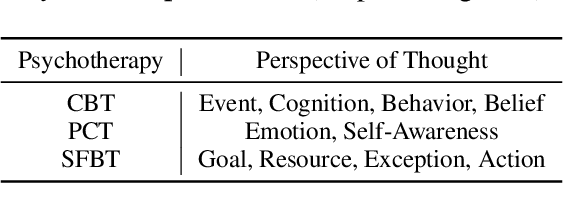
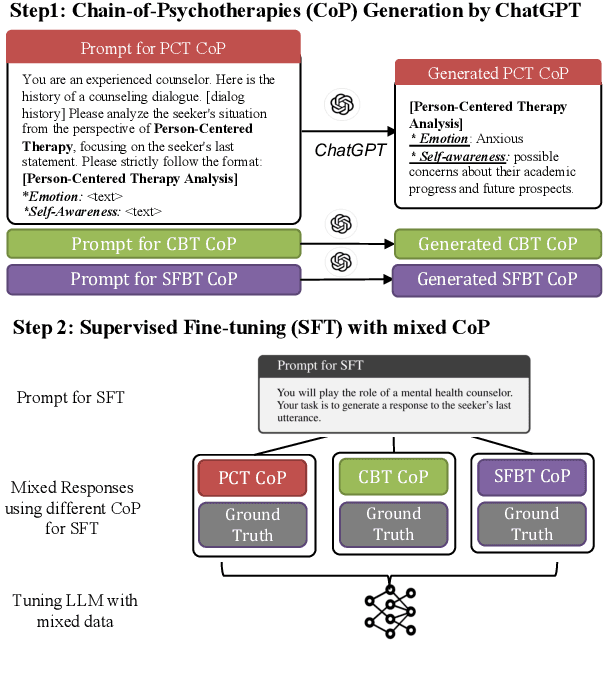
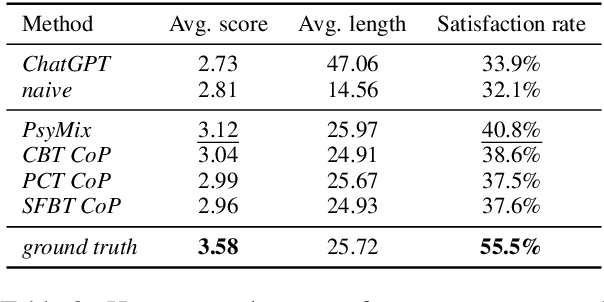
In the realm of mental health support chatbots, it is vital to show empathy and encourage self-exploration to provide tailored solutions. However, current approaches tend to provide general insights or solutions without fully understanding the help-seeker's situation. Therefore, we propose PsyMix, a chatbot that integrates the analyses of the seeker's state from the perspective of a psychotherapy approach (Chain-of-Psychotherapies, CoP) before generating the response, and learns to incorporate the strength of various psychotherapies by fine-tuning on a mixture of CoPs. Through comprehensive evaluation, we found that PsyMix can outperform the ChatGPT baseline, and demonstrate a comparable level of empathy in its responses to that of human counselors.
A Cognitive Evaluation Benchmark of Image Reasoning and Description for Large Vision Language Models
Feb 29, 2024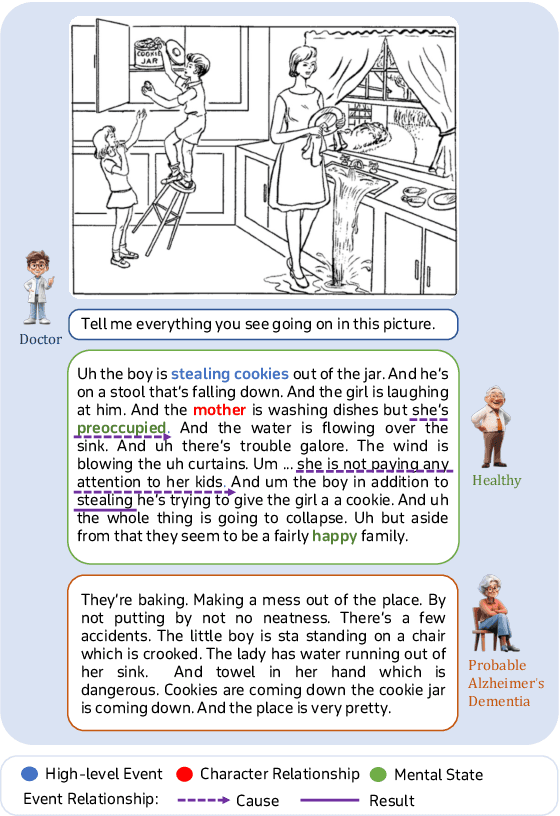



Large Vision Language Models (LVLMs), despite their recent success, are hardly comprehensively tested for their cognitive abilities. Inspired by the prevalent use of the "Cookie Theft" task in human cognition test, we propose a novel evaluation benchmark to evaluate high-level cognitive ability of LVLMs using images with rich semantics. It defines eight reasoning capabilities and consists of an image description task and a visual question answering task. Our evaluation on well-known LVLMs shows that there is still a large gap in cognitive ability between LVLMs and humans.
Technology Report:Multi-Mobile Robot Localization and Navigation based on Visible Light Positioning
Nov 18, 2021We demonstrated multi-mobile robot navigation based on Visible Light Positioning(VLP) localization. From our experiment, the VLP can accurately locate robots' positions in navigation.