 Add to Chrome
 Add to Firefox
 Add to Edge
FaceOracle: Chat with a Face Image Oracle
Jan 13, 2025
A face image is a mandatory part of ID and travel documents. Obtaining high-quality face images when issuing such documents is crucial for both human examiners and automated face recognition systems. In several international standards, face image quality requirements are intricate and defined in detail. Identifying and understanding non-compliance or defects in the submitted face images is crucial for both issuing authorities and applicants. In this work, we introduce FaceOracle, an LLM-powered AI assistant that helps its users analyze a face image in a natural conversational manner using standard compliant algorithms. Leveraging the power of LLMs, users can get explanations of various face image quality concepts as well as interpret the outcome of face image quality assessment (FIQA) algorithms. We implement a proof-of-concept that demonstrates how experts at an issuing authority could integrate FaceOracle into their workflow to analyze, understand, and communicate their decisions more efficiently, resulting in enhanced productivity.

Eye Sclera for Fair Face Image Quality Assessment
Jan 13, 2025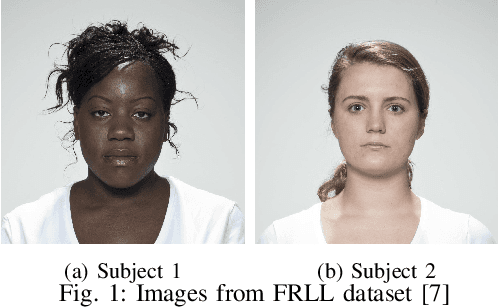
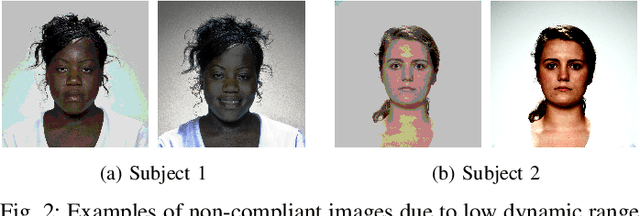
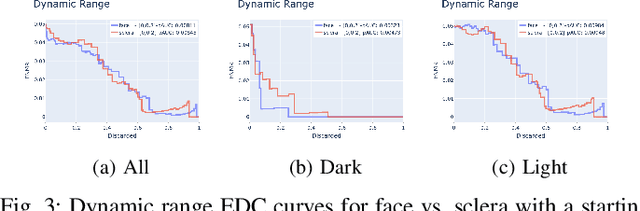
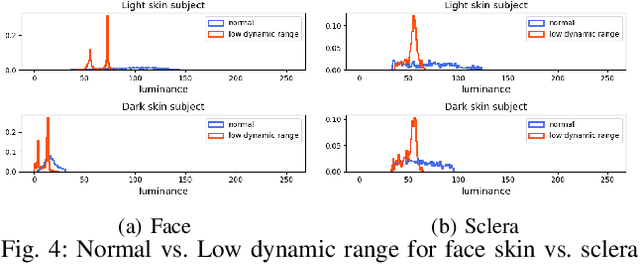
Fair operational systems are crucial in gaining and maintaining society's trust in face recognition systems (FRS). FRS start with capturing an image and assessing its quality before using it further for enrollment or verification. Fair Face Image Quality Assessment (FIQA) schemes therefore become equally important in the context of fair FRS. This work examines the sclera as a quality assessment region for obtaining a fair FIQA. The sclera region is agnostic to demographic variations and skin colour for assessing the quality of a face image. We analyze three skin tone related ISO/IEC face image quality assessment measures and assess the sclera region as an alternative area for assessing FIQ. Our analysis of the face dataset of individuals from different demographic groups representing different skin tones indicates sclera as an alternative to measure dynamic range, over- and under-exposure of face using sclera region alone. The sclera region being agnostic to skin tone, i.e., demographic factors, provides equal utility as a fair FIQA as shown by our Error-vs-Discard Characteristic (EDC) curve analysis.
Towards Iris Presentation Attack Detection with Foundation Models
Jan 10, 2025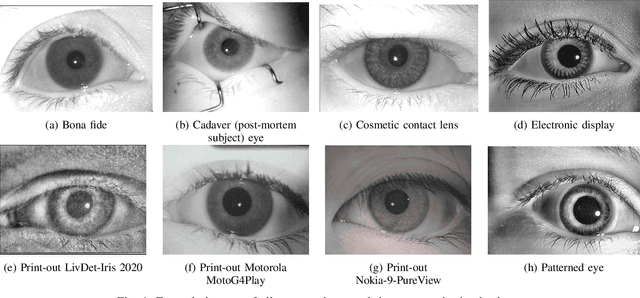
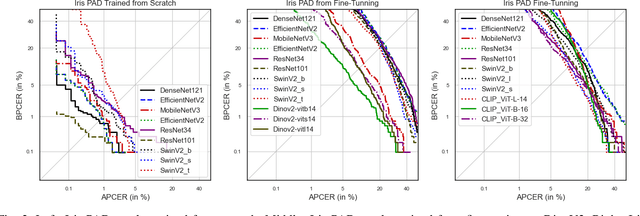
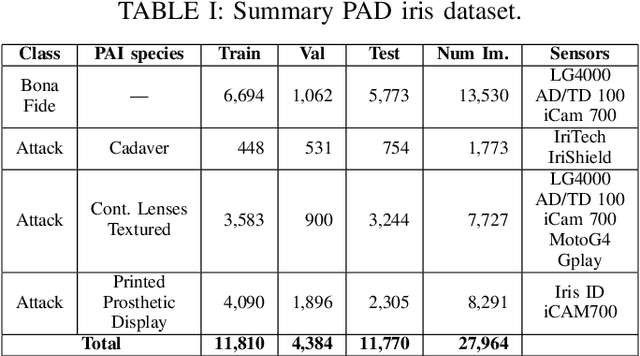
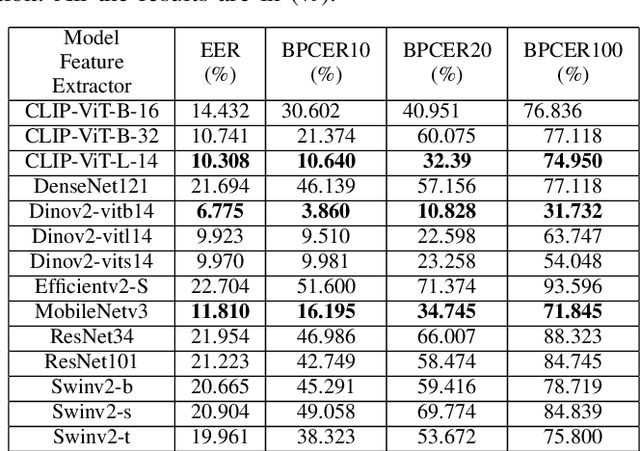
Foundation models are becoming increasingly popular due to their strong generalization capabilities resulting from being trained on huge datasets. These generalization capabilities are attractive in areas such as NIR Iris Presentation Attack Detection (PAD), in which databases are limited in the number of subjects and diversity of attack instruments, and there is no correspondence between the bona fide and attack images because, most of the time, they do not belong to the same subjects. This work explores an iris PAD approach based on two foundation models, DinoV2 and VisualOpenClip. The results show that fine-tuning prediction with a small neural network as head overpasses the state-of-the-art performance based on deep learning approaches. However, systems trained from scratch have still reached better results if bona fide and attack images are available.
LADIMO: Face Morph Generation through Biometric Template Inversion with Latent Diffusion
Oct 10, 2024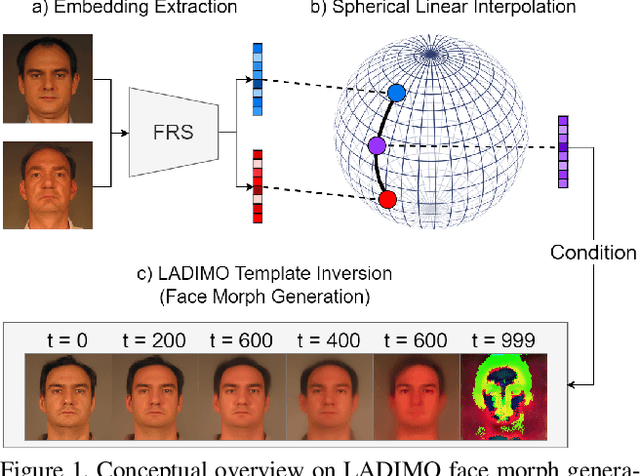

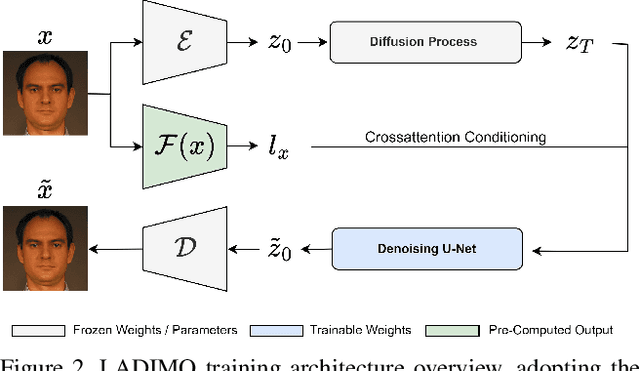
Face morphing attacks pose a severe security threat to face recognition systems, enabling the morphed face image to be verified against multiple identities. To detect such manipulated images, the development of new face morphing methods becomes essential to increase the diversity of training datasets used for face morph detection. In this study, we present a representation-level face morphing approach, namely LADIMO, that performs morphing on two face recognition embeddings. Specifically, we train a Latent Diffusion Model to invert a biometric template - thus reconstructing the face image from an FRS latent representation. Our subsequent vulnerability analysis demonstrates the high morph attack potential in comparison to MIPGAN-II, an established GAN-based face morphing approach. Finally, we exploit the stochastic LADMIO model design in combination with our identity conditioning mechanism to create unlimited morphing attacks from a single face morph image pair. We show that each face morph variant has an individual attack success rate, enabling us to maximize the morph attack potential by applying a simple re-sampling strategy. Code and pre-trained models available here: https://github.com/dasec/LADIMO
SynMorph: Generating Synthetic Face Morphing Dataset with Mated Samples
Sep 09, 2024


Face morphing attack detection (MAD) algorithms have become essential to overcome the vulnerability of face recognition systems. To solve the lack of large-scale and public-available datasets due to privacy concerns and restrictions, in this work we propose a new method to generate a synthetic face morphing dataset with 2450 identities and more than 100k morphs. The proposed synthetic face morphing dataset is unique for its high-quality samples, different types of morphing algorithms, and the generalization for both single and differential morphing attack detection algorithms. For experiments, we apply face image quality assessment and vulnerability analysis to evaluate the proposed synthetic face morphing dataset from the perspective of biometric sample quality and morphing attack potential on face recognition systems. The results are benchmarked with an existing SOTA synthetic dataset and a representative non-synthetic and indicate improvement compared with the SOTA. Additionally, we design different protocols and study the applicability of using the proposed synthetic dataset on training morphing attack detection algorithms.
First Competition on Presentation Attack Detection on ID Card
Aug 31, 2024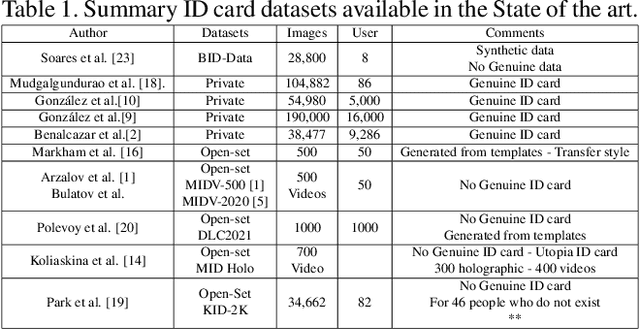

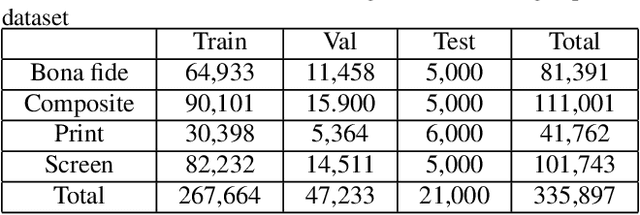

This paper summarises the Competition on Presentation Attack Detection on ID Cards (PAD-IDCard) held at the 2024 International Joint Conference on Biometrics (IJCB2024). The competition attracted a total of ten registered teams, both from academia and industry. In the end, the participating teams submitted five valid submissions, with eight models to be evaluated by the organisers. The competition presented an independent assessment of current state-of-the-art algorithms. Today, no independent evaluation on cross-dataset is available; therefore, this work determined the state-of-the-art on ID cards. To reach this goal, a sequestered test set and baseline algorithms were used to evaluate and compare all the proposals. The sequestered test dataset contains ID cards from four different countries. In summary, a team that chose to be "Anonymous" reached the best average ranking results of 74.80%, followed very closely by the "IDVC" team with 77.65%.
On the Feasibility of Creating Iris Periocular Morphed Images
Aug 24, 2024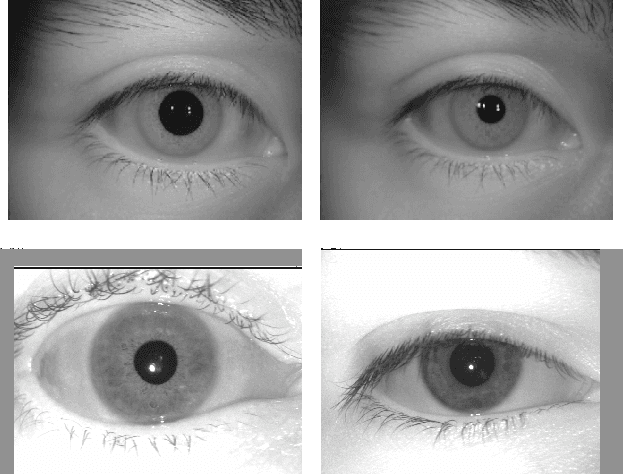
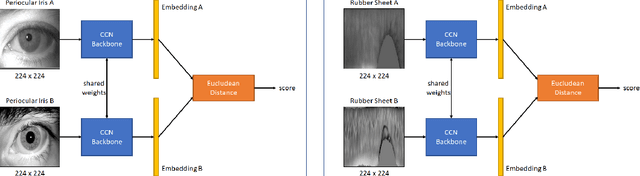
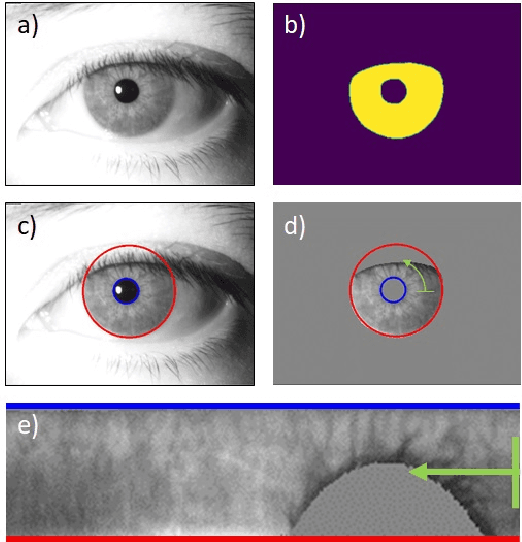
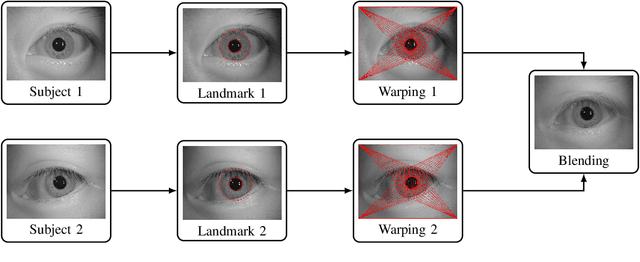
In the last few years, face morphing has been shown to be a complex challenge for Face Recognition Systems (FRS). Thus, the evaluation of other biometric modalities such as fingerprint, iris, and others must be explored and evaluated to enhance biometric systems. This work proposes an end-to-end framework to produce iris morphs at the image level, creating morphs from Periocular iris images. This framework considers different stages such as pair subject selection, segmentation, morph creation, and a new iris recognition system. In order to create realistic morphed images, two approaches for subject selection are explored: random selection and similar radius size selection. A vulnerability analysis and a Single Morphing Attack Detection algorithm were also explored. The results show that this approach obtained very realistic images that can confuse conventional iris recognition systems.
Fairness measures for biometric quality assessment
Aug 21, 2024Quality assessment algorithms measure the quality of a captured biometric sample. Since the sample quality strongly affects the recognition performance of a biometric system, it is essential to only process samples of sufficient quality and discard samples of low-quality. Even though quality assessment algorithms are not intended to yield very different quality scores across demographic groups, quality score discrepancies are possible, resulting in different discard ratios. To ensure that quality assessment algorithms do not take demographic characteristics into account when assessing sample quality and consequently to ensure that the quality algorithms perform equally for all individuals, it is crucial to develop a fairness measure. In this work we propose and compare multiple fairness measures for evaluating quality components across demographic groups. Proposed measures, could be used as potential candidates for an upcoming standard in this important field.
Generating Automatically Print/Scan Textures for Morphing Attack Detection Applications
Aug 18, 2024Morphing Attack Detection (MAD) is a relevant topic that aims to detect attempts by unauthorised individuals to access a "valid" identity. One of the main scenarios is printing morphed images and submitting the respective print in a passport application process. Today, small datasets are available to train the MAD algorithm because of privacy concerns and the limitations resulting from the effort associated with the printing and scanning of images at large numbers. In order to improve the detection capabilities and spot such morphing attacks, it will be necessary to have a larger and more realistic dataset representing the passport application scenario with the diversity of devices and the resulting printed scanned or compressed images. Creating training data representing the diversity of attacks is a very demanding task because the training material is developed manually. This paper proposes two different methods based on transfer-transfer for automatically creating digital print/scan face images and using such images in the training of a Morphing Attack Detection algorithm. Our proposed method can reach an Equal Error Rate (EER) of 3.84% and 1.92% on the FRGC/FERET database when including our synthetic and texture-transfer print/scan with 600 dpi to handcrafted images, respectively.
Towards Inclusive Face Recognition Through Synthetic Ethnicity Alteration
May 02, 2024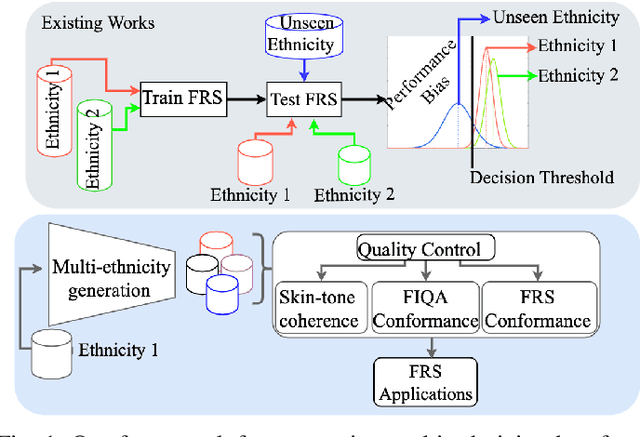
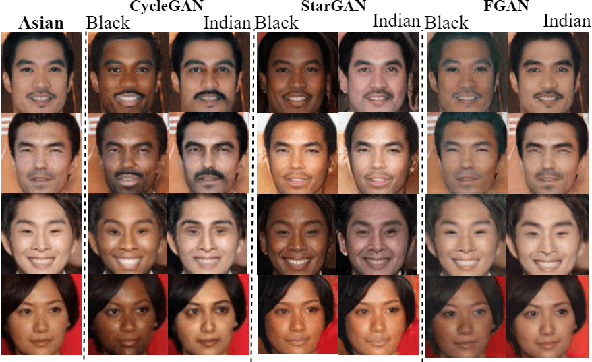
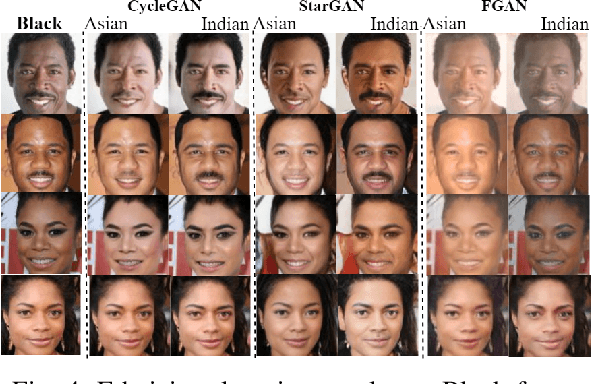
Numerous studies have shown that existing Face Recognition Systems (FRS), including commercial ones, often exhibit biases toward certain ethnicities due to under-represented data. In this work, we explore ethnicity alteration and skin tone modification using synthetic face image generation methods to increase the diversity of datasets. We conduct a detailed analysis by first constructing a balanced face image dataset representing three ethnicities: Asian, Black, and Indian. We then make use of existing Generative Adversarial Network-based (GAN) image-to-image translation and manifold learning models to alter the ethnicity from one to another. A systematic analysis is further conducted to assess the suitability of such datasets for FRS by studying the realistic skin-tone representation using Individual Typology Angle (ITA). Further, we also analyze the quality characteristics using existing Face image quality assessment (FIQA) approaches. We then provide a holistic FRS performance analysis using four different systems. Our findings pave the way for future research works in (i) developing both specific ethnicity and general (any to any) ethnicity alteration models, (ii) expanding such approaches to create databases with diverse skin tones, (iii) creating datasets representing various ethnicities which further can help in mitigating bias while addressing privacy concerns.
* 8 Pages