 Add to Chrome
 Add to Firefox
 Add to Edge
MOC-3D: Manifold-Order Consistency for Text-to-3D Generation
May 03, 2026
With the burgeoning development of fields such as the Metaverse, Virtual Reality (VR), and Digital Twins, text-to-3D generation has emerged as a research hotspot in both academia and industry. Currently, optimization methods based on Score Distillation Sampling (SDS) utilizing 2D diffusion priors have become the mainstream technological paradigm in this field. However, due to the view bias of 2D priors and the mode-seeking ambiguity combined with gradient noise induced by high Classifier-Free Guidance (CFG), these methods still suffer from macro-topological inconsistency (e.g., the Janus problem) and micro-geometric discontinuity. To address these challenges, we propose MOC-3D, a text-to-3D generation method based on geometric manifold and semantic view-order consistency. Built upon the ScaleDreamer framework, our method incorporates a Semantic View-Order Constraint Module and a Manifold-based Feature Continuity Module. The former aims to rectify macro-topological inconsistency, while the latter focuses on eliminating micro-geometric discontinuity. Specifically, the Semantic View-Order Constraint Module leverages the prior knowledge of CLIP to impose a Monotonicity Rank Constraint on semantic score representations across different views, thereby providing effective guidance for the global topological structure of 3D objects. Meanwhile, the Manifold-based Feature Continuity Module employs the Riemannian Metric on the Symmetric Positive Definite (SPD) manifold. By measuring the distance of feature statistical distributions in the Riemannian space, it promotes the smooth evolution and continuity of micro-textures across multi-views in a statistical sense. Under the macro-micro synergistic optimization of these two modules, our model can simultaneously improve macro-structural consistency and micro-detail continuity.

LeafInst - Unified Instance Segmentation Network for Fine-Grained Forestry Leaf Phenotype Analysis: A New UAV based Benchmark
Mar 04, 2026Intelligent forest tree breeding has advanced plant phenotyping, yet existing research largely focuses on large-leaf agricultural crops, with limited attention to fine-grained leaf analysis of sapling trees in open-field environments. Natural scenes introduce challenges including scale variation, illumination changes, and irregular leaf morphology. To address these issues, we collected UAV RGB imagery of field-grown saplings and constructed the Poplar-leaf dataset, containing 1,202 branches and 19,876 pixel-level annotated leaf instances. To our knowledge, this is the first instance segmentation dataset specifically designed for forestry leaves in open-field conditions. We propose LeafInst, a novel segmentation framework tailored for irregular and multi-scale leaf structures. The model integrates an Asymptotic Feature Pyramid Network (AFPN) for multi-scale perception, a Dynamic Asymmetric Spatial Perception (DASP) module for irregular shape modeling, and a dual-residual Dynamic Anomalous Regression Head (DARH) with Top-down Concatenation decoder Feature Fusion (TCFU) to improve detection and segmentation performance. On Poplar-leaf, LeafInst achieves 68.4 mAP, outperforming YOLOv11 by 7.1 percent and MaskDINO by 6.5 percent. On the public PhenoBench benchmark, it reaches 52.7 box mAP, exceeding MaskDINO by 3.4 percent. Additional experiments demonstrate strong generalization and practical utility for large-scale leaf phenotyping.
A Novel WaveInst-based Network for Tree Trunk Structure Extraction and Pattern Analysis in Forest Inventory
May 03, 2025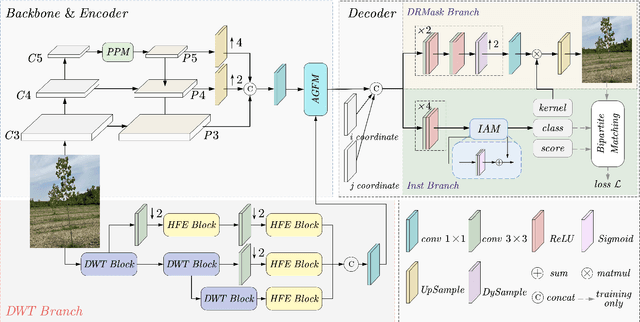
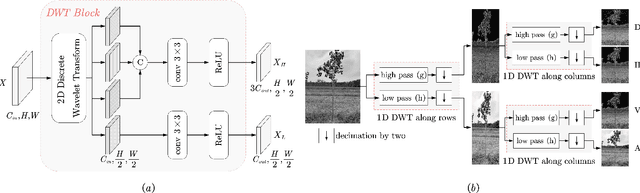
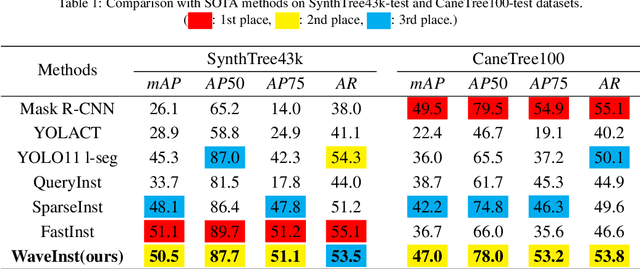
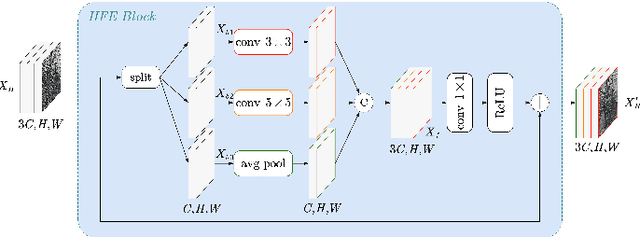
The pattern analysis of tree structure holds significant scientific value for genetic breeding and forestry management. The current trunk and branch extraction technologies are mainly LiDAR-based or UAV-based. The former approaches obtain high-precision 3D data, but its equipment cost is high and the three-dimensional (3D) data processing is complex. The latter approaches efficiently capture canopy information, but they miss the 3-D structure of trees. In order to deal with the branch information extraction from the complex background interference and occlusion, this work proposes a novel WaveInst instance segmentation framework, involving a discrete wavelet transform, to enhance multi-scale edge information for accurately improving tree structure extraction. Experimental results of the proposed model show superior performance on SynthTree43k, CaneTree100, Urban Street and our PoplarDataset. Moreover, we present a new Phenotypic dataset PoplarDataset, which is dedicated to extract tree structure and pattern analysis from artificial forest. The proposed method achieves a mean average precision of 49.6 and 24.3 for the structure extraction of mature and juvenile trees, respectively, surpassing the existing state-of-the-art method by 9.9. Furthermore, by in tegrating the segmentation model within the regression model, we accurately achieve significant tree grown parameters, such as the location of trees, the diameter-at-breast-height of individual trees, and the plant height, from 2D images directly. This study provides a scientific and plenty of data for tree structure analysis in related to the phenotype research, offering a platform for the significant applications in precision forestry, ecological monitoring, and intelligent breeding.