 Add to Chrome
 Add to Firefox
 Add to Edge
MOC-3D: Manifold-Order Consistency for Text-to-3D Generation
May 03, 2026
With the burgeoning development of fields such as the Metaverse, Virtual Reality (VR), and Digital Twins, text-to-3D generation has emerged as a research hotspot in both academia and industry. Currently, optimization methods based on Score Distillation Sampling (SDS) utilizing 2D diffusion priors have become the mainstream technological paradigm in this field. However, due to the view bias of 2D priors and the mode-seeking ambiguity combined with gradient noise induced by high Classifier-Free Guidance (CFG), these methods still suffer from macro-topological inconsistency (e.g., the Janus problem) and micro-geometric discontinuity. To address these challenges, we propose MOC-3D, a text-to-3D generation method based on geometric manifold and semantic view-order consistency. Built upon the ScaleDreamer framework, our method incorporates a Semantic View-Order Constraint Module and a Manifold-based Feature Continuity Module. The former aims to rectify macro-topological inconsistency, while the latter focuses on eliminating micro-geometric discontinuity. Specifically, the Semantic View-Order Constraint Module leverages the prior knowledge of CLIP to impose a Monotonicity Rank Constraint on semantic score representations across different views, thereby providing effective guidance for the global topological structure of 3D objects. Meanwhile, the Manifold-based Feature Continuity Module employs the Riemannian Metric on the Symmetric Positive Definite (SPD) manifold. By measuring the distance of feature statistical distributions in the Riemannian space, it promotes the smooth evolution and continuity of micro-textures across multi-views in a statistical sense. Under the macro-micro synergistic optimization of these two modules, our model can simultaneously improve macro-structural consistency and micro-detail continuity.

Uncovering Dominant Features in Short-term Power Load Forecasting Based on Multi-source Feature
Mar 23, 2021

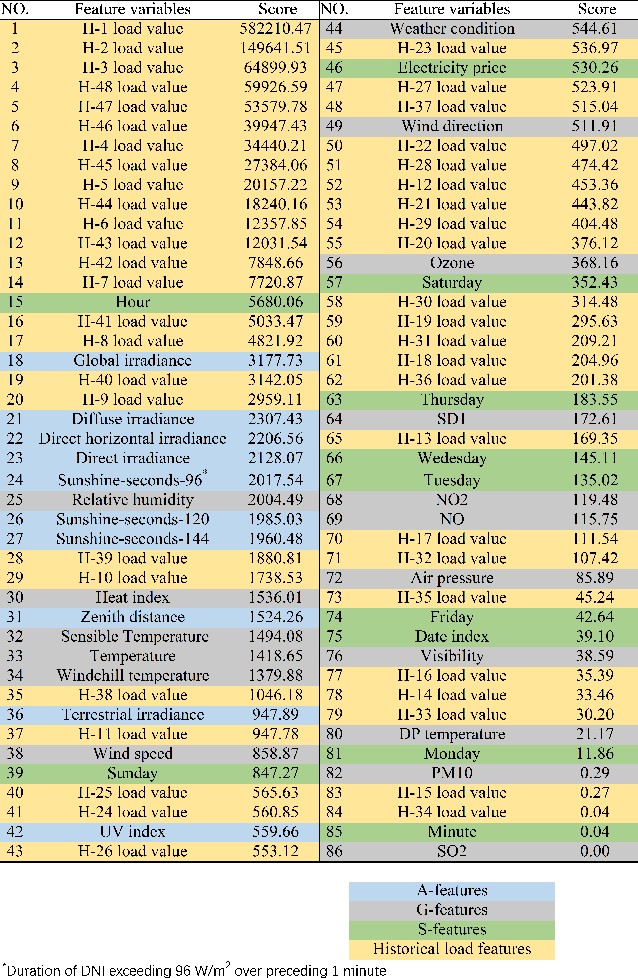
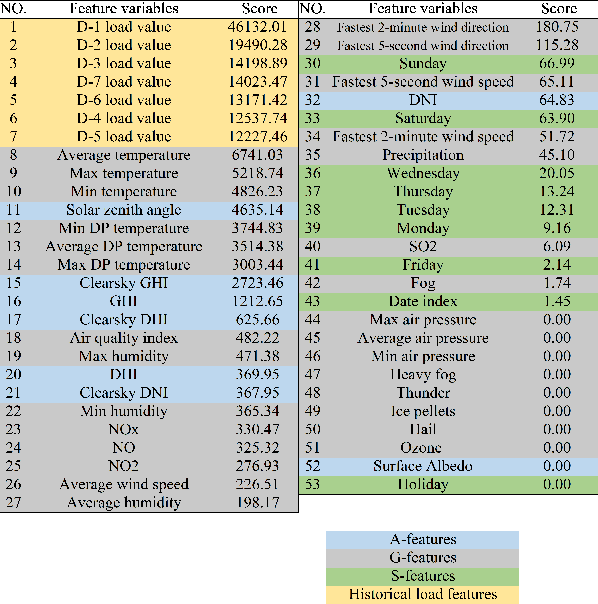
Due to the limitation of data availability, traditional power load forecasting methods focus more on studying the load variation pattern and the influence of only a few factors such as temperature and holidays, which fail to reveal the inner mechanism of load variation. This paper breaks the limitation and collects 80 potential features from astronomy, geography, and society to study the complex nexus between power load variation and influence factors, based on which a short-term power load forecasting method is proposed. Case studies show that, compared with the state-of-the-art methods, the proposed method improves the forecasting accuracy by 33.0% to 34.7%. The forecasting result reveals that geographical features have the most significant impact on improving the load forecasting accuracy, in which temperature is the dominant feature. Astronomical features have more significant influence than social features and features related to the sun play an important role, which are obviously ignored in previous research. Saturday and Monday are the most important social features. Temperature, solar zenith angle, civil twilight duration, and lagged clear sky global horizontal irradiance have a V-shape relationship with power load, indicating that there exist balance points for them. Global horizontal irradiance is negatively related to power load.