 Add to Chrome
 Add to Firefox
 Add to Edge
Physically-Constrained Mamba-SDE for Remaining Useful Life Prediction under Irregular Observations
Jun 01, 2026
Accurate Remaining Useful Life prediction is critical for industrial predictive maintenance. However, real-world deployment is challenging due to the irregular nature of sensor observations, characterized by asynchronous sampling, burst missingness, and temporal jitter. Compounding this issue, purely data-driven models often generate physically implausible degradation trajectories that violate the irreversible nature of damage accumulation. To address this, we propose PC-MambaSDE, a unified continuous-time framework for robust RUL prediction under irregular observations. Specifically, we design a Mask-Aware Continuous Mamba Encoder that explicitly leverages observation masks to extract context-rich control signals. Furthermore, we introduce a Physics-Guided Latent SDE with parametrically rectified hybrid drift, superimposing a global physical bias to enforce monotonic degradation even amid severe observation gaps. Additionally, we formulate RUL prediction as a boundary value problem via a Terminal Degradation Penalty, which decouples a Health Index dimension and applies a penalty loss to guide trajectories toward the failure state. Theoretically, we prove that our variational objective is mathematically equivalent to minimizing the KL divergence via Girsanov's theorem, and we guarantee the global asymptotic stability of the learned dynamics through Lyapunov analysis. To enable rigorous evaluation, we develop a Hybrid Irregularity Generation Scheme that simulates realistic industrial imperfections. Extensive experiments on public benchmarks demonstrate that PC-MambaSDE significantly outperforms state-of-the-art methods, particularly under extreme observation scarcity, validating the efficacy of embedding physical priors into continuous-time latent dynamics.

DARE-EEG: A Foundation Model for Mining Dual-Aligned Representation of EEG
May 18, 2026Foundation models pre-trained through masked reconstruction on large-scale EEG data have emerged as a promising paradigm for learning generalizable neural representations across diverse brain-computer interface applications. However, a critical yet overlooked challenge is that EEG encoders must learn representations invariant to incomplete observations-when different masked views of the same signal have minimal overlap, existing methods fail to constrain them to a consistent latent subspace, leading to degraded transferability. To address this, we propose DARE-EEG, a self-supervised foundation model that explicitly enforces the mask-invariance property through dual-aligned representation learning during pre-training. Specifically, we introduce mask alignment that constrains representations from multiple masked views of the same EEG sample via contrastive learning, complementing anchor alignment that aligns masked representations to momentum-updated complete features for semantic stability. Additionally, we propose conv-linear-probing, a parameter-efficient strategy that adapts pre-trained representations to heterogeneous electrode configurations and sampling rates through decoupled spectro-spatial projections. Extensive experiments across diverse EEG benchmarks demonstrate that DARE-EEG consistently achieves state-of-the-art in accuracy performance while maintaining relatively low parameter complexity and superior cross-dataset portability compared to existing methods. Furthermore, DARE-EEG contributes to effectively discovering and utilizing the rich potential representations in EEG.
LeafInst - Unified Instance Segmentation Network for Fine-Grained Forestry Leaf Phenotype Analysis: A New UAV based Benchmark
Mar 04, 2026Intelligent forest tree breeding has advanced plant phenotyping, yet existing research largely focuses on large-leaf agricultural crops, with limited attention to fine-grained leaf analysis of sapling trees in open-field environments. Natural scenes introduce challenges including scale variation, illumination changes, and irregular leaf morphology. To address these issues, we collected UAV RGB imagery of field-grown saplings and constructed the Poplar-leaf dataset, containing 1,202 branches and 19,876 pixel-level annotated leaf instances. To our knowledge, this is the first instance segmentation dataset specifically designed for forestry leaves in open-field conditions. We propose LeafInst, a novel segmentation framework tailored for irregular and multi-scale leaf structures. The model integrates an Asymptotic Feature Pyramid Network (AFPN) for multi-scale perception, a Dynamic Asymmetric Spatial Perception (DASP) module for irregular shape modeling, and a dual-residual Dynamic Anomalous Regression Head (DARH) with Top-down Concatenation decoder Feature Fusion (TCFU) to improve detection and segmentation performance. On Poplar-leaf, LeafInst achieves 68.4 mAP, outperforming YOLOv11 by 7.1 percent and MaskDINO by 6.5 percent. On the public PhenoBench benchmark, it reaches 52.7 box mAP, exceeding MaskDINO by 3.4 percent. Additional experiments demonstrate strong generalization and practical utility for large-scale leaf phenotyping.
VidLaDA: Bidirectional Diffusion Large Language Models for Efficient Video Understanding
Jan 25, 2026Standard Autoregressive Video LLMs inevitably suffer from causal masking biases that hinder global spatiotemporal modeling, leading to suboptimal understanding efficiency. We propose VidLaDA, a Video LLM based on Diffusion Language Model utilizing bidirectional attention to capture bidirectional dependencies. To further tackle the inference bottleneck of diffusion decoding on massive video tokens, we introduce MARS-Cache. This framework accelerates inference by combining asynchronous visual cache refreshing with frame-wise chunk attention, effectively pruning redundancy while preserving global connectivity via anchor tokens. Extensive experiments show VidLaDA outperforms diffusion baselines and rivals state-of-the-art autoregressive models (e.g., Qwen2.5-VL and LLaVA-Video), with MARS-Cache delivering over 12x speedup without compromising reasoning accuracy. Code and checkpoints are open-sourced at https://github.com/ziHoHe/VidLaDA.
OntoTune: Ontology-Driven Learning for Query Optimization with Convolutional Models
Nov 10, 2025Query optimization has been studied using machine learning, reinforcement learning, and, more recently, graph-based convolutional networks. Ontology, as a structured, information-rich knowledge representation, can provide context, particularly in learning problems. This paper presents OntoTune, an ontology-based platform for enhancing learning for query optimization. By connecting SQL queries, database metadata, and statistics, the ontology developed in this research is promising in capturing relationships and important determinants of query performance. This research also develops a method to embed ontologies while preserving as much of the relationships and key information as possible, before feeding it into learning algorithms such as tree-based and graph-based convolutional networks. A case study shows how OntoTune's ontology-driven learning delivers performance gains compared with database system default query execution.
e-person Architecture and Framework for Human-AI Co-adventure Relationship
Mar 28, 2025This paper proposes the e-person architecture for constructing a unified and incremental development of AI ethics. The e-person architecture takes the reduction of uncertainty through collaborative cognition and action with others as a unified basis for ethics. By classifying and defining uncertainty along two axes - (1) first, second, and third person perspectives, and (2) the difficulty of inference based on the depth of information - we support the development of unified and incremental development of AI ethics. In addition, we propose the e-person framework based on the free energy principle, which considers the reduction of uncertainty as a unifying principle of brain function, with the aim of implementing the e-person architecture, and we show our previous works and future challenges based on the proposed framework.
Environment-Centric Active Inference
Aug 23, 2024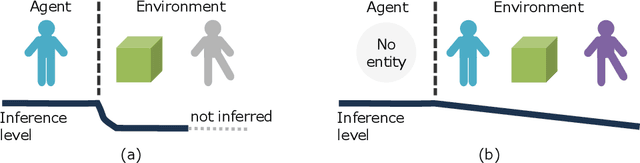
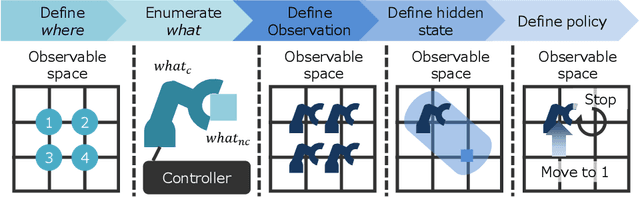
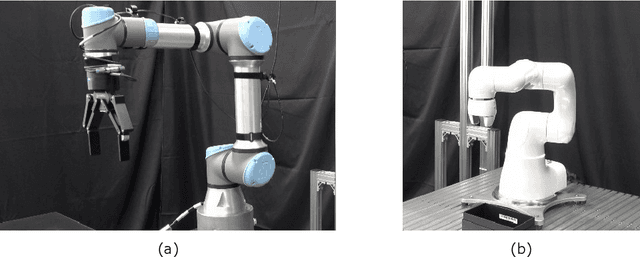
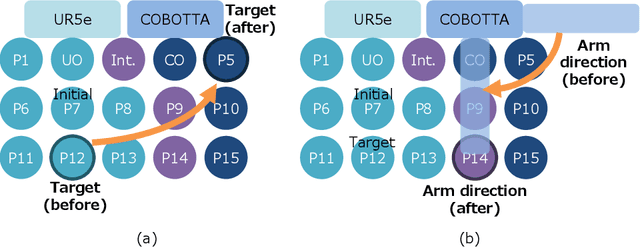
To handle unintended changes in the environment by agents, we propose an environment-centric active inference EC-AIF in which the Markov Blanket of active inference is defined starting from the environment. In normal active inference, the Markov Blanket is defined starting from the agent. That is, first the agent was defined as the entity that performs the "action" such as a robot or a person, then the environment was defined as other people or objects that are directly affected by the agent's "action," and the boundary between the agent and the environment was defined as the Markov Blanket. This agent-centric definition does not allow the agent to respond to unintended changes in the environment caused by factors outside of the defined environment. In the proposed EC-AIF, there is no entity corresponding to an agent. The environment includes all observable things, including people and things conventionally considered to be the environment, as well as entities that perform "actions" such as robots and people. Accordingly, all states, including robots and people, are included in inference targets, eliminating unintended changes in the environment. The EC-AIF was applied to a robot arm and validated with an object transport task by the robot arm. The results showed that the robot arm successfully transported objects while responding to changes in the target position of the object and to changes in the orientation of another robot arm.
Denoising Low-dose Images Using Deep Learning of Time Series Images
Mar 31, 2024Digital image devices have been widely applied in many fields, including scientific imaging, recognition of individuals, and remote sensing. As the application of these imaging technologies to autonomous driving and measurement, image noise generated when observation cannot be performed with a sufficient dose has become a major problem. Machine learning denoise technology is expected to be the solver of this problem, but there are the following problems. Here we report, artifacts generated by machine learning denoise in ultra-low dose observation using an in-situ observation video of an electron microscope as an example. And as a method to solve this problem, we propose a method to decompose a time series image into a 2D image of the spatial axis and time to perform machine learning denoise. Our method opens new avenues accurate and stable reconstruction of continuous high-resolution images from low-dose imaging in science, industry, and life.
Response Style Characterization for Repeated Measures Using the Visual Analogue Scale
Mar 15, 2024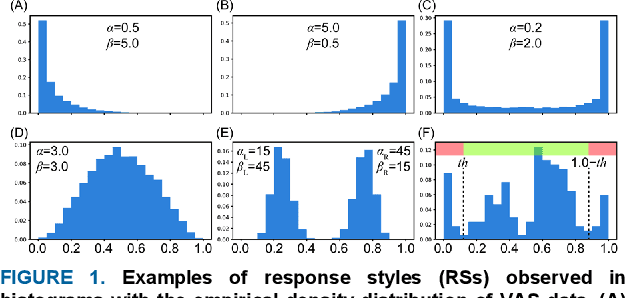
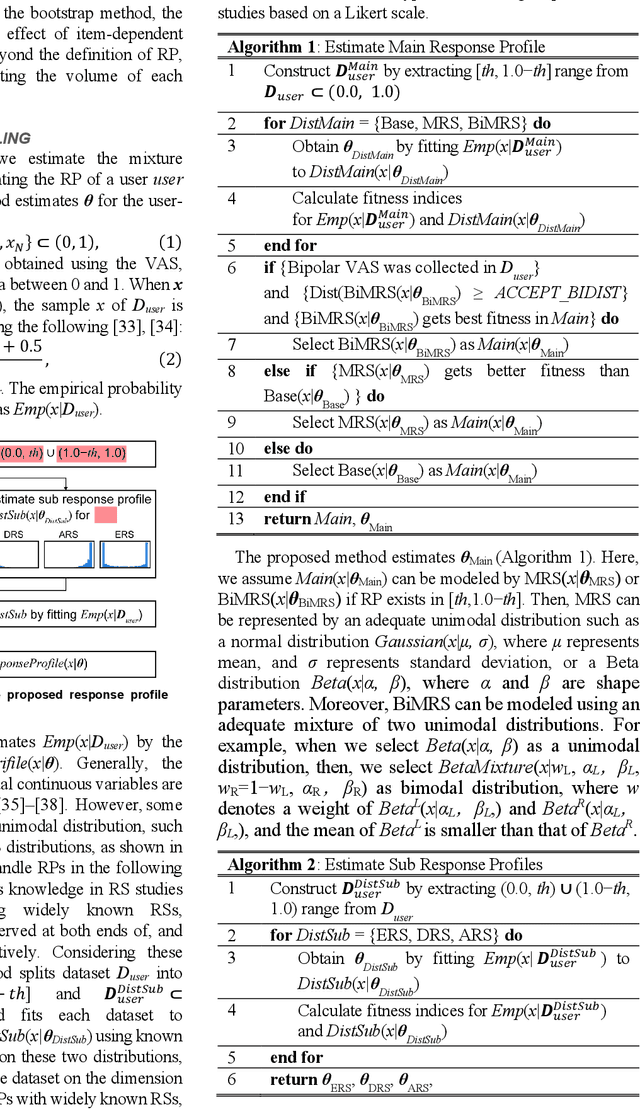
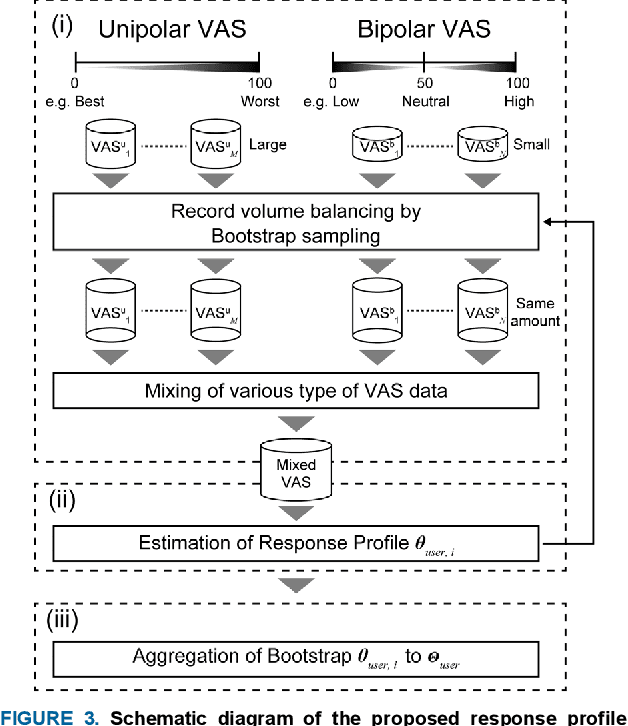
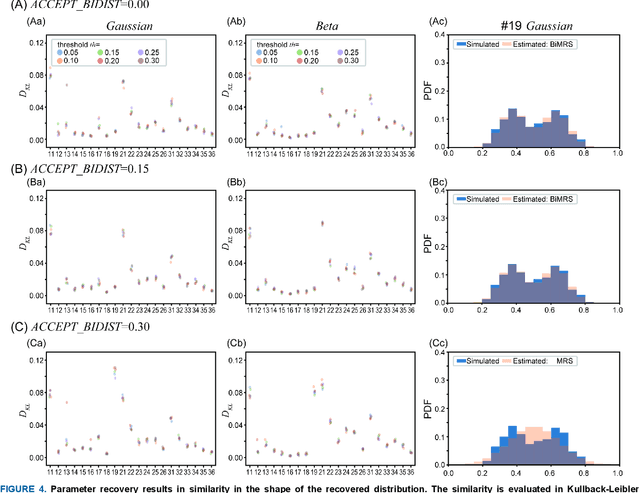
Self-report measures (e.g., Likert scales) are widely used to evaluate subjective health perceptions. Recently, the visual analog scale (VAS), a slider-based scale, has become popular owing to its ability to precisely and easily assess how people feel. These data can be influenced by the response style (RS), a user-dependent systematic tendency that occurs regardless of questionnaire instructions. Despite its importance, especially in between-individual analysis, little attention has been paid to handling the RS in the VAS (denoted as response profile (RP)), as it is mainly used for within-individual monitoring and is less affected by RP. However, VAS measurements often require repeated self-reports of the same questionnaire items, making it difficult to apply conventional methods on a Likert scale. In this study, we developed a novel RP characterization method for various types of repeatedly measured VAS data. This approach involves the modeling of RP as distributional parameters ${\theta}$ through a mixture of RS-like distributions, and addressing the issue of unbalanced data through bootstrap sampling for treating repeated measures. We assessed the effectiveness of the proposed method using simulated pseudo-data and an actual dataset from an empirical study. The assessment of parameter recovery showed that our method accurately estimated the RP parameter ${\theta}$, demonstrating its robustness. Moreover, applying our method to an actual VAS dataset revealed the presence of individual RP heterogeneity, even in repeated VAS measurements, similar to the findings of the Likert scale. Our proposed method enables RP heterogeneity-aware VAS data analysis, similar to Likert-scale data analysis.
The impact of individual information exchange strategies on the distribution of social wealth
Apr 02, 2023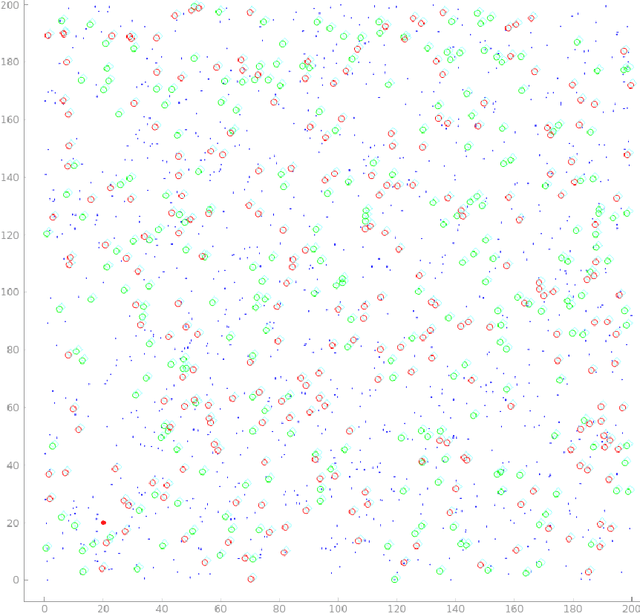
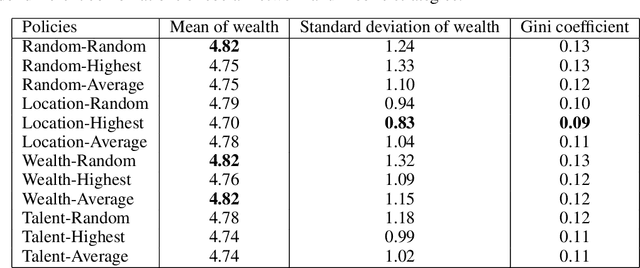
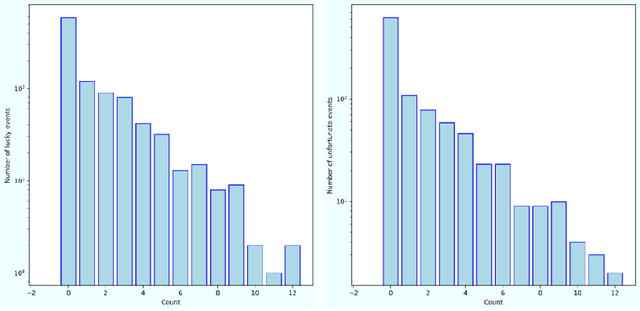
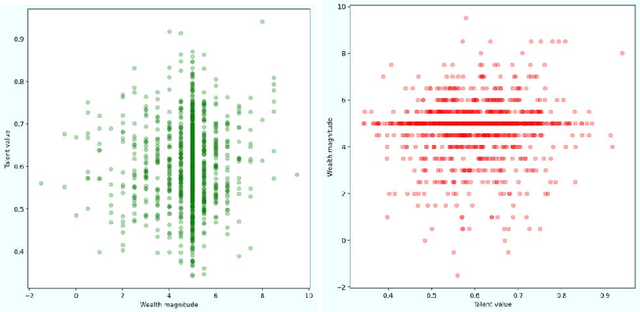
Wealth distribution is a complex and critical aspect of any society. Information exchange is considered to have played a role in shaping wealth distribution patterns, but the specific dynamic mechanism is still unclear. In this research, we used simulation-based methods to investigate the impact of different modes of information exchange on wealth distribution. We compared different combinations of information exchange strategies and moving strategies, analyzed their impact on wealth distribution using classic wealth distribution indicators such as the Gini coefficient. Our findings suggest that information exchange strategies have significant impact on wealth distribution and that promoting more equitable access to information and resources is crucial in building a just and equitable society for all.