 Add to Chrome
 Add to Firefox
 Add to Edge
OMIBench: Benchmarking Olympiad-Level Multi-Image Reasoning in Large Vision-Language Model
Apr 22, 2026
Large vision-language models (LVLMs) have made substantial advances in reasoning tasks at the Olympiad level. Nevertheless, current Olympiad-level multimodal reasoning benchmarks for these models often emphasize single-image analysis and fail to exploit contextual information across multiple images. We present OMIBench, a benchmark designed to evaluate Olympiad-level reasoning when the required evidence is distributed over multiple images. It contains problems from biology, chemistry, mathematics, and physics Olympiads, together with manually annotated rationales and evaluation protocols for both exact and semantic answer matching. Across extensive experiments on OMIBench, we observe meaningful performance gaps in existing models. Even the strongest LVLMs, such as Gemini-3-Pro, attain only about 50% on the benchmark. These results position OMIBench as a focused resources for studying and improving multi-image reasoning in LVLMs.

The Universal Landscape of Human Reasoning
Oct 24, 2025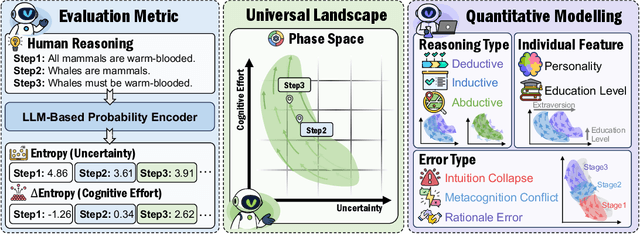
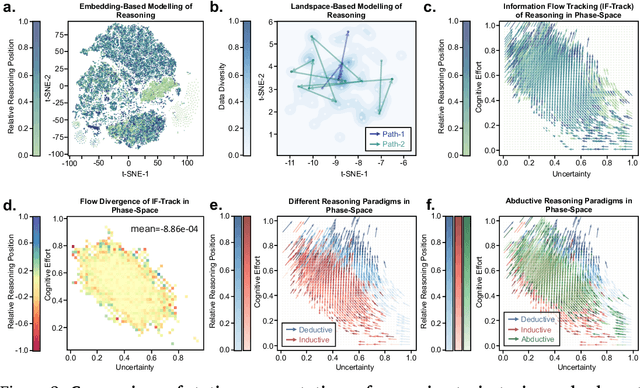
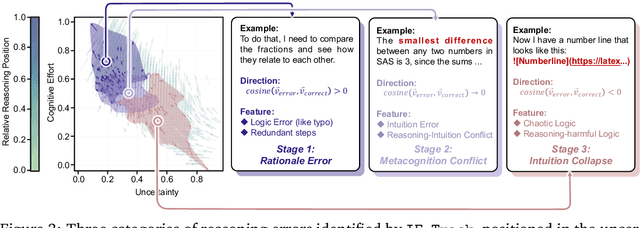
Understanding how information is dynamically accumulated and transformed in human reasoning has long challenged cognitive psychology, philosophy, and artificial intelligence. Existing accounts, from classical logic to probabilistic models, illuminate aspects of output or individual modelling, but do not offer a unified, quantitative description of general human reasoning dynamics. To solve this, we introduce Information Flow Tracking (IF-Track), that uses large language models (LLMs) as probabilistic encoder to quantify information entropy and gain at each reasoning step. Through fine-grained analyses across diverse tasks, our method is the first successfully models the universal landscape of human reasoning behaviors within a single metric space. We show that IF-Track captures essential reasoning features, identifies systematic error patterns, and characterizes individual differences. Applied to discussion of advanced psychological theory, we first reconcile single- versus dual-process theories in IF-Track and discover the alignment of artificial and human cognition and how LLMs reshaping human reasoning process. This approach establishes a quantitative bridge between theory and measurement, offering mechanistic insights into the architecture of reasoning.