 Add to Chrome
 Add to Firefox
 Add to Edge
RECAP: Feedback-Driven Streaming Semantic User Profiles for Short-Video Recommendation
Jul 17, 2026
Language-based user profiles convert long behavioral histories into explicit semantic representations for recommendation. However, most profile generators are optimized in an open loop: they may summarize past behavior fluently, but are not directly trained to improve future recommendation. We study this problem in real-world short-video recommendation, where user behaviors continuously arrive as streams and profiles must be incrementally updated under limited capacity. This requires maintaining a consistent bounded profile state and constructing profile-targeted semantic feedback from industrial implicit behavior logs. We propose RECAP, an offline closed-loop framework for optimizing streaming structured semantic profiles with historical recommendation feedback. RECAP maintains each profile as a bounded structured memory by combining LLM-based semantic updates with deterministic lifecycle and capacity control. RECAP constructs profile-targeted semantic feedback by filtering label-consistent behavior pairs with an LLM judge and training a dual-tower evaluator whose matching score serves as a GRPO reward. Experiments on Kuaishou short-video data show that RECAP improves uAUC by 0.0084 and Recall@2000 by about 4.9% over the base generator. Further analyses confirm the benefits of feedback construction and policy optimization, and show more grounded refinement and user-level abstraction in profile updates. A seven-day online A/B test further shows a statistically significant 0.139% improvement in average application usage time per user.

RoboSurg-VQA: A Multimodal Benchmark for Surgical Segmentation-Aware Visual Question Answering
May 21, 2026Reliable visual understanding in robot-assisted and minimally invasive surgery (RMIS/MIS) demands more than accurate masks: in clinical practice, clinicians pose language-like questions about procedural context, visibility, artefacts, and the presence of anatomical structures and surgical instruments, often under degraded views caused by occlusion, smoke, bleeding, and specular highlights. We present \textbf{RoboSurg-VQA}, a segmentation-aware visual question answering (VQA) benchmark built by repurposing public surgical segmentation datasets under a shared schema. Each frame is paired with a fixed set of clinically motivated questions spanning procedure context, anatomy (including region), imaging modality/view, surgical artefacts, image quality, and basic visibility and spatial attributes, with closed answer sets to enable consistent evaluation. To scale annotation, we generate candidate answers via constrained prompting with automatic validity and consistency checks, followed by human auditing to improve plausibility and label consistency. We report benchmark statistics, sanity baselines, and common evaluation challenges under challenging surgical conditions. The code will be available on https://github.com/ziyangwang007/Robosurg-VQA.
Intrinsic Image Transformation via Scale Space Decomposition
May 25, 2018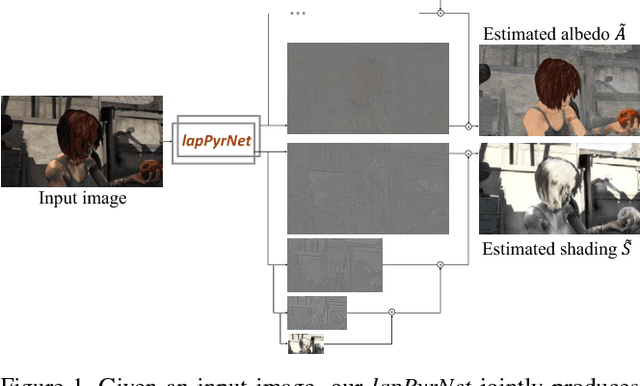
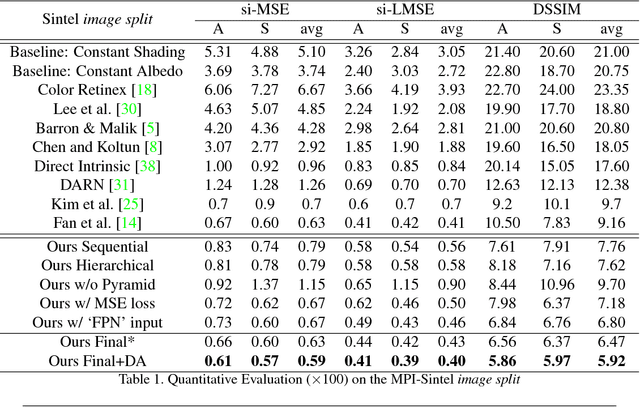
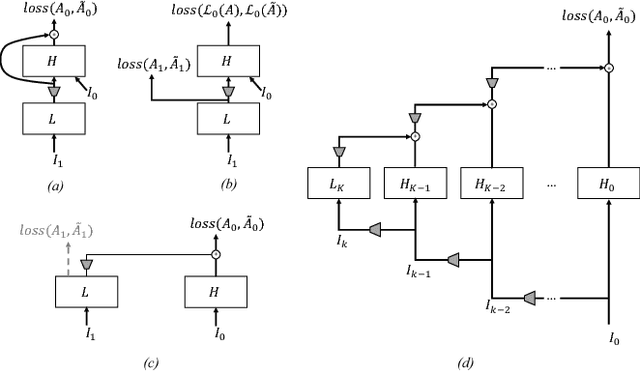
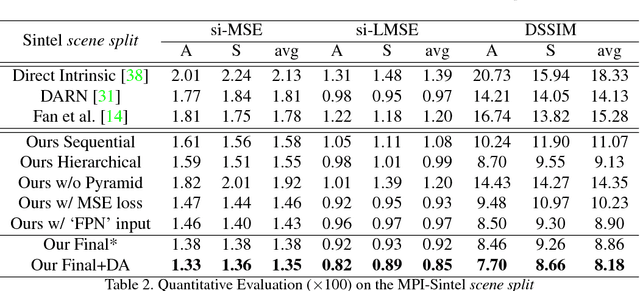
We introduce a new network structure for decomposing an image into its intrinsic albedo and shading. We treat this as an image-to-image transformation problem and explore the scale space of the input and output. By expanding the output images (albedo and shading) into their Laplacian pyramid components, we develop a multi-channel network structure that learns the image-to-image transformation function in successive frequency bands in parallel, within each channel is a fully convolutional neural network with skip connections. This network structure is general and extensible, and has demonstrated excellent performance on the intrinsic image decomposition problem. We evaluate the network on two benchmark datasets: the MPI-Sintel dataset and the MIT Intrinsic Images dataset. Both quantitative and qualitative results show our model delivers a clear progression over state-of-the-art.