 Add to Chrome
 Add to Firefox
 Add to Edge
Event3R: Asynchronous-to-Global 3D Reconstruction from Event Camera via Spatial-Temporal Feature Aggregation
Jul 17, 2026
Robust 3D reconstruction is essential for robotics and embodied perception. Recent feed-forward approaches such as DUSt3R have demonstrated impressive progress in dense 3D reconstruction from RGB images, achieving global geometric consistency and strong generalization. However, extending such dense 3D reconstruction to event cameras remains challenging due to their asynchronous, sparse, and highly dynamic nature, as well as the lack of large-scale, well-labeled datasets. In this work, we introduce Event3R, a feed-forward framework that directly maps asynchronous event streams to globally consistent 3D point clouds. Event3R represents incoming events as spatial-temporal voxels, enabling time-aware feature integration through a temporal attention module that enhances the module's temporal feature learning. To further strengthen temporal representation learning and reduce reliance on labeled data, we propose a Masked Bin Modeling (MBM) strategy for self-supervised pre-training, enabling robust temporal representation learning with minimal labeled data, and retain it as an auxiliary fine-tuning objective. In addition, contrastive alignment and consistency regularization losses are incorporated during fine-tuning to reinforce structural correspondence and temporal coherence across views. Extensive experiments on both synthetic and real-world benchmarks demonstrate that Event3R achieves robust, temporally consistent, and globally aligned 3D reconstructions, significantly outperforming existing event-based methods.

Walking in the Implicit: Interactive World Exploration via Neural Scene Representation
Jun 29, 2026Interactive video generation systems for camera-controlled world exploration roll out growing sequences of latent video frames, entangling state transition with high-frequency observation synthesis. We propose Walking in the Implicit, a scene-centric paradigm that changes the rollout variable from frame latents to a fixed-length, renderable implicit state, termed Neural Implicit Scene (NIS). This factorizes interactive generation into stochastic transition of a compact scene state and deterministic pose-conditioned rendering given the sampled state. We instantiate this paradigm as NeuWorld: a transformer VAE learns locally anchored NIS from sparse posed frames, and a diffusion transformer evolves NIS conditioned on future camera trajectories and geometry-aware retrieved history. By reusing the VAE encoder as a unified conditioner, NeuWorld maps camera, reference-image, and history cues into the same NIS modality, avoiding external heterogeneous encoders. Trained from scratch on public posed-view data without pretrained video backbones or auxiliary 3D reconstructors, NeuWorld achieves strong long-horizon consistency with favorable inference efficiency.
VicaSplat: A Single Run is All You Need for 3D Gaussian Splatting and Camera Estimation from Unposed Video Frames
Mar 13, 2025We present VicaSplat, a novel framework for joint 3D Gaussians reconstruction and camera pose estimation from a sequence of unposed video frames, which is a critical yet underexplored task in real-world 3D applications. The core of our method lies in a novel transformer-based network architecture. In particular, our model starts with an image encoder that maps each image to a list of visual tokens. All visual tokens are concatenated with additional inserted learnable camera tokens. The obtained tokens then fully communicate with each other within a tailored transformer decoder. The camera tokens causally aggregate features from visual tokens of different views, and further modulate them frame-wisely to inject view-dependent features. 3D Gaussian splats and camera pose parameters can then be estimated via different prediction heads. Experiments show that VicaSplat surpasses baseline methods for multi-view inputs, and achieves comparable performance to prior two-view approaches. Remarkably, VicaSplat also demonstrates exceptional cross-dataset generalization capability on the ScanNet benchmark, achieving superior performance without any fine-tuning. Project page: https://lizhiqi49.github.io/VicaSplat.
IncEventGS: Pose-Free Gaussian Splatting from a Single Event Camera
Oct 10, 2024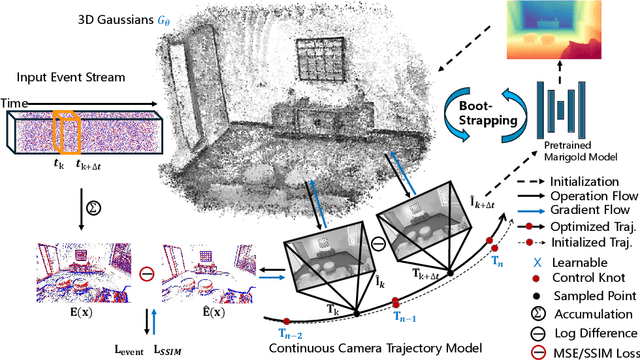


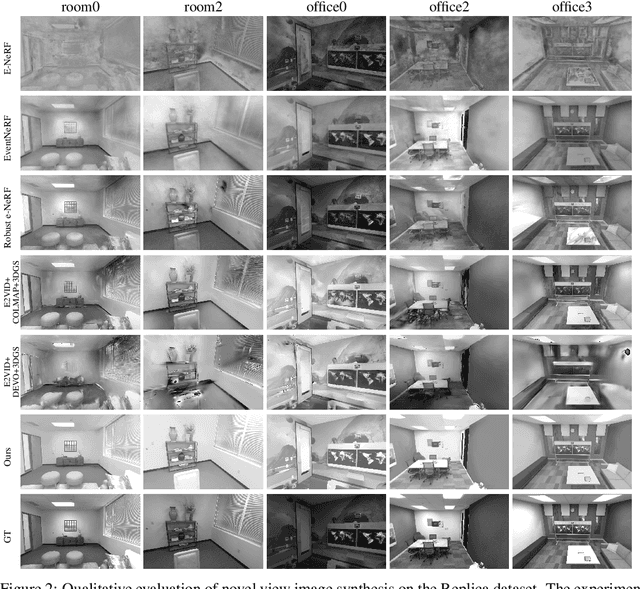
Implicit neural representation and explicit 3D Gaussian Splatting (3D-GS) for novel view synthesis have achieved remarkable progress with frame-based camera (e.g. RGB and RGB-D cameras) recently. Compared to frame-based camera, a novel type of bio-inspired visual sensor, i.e. event camera, has demonstrated advantages in high temporal resolution, high dynamic range, low power consumption and low latency. Due to its unique asynchronous and irregular data capturing process, limited work has been proposed to apply neural representation or 3D Gaussian splatting for an event camera. In this work, we present IncEventGS, an incremental 3D Gaussian Splatting reconstruction algorithm with a single event camera. To recover the 3D scene representation incrementally, we exploit the tracking and mapping paradigm of conventional SLAM pipelines for IncEventGS. Given the incoming event stream, the tracker firstly estimates an initial camera motion based on prior reconstructed 3D-GS scene representation. The mapper then jointly refines both the 3D scene representation and camera motion based on the previously estimated motion trajectory from the tracker. The experimental results demonstrate that IncEventGS delivers superior performance compared to prior NeRF-based methods and other related baselines, even we do not have the ground-truth camera poses. Furthermore, our method can also deliver better performance compared to state-of-the-art event visual odometry methods in terms of camera motion estimation. Code is publicly available at: https://github.com/wu-cvgl/IncEventGS.