 Add to Chrome
 Add to Firefox
 Add to Edge
RecourseBench: A Modular Framework for Reproducible Algorithmic Recourse Evaluation
Jun 15, 2026
Algorithmic recourse methods provide counterfactual explanations that inform individuals of the actions required to overturn an unfavorable model decision. Despite rapid methodological progress, principled comparison remains elusive; existing frameworks are often difficult to extend and lack both interoperability and systematic verification that integrated methods faithfully reproduce their originally reported results. We introduce \emph{RecourseBench}, a unified evaluation framework built around three commitments namely, modularity, reproducibility, and interactivity. The framework decomposes the pipeline into five fully decoupled layers -- Data, Preprocessing, Model, Recourse Method, and Evaluation -- governed by abstract interfaces and a dynamic registry. To address the reproducibility gap in prior benchmarks, we introduce a four-tier classification system in which every integrated method is validated by an automated test suite against its originally reported results. We further provide an interactive web interface for flexible, configuration-driven comparison across methods, datasets, and model architectures. Our framework currently integrates 28 state-of-the-art recourse methods and, to our knowledge, constitutes the first recourse benchmark to explicitly enforce method-level reproducibility through automated, quantitative testing.

Source-free Domain Adaptation for Multi-site and Lifespan Brain Skull Stripping
Mar 11, 2022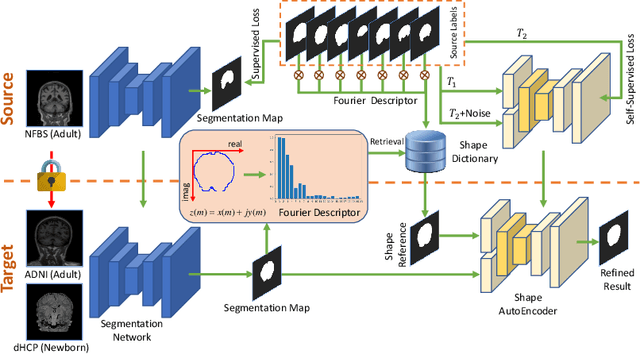

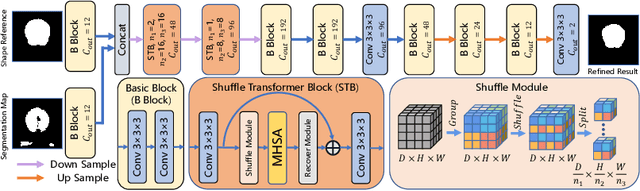

Skull stripping is a crucial prerequisite step in the analysis of brain magnetic resonance (MR) images. Although many excellent works or tools have been proposed, they suffer from low generalization capability. For instance, the model trained on a dataset with specific imaging parameters (source domain) cannot be well applied to other datasets with different imaging parameters (target domain). Especially, for the lifespan datasets, the model trained on an adult dataset is not applicable to an infant dataset due to the large domain difference. To address this issue, numerous domain adaptation (DA) methods have been proposed to align the extracted features between the source and target domains, requiring concurrent access to the input images of both domains. Unfortunately, it is problematic to share the images due to privacy. In this paper, we design a source-free domain adaptation framework (SDAF) for multi-site and lifespan skull stripping that can accomplish domain adaptation without access to source domain images. Our method only needs to share the source labels as shape dictionaries and the weights trained on the source data, without disclosing private information from source domain subjects. To deal with the domain shift between multi-site lifespan datasets, we take advantage of the brain shape prior which is invariant to imaging parameters and ages. Experiments demonstrate that our framework can significantly outperform the state-of-the-art methods on multi-site lifespan datasets.