 Add to Chrome
 Add to Firefox
 Add to Edge
Tencent WorkBuddy Bench: A Multi-Domain Coding-Agent Benchmark with Contamination-Resistant Task Construction
Jul 23, 2026
We introduce Tencent WorkBuddy Bench, a multi-domain evaluation suite for coding agents; this report documents its construction methodology, scoring protocol, and a cross-model leaderboard. At its core is a unified evaluation framework for constructing and running distribution-informed coding-agent tasks across four work domains - Code, Web, Office, and Security. Rather than adapting public issue text, every task is reverse-engineered from a real commit, pull request, or business scenario and rewritten as a short, colloquial, role-played request, so that a task's prompt is not recoverable by web-searching the underlying issue, pull request, or commit thread. Because the dataset is released openly - task directories, environment images, evaluation harness, tests, and reference solutions - contamination resistance rests on this construction together with dataset versioning rather than on secrecy. The four subsets - repository-level engineering, front-end development, office and business workflows, and red-/blue-team security - probe complementary facets of real work, each with its own verification style. All are packaged in a uniform task-directory format and run, under a uniform and reproducible protocol, on two agent harnesses (CodeBuddy Code and Claude Code); the full open release makes the benchmark reproducible end to end and directly auditable, since any third party can re-run each task and inspect its content. Because each subset uses a different scoring instrument, scores are not comparable across subsets and the suite reports no suite-wide average. We report a cross-model leaderboard across several model families.

Youtu-Agent: Scaling Agent Productivity with Automated Generation and Hybrid Policy Optimization
Dec 31, 2025Existing Large Language Model (LLM) agent frameworks face two significant challenges: high configuration costs and static capabilities. Building a high-quality agent often requires extensive manual effort in tool integration and prompt engineering, while deployed agents struggle to adapt to dynamic environments without expensive fine-tuning. To address these issues, we propose \textbf{Youtu-Agent}, a modular framework designed for the automated generation and continuous evolution of LLM agents. Youtu-Agent features a structured configuration system that decouples execution environments, toolkits, and context management, enabling flexible reuse and automated synthesis. We introduce two generation paradigms: a \textbf{Workflow} mode for standard tasks and a \textbf{Meta-Agent} mode for complex, non-standard requirements, capable of automatically generating tool code, prompts, and configurations. Furthermore, Youtu-Agent establishes a hybrid policy optimization system: (1) an \textbf{Agent Practice} module that enables agents to accumulate experience and improve performance through in-context optimization without parameter updates; and (2) an \textbf{Agent RL} module that integrates with distributed training frameworks to enable scalable and stable reinforcement learning of any Youtu-Agents in an end-to-end, large-scale manner. Experiments demonstrate that Youtu-Agent achieves state-of-the-art performance on WebWalkerQA (71.47\%) and GAIA (72.8\%) using open-weight models. Our automated generation pipeline achieves over 81\% tool synthesis success rate, while the Practice module improves performance on AIME 2024/2025 by +2.7\% and +5.4\% respectively. Moreover, our Agent RL training achieves 40\% speedup with steady performance improvement on 7B LLMs, enhancing coding/reasoning and searching capabilities respectively up to 35\% and 21\% on Maths and general/multi-hop QA benchmarks.
LUCY: Linguistic Understanding and Control Yielding Early Stage of Her
Jan 27, 2025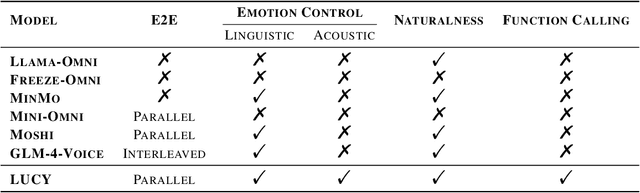
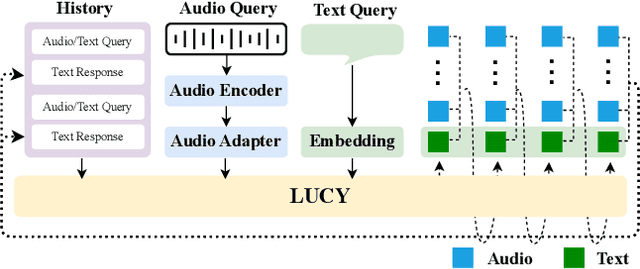
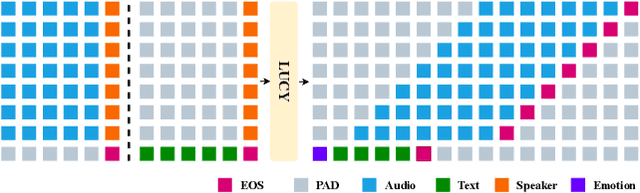
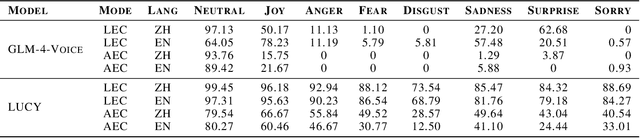
The film Her features Samantha, a sophisticated AI audio agent who is capable of understanding both linguistic and paralinguistic information in human speech and delivering real-time responses that are natural, informative and sensitive to emotional subtleties. Moving one step toward more sophisticated audio agent from recent advancement in end-to-end (E2E) speech systems, we propose LUCY, a E2E speech model that (1) senses and responds to user's emotion, (2) deliver responses in a succinct and natural style, and (3) use external tool to answer real-time inquiries. Experiment results show that LUCY is better at emotion control than peer models, generating emotional responses based on linguistic emotional instructions and responding to paralinguistic emotional cues. Lucy is also able to generate responses in a more natural style, as judged by external language models, without sacrificing much performance on general question answering. Finally, LUCY can leverage function calls to answer questions that are out of its knowledge scope.