 Add to Chrome
 Add to Firefox
 Add to Edge
SparseForge: Efficient Semi-Structured LLM Sparsification via Annealing of Hessian-Guided Soft-Mask
May 07, 2026
Semi-structured sparsity provides a practical path to accelerate large language models (LLMs) with native hardware support, but post-training semi-structured pruning often suffers from substantial quality degradation due to strong structural coupling. Existing methods rely on large-scale sparse retraining to recover accuracy, resulting in high computational cost. We propose SparseForge, a post-training framework that improves recovery efficiency by directly optimizing the sparsity mask rather than scaling up retraining tokens. SparseForge combines Hessian-aware importance estimation with progressive annealing of soft masks into hardware-executable structured sparsity, enabling stable and efficient sparse recovery. On LLaMA-2-7B under 2:4 sparsity, SparseForge achieves 57.27% average zero-shot accuracy with only $\textbf{5B}$ retraining tokens, surpassing the dense model's 56.43% accuracy and approaching the 57.52% result of a state-of-the-art method using $\textbf{40B}$ tokens. Such improvements on the accuracy-efficiency trade-off from SparseForge are shown to be consistent across model families.

Twilight: Adaptive Attention Sparsity with Hierarchical Top-$p$ Pruning
Feb 06, 2025


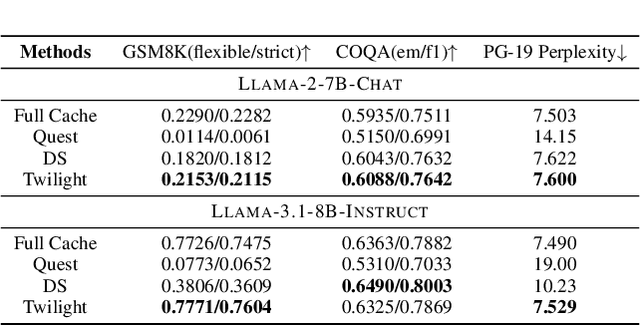
Leveraging attention sparsity to accelerate long-context large language models (LLMs) has been a hot research topic. However, current algorithms such as sparse attention or key-value (KV) cache compression tend to use a fixed budget, which presents a significant challenge during deployment because it fails to account for the dynamic nature of real-world scenarios, where the optimal balance between accuracy and efficiency can vary greatly. In this paper, we find that borrowing top-$p$ sampling (nucleus sampling) to sparse attention can surprisingly achieve adaptive budgeting. Based on this, we propose Twilight, a framework to bring adaptive sparsity to any existing sparse attention algorithm without sacrificing their accuracy. Empirical results show that Twilight can adaptively prune at most 98% of redundant tokens, leading to $15.4\times$ acceleration in self-attention operations and $3.9\times$ acceleration in end-to-end per token latency in long context LLM decoding.
Parrot: Efficient Serving of LLM-based Applications with Semantic Variable
May 30, 2024The rise of large language models (LLMs) has enabled LLM-based applications (a.k.a. AI agents or co-pilots), a new software paradigm that combines the strength of LLM and conventional software. Diverse LLM applications from different tenants could design complex workflows using multiple LLM requests to accomplish one task. However, they have to use the over-simplified request-level API provided by today's public LLM services, losing essential application-level information. Public LLM services have to blindly optimize individual LLM requests, leading to sub-optimal end-to-end performance of LLM applications. This paper introduces Parrot, an LLM service system that focuses on the end-to-end experience of LLM-based applications. Parrot proposes Semantic Variable, a unified abstraction to expose application-level knowledge to public LLM services. A Semantic Variable annotates an input/output variable in the prompt of a request, and creates the data pipeline when connecting multiple LLM requests, providing a natural way to program LLM applications. Exposing Semantic Variables to the public LLM service allows it to perform conventional data flow analysis to uncover the correlation across multiple LLM requests. This correlation opens a brand-new optimization space for the end-to-end performance of LLM-based applications. Extensive evaluations demonstrate that Parrot can achieve up to an order-of-magnitude improvement for popular and practical use cases of LLM applications.