 Add to Chrome
 Add to Firefox
 Add to Edge
Reward-Guided Semantic Evolution for Test-time Adaptive Object Detection
May 06, 2026
Open-vocabulary object detection with vision-language models (VLMs) such as Grounding DINO suffers from performance degradation under test-time distribution shifts, primarily due to semantic misalignment between text embeddings and shifted visual embeddings of region proposals. While recent test-time adaptive object detection methods for VLM-based either rely on costly backpropagation or bypass semantic misalignment via external memory, none directly and efficiently align text and vision in a training-free manner. To address this, we propose Reward-Guided Semantic Evolution (RGSE), a training-free framework that directly refines the text embeddings at test time. Inspired by evolutionary search, RGSE treats text embedding adaptation as a semantic search process: it perturbs text embeddings as candidate variants, evaluates them via cosine similarity with current and historical high-confidence visual proposals as a reward signal, and fuses them into a refined embedding through reward-weighted averaging. Without any backpropagation, RGSE achieves state-of-the-art performance across multiple detection benchmarks while adding minimal computational overhead. Our code will be open source upon publication.

Intent Mismatch Causes LLMs to Get Lost in Multi-Turn Conversation
Feb 07, 2026Multi-turn conversation has emerged as a predominant interaction paradigm for Large Language Models (LLMs). Users often employ follow-up questions to refine their intent, expecting LLMs to adapt dynamically. However, recent research reveals that LLMs suffer a substantial performance drop in multi-turn settings compared to single-turn interactions with fully specified instructions, a phenomenon termed ``Lost in Conversation'' (LiC). While this prior work attributes LiC to model unreliability, we argue that the root cause lies in an intent alignment gap rather than intrinsic capability deficits. In this paper, we first demonstrate that LiC is not a failure of model capability but rather a breakdown in interaction between users and LLMs. We theoretically show that scaling model size or improving training alone cannot resolve this gap, as it arises from structural ambiguity in conversational context rather than representational limitations. To address this, we propose to decouple intent understanding from task execution through a Mediator-Assistant architecture. By utilizing an experience-driven Mediator to explicate user inputs into explicit, well-structured instructions based on historical interaction patterns, our approach effectively bridges the gap between vague user intent and model interpretation. Experimental results demonstrate that this method significantly mitigates performance degradation in multi-turn conversations across diverse LLMs.
Tailed Low-Rank Matrix Factorization for Similarity Matrix Completion
Sep 29, 2024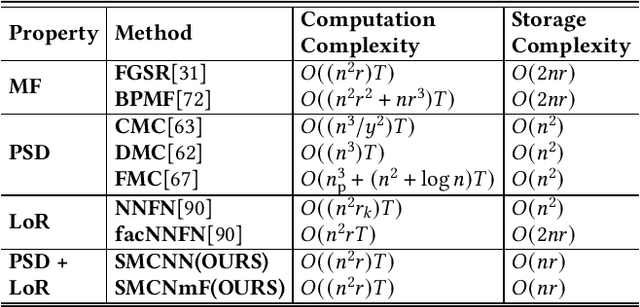
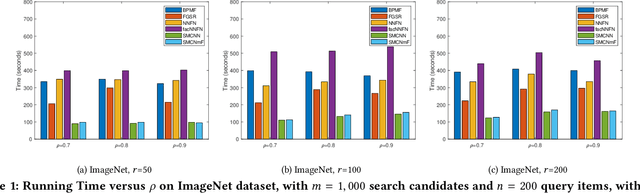
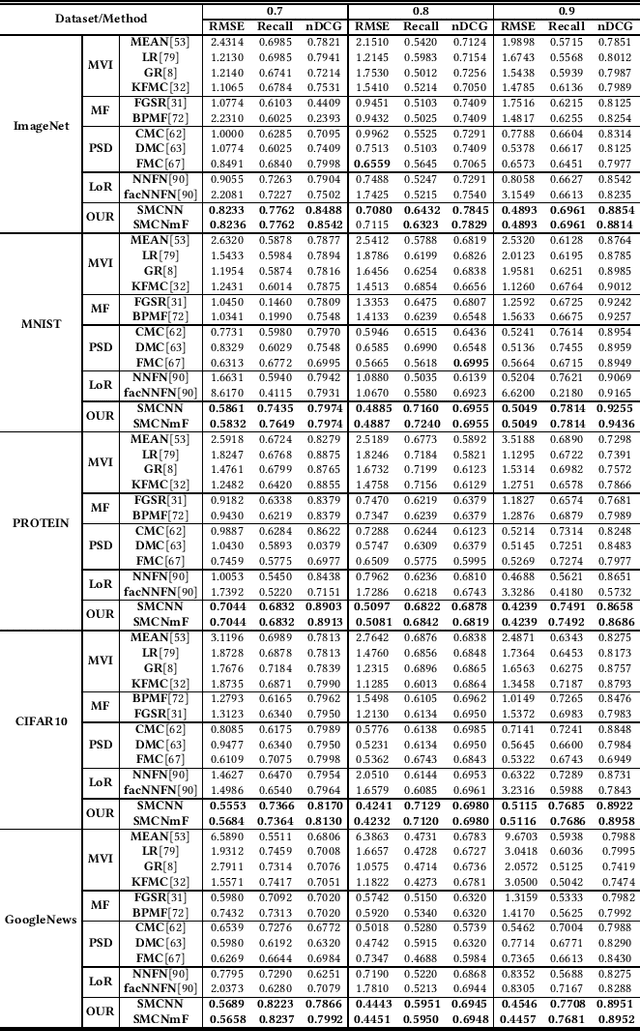
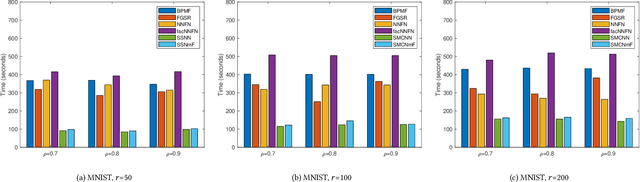
Similarity matrix serves as a fundamental tool at the core of numerous downstream machine-learning tasks. However, missing data is inevitable and often results in an inaccurate similarity matrix. To address this issue, Similarity Matrix Completion (SMC) methods have been proposed, but they suffer from high computation complexity due to the Singular Value Decomposition (SVD) operation. To reduce the computation complexity, Matrix Factorization (MF) techniques are more explicit and frequently applied to provide a low-rank solution, but the exact low-rank optimal solution can not be guaranteed since it suffers from a non-convex structure. In this paper, we introduce a novel SMC framework that offers a more reliable and efficient solution. Specifically, beyond simply utilizing the unique Positive Semi-definiteness (PSD) property to guide the completion process, our approach further complements a carefully designed rank-minimization regularizer, aiming to achieve an optimal and low-rank solution. Based on the key insights that the underlying PSD property and Low-Rank property improve the SMC performance, we present two novel, scalable, and effective algorithms, SMCNN and SMCNmF, which investigate the PSD property to guide the estimation process and incorporate nonconvex low-rank regularizer to ensure the low-rank solution. Theoretical analysis ensures better estimation performance and convergence speed. Empirical results on real-world datasets demonstrate the superiority and efficiency of our proposed methods compared to various baseline methods.