 Add to Chrome
 Add to Firefox
 Add to Edge
Boosting Generalizable Depth Estimation in Endoscopy by Mixture of Lightweight Experts and Intrinsic Image Alignment
Aug 01, 2026
Depth estimation is a significant task for 3D perception in endoscopic surgeries. However, illumination interference and feature diversity in various endoscopic scenes are still challenges for generalizable depth estimation and ego-motion estimation. Based on this, a novel self-supervised framework, EndoMINI, is proposed for depth estimation in endoscopic scenes. Specifically, mixture of low-rank experts (MiLoRE) is proposed to perform parameter-efficient fine-tuning, which can also boost the model adaptation to scenes with different characteristics. Meanwhile, an intrinsic image alignment (IIA) is introduced into the training loss to alleviate the influence of light reflectance in endoscopy with a novel intrinsic image decomposition network. The proposed method is evaluated on SCARED datasets for supervised depth estimation, and two endoscopic datasets, Hamlyn and SERV-CT, for zero-shot depth estimation, compared with state-of-the-art works as well. The experimental results demonstrate outstanding performance of the proposed model and the effects of the main contributions.

Parameter-Efficient Adaptation of SAM3 for Prompt-Driven Surgical Concept Segmentation
Jul 26, 2026Efficient surgical segmentation empowers clinical diagnosis, intraoperative monitoring, and downstream robotic pipelines for reconstruction and simulation. Although prompt-driven foundation models like Segment Anything Model 3 (SAM3) achieve strong segmentation performance on natural images, surgical data exhibits domain gaps against its pre-training data, resulting in degraded segmentation accuracy. Furthermore, existing medical SAM methods require full-parameter fine-tuning, incurring heavy computational consumption and low efficiency. To address these limitations, this work proposes a parameter-efficient Low-Rank Adaptation (LoRA) adaptation of SAM3 for surgical concept segmentation. We inject low-rank adapters into the prompt encoder, detector and tracker while fully freezing the vision backbone, which only optimizes 0.98% of the total model parameters and supports training on a single consumer GPU. Comprehensive experiments demonstrate that our method consistently outperforms zero-shot SAM3 and other mainstream baselines, and the generated segmentation results can be directly deployed to support downstream robotic surgical scene reconstruction and physical simulation pipelines.
Learning Consistency Pursued Correlation Filters for Real-Time UAV Tracking
Aug 09, 2020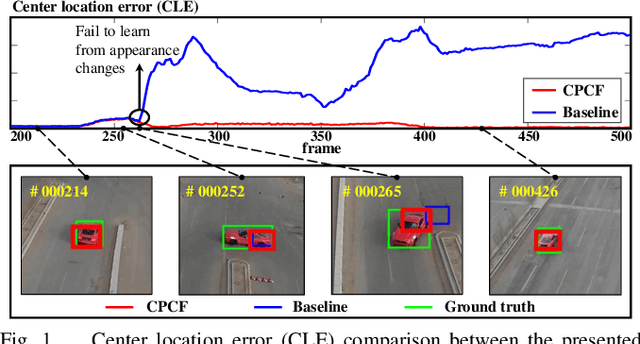
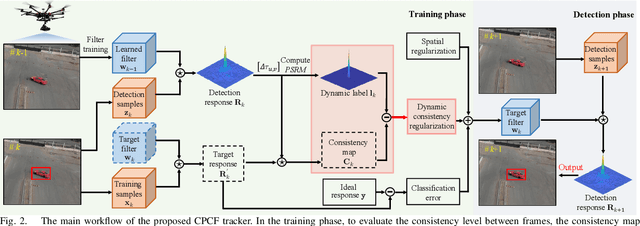
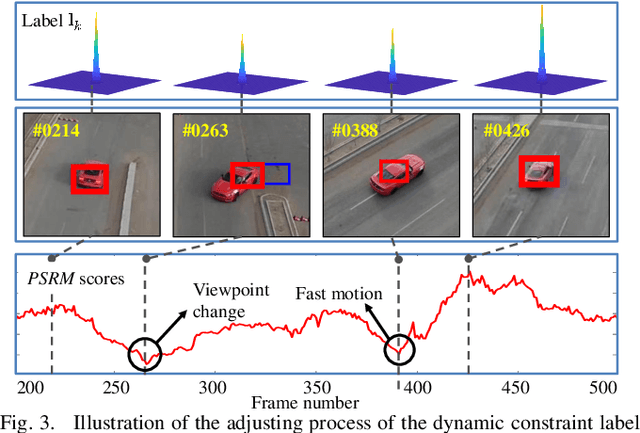
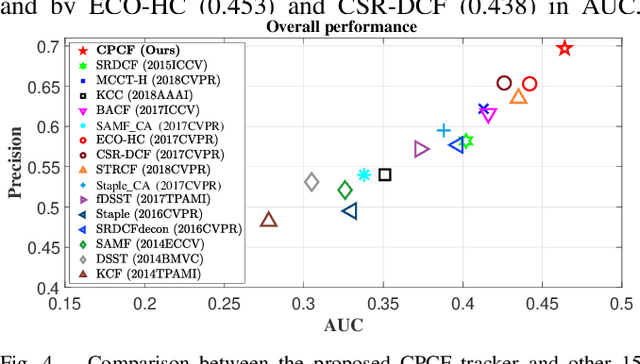
Correlation filter (CF)-based methods have demonstrated exceptional performance in visual object tracking for unmanned aerial vehicle (UAV) applications, but suffer from the undesirable boundary effect. To solve this issue, spatially regularized correlation filters (SRDCF) proposes the spatial regularization to penalize filter coefficients, thereby significantly improving the tracking performance. However, the temporal information hidden in the response maps is not considered in SRDCF, which limits the discriminative power and the robustness for accurate tracking. This work proposes a novel approach with dynamic consistency pursued correlation filters, i.e., the CPCF tracker. Specifically, through a correlation operation between adjacent response maps, a practical consistency map is generated to represent the consistency level across frames. By minimizing the difference between the practical and the scheduled ideal consistency map, the consistency level is constrained to maintain temporal smoothness, and rich temporal information contained in response maps is introduced. Besides, a dynamic constraint strategy is proposed to further improve the adaptability of the proposed tracker in complex situations. Comprehensive experiments are conducted on three challenging UAV benchmarks, i.e., UAV123@10FPS, UAVDT, and DTB70. Based on the experimental results, the proposed tracker favorably surpasses the other 25 state-of-the-art trackers with real-time running speed ($\sim$43FPS) on a single CPU.
* IROS 2020 accepted, 8 pages, 7 figures, and 2 tables