 Add to Chrome
 Add to Firefox
 Add to Edge
Large-Scale 3D Ground-Motion Synthesis with Physics-Inspired Latent Operator Flow Matching
Mar 18, 2026
Earthquake hazard analysis and design of spatially distributed infrastructure, such as power grids and energy pipeline networks, require scenario-specific ground-motion time histories with realistic frequency content and spatiotemporal coherence. However, producing the large ensembles needed for uncertainty quantification with physics-based simulations is computationally intensive and impractical for engineering workflows. To address this challenge, we introduce Ground-Motion Flow (GMFlow), a physics-inspired latent operator flow matching framework that generates realistic, large-scale regional ground-motion time-histories conditioned on physical parameters. Validated on simulated earthquake scenarios in the San Francisco Bay Area, GMFlow generates spatially coherent ground motion across more than 9 million grid points in seconds, achieving a 10,000-fold speedup over the simulation workflow, which opens a path toward rapid and uncertainty-aware hazard assessment for distributed infrastructure. More broadly, GMFlow advances mesh-agnostic functional generative modeling and could potentially be extended to the synthesis of large-scale spatiotemporal physical fields in diverse scientific domains.

Enforcing Reciprocity in Operator Learning for Seismic Wave Propagation
Feb 12, 2026Accurate and efficient wavefield modeling underpins seismic structure and source studies. Traditional methods comply with physical laws but are computationally intensive. Data-driven methods, while opening new avenues for advancement, have yet to incorporate strict physical consistency. The principle of reciprocity is one of the most fundamental physical laws in wave propagation. We introduce the Reciprocity-Enforced Neural Operator (RENO), a transformer-based architecture for modeling seismic wave propagation that hard-codes the reciprocity principle. The model leverages the cross-attention mechanism and commutative operations to guarantee invariance under swapping source and receiver positions. Beyond improved physical consistency, the proposed architecture supports simultaneous realizations for multiple sources without crosstalk issues. This yields an order-of-magnitude inference speedup at a similar memory footprint over an reciprocity-unenforced neural operator on a realistic configuration. We demonstrate the functionality using the reciprocity relation for particle velocity fields under single forces. This architecture is also applicable to pressure fields under dilatational sources and travel-time fields governed by the eikonal equation, paving the way for encoding more complex reciprocity relations.
Stochastic Process Learning via Operator Flow Matching
Jan 07, 2025
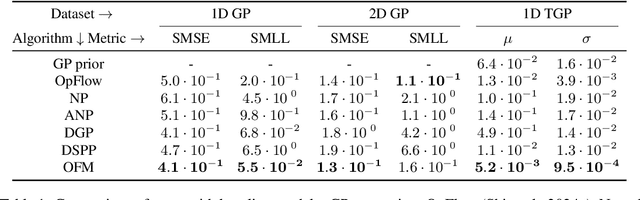
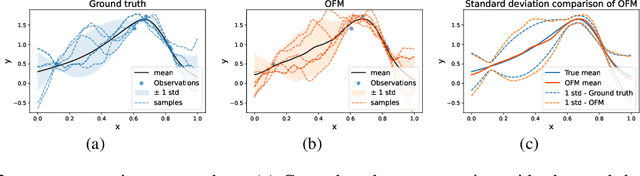
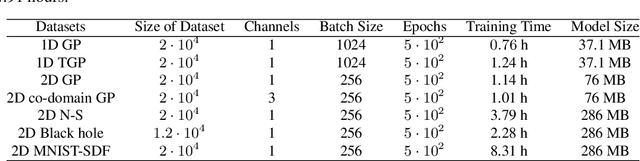
Expanding on neural operators, we propose a novel framework for stochastic process learning across arbitrary domains. In particular, we develop operator flow matching (\alg) for learning stochastic process priors on function spaces. \alg provides the probability density of the values of any collection of points and enables mathematically tractable functional regression at new points with mean and density estimation. Our method outperforms state-of-the-art models in stochastic process learning, functional regression, and prior learning.
Universal Functional Regression with Neural Operator Flows
Apr 03, 2024Regression on function spaces is typically limited to models with Gaussian process priors. We introduce the notion of universal functional regression, in which we aim to learn a prior distribution over non-Gaussian function spaces that remains mathematically tractable for functional regression. To do this, we develop Neural Operator Flows (OpFlow), an infinite-dimensional extension of normalizing flows. OpFlow is an invertible operator that maps the (potentially unknown) data function space into a Gaussian process, allowing for exact likelihood estimation of functional point evaluations. OpFlow enables robust and accurate uncertainty quantification via drawing posterior samples of the Gaussian process and subsequently mapping them into the data function space. We empirically study the performance of OpFlow on regression and generation tasks with data generated from Gaussian processes with known posterior forms and non-Gaussian processes, as well as real-world earthquake seismograms with an unknown closed-form distribution.
Broadband Ground Motion Synthesis via Generative Adversarial Neural Operators: Development and Validation
Sep 07, 2023


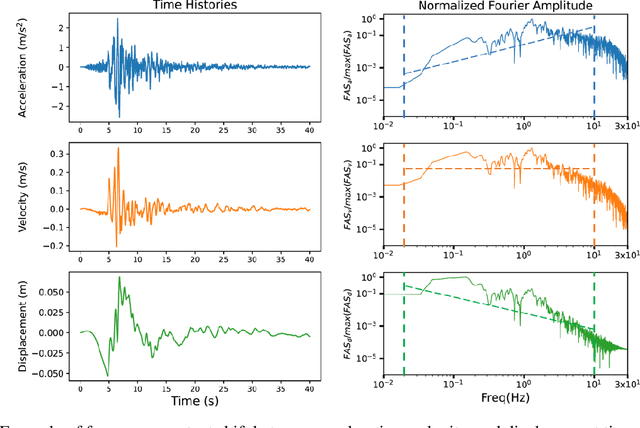
We present a data-driven model for ground-motion synthesis using a Generative Adversarial Neural Operator (GANO) that combines recent advancements in machine learning and open access strong motion data sets to generate three-component acceleration time histories conditioned on moment magnitude ($M$), rupture distance ($R_{rup}$), time-average shear-wave velocity at the top $30m$ ($V_{S30}$), and tectonic environment or style of faulting. We use Neural Operators, a resolution invariant architecture that guarantees that the model training is independent of the data sampling frequency. We first present the conditional ground-motion synthesis algorithm (referred to heretofore as cGM-GANO) and discuss its advantages compared to previous work. Next, we verify the cGM-GANO framework using simulated ground motions generated with the Southern California Earthquake Center (SCEC) Broadband Platform (BBP). We lastly train cGM-GANO on a KiK-net dataset from Japan, showing that the framework can recover the magnitude, distance, and $V_{S30}$ scaling of Fourier amplitude and pseudo-spectral accelerations. We evaluate cGM-GANO through residual analysis with the empirical dataset as well as by comparison with conventional Ground Motion Models (GMMs) for selected ground motion scenarios. Results show that cGM-GANO produces consistent median scaling with the GMMs for the corresponding tectonic environments. The largest misfit is observed at short distances due to the scarcity of training data. With the exception of short distances, the aleatory variability of the response spectral ordinates is also well captured, especially for subduction events due to the adequacy of training data. Applications of the presented framework include generation of risk-targeted ground motions for site-specific engineering applications.