 Add to Chrome
 Add to Firefox
 Add to Edge
CanniUplift: A Holistic Framework for Mitigating Seller and Incentive Cannibalization in E-commerce Uplift Modeling
Jul 06, 2026
Personalized incentive allocation is vital for e-commerce, where uplift modeling is the standard for estimating Individual Treatment Effects (ITE). However, traditional models often fail in complex multi-seller environments with violations of the Stable Unit Treatment Value Assumption (SUTVA). We identify two critical challenges: Seller-level Cannibalization, where incentives shift expenditure between shops without growing the platform, and Incentive-level Cannibalization, where organic conversions or alternative rewards introduce significant noise into incrementality estimation. In this paper, we propose CanniUplift, a unified framework to mitigate these dual-source cannibalization effects. Specifically, we design Platform-level Global Alignment (PGA) to capture cross-shop substitution through global GMV consistency constraints. To tackle incentive-driven noise, we introduce Redemption-based Decomposition Denoising (RDD), which uses redemption behavior to decompose treated outcomes and reduce attribution noise within an entire-space framework. Furthermore, a Treat-Attention mechanism is designed to model intricate interactions between users' historical behaviors and current treatment options. Extensive experiments on both synthetic and large-scale industrial datasets demonstrate that CanniUplift significantly outperforms state-of-the-art baselines. Ablation studies confirm that the integration of PGA and RDD consistently improves wAUUC and wQINI. Successfully deployed online, our framework achieved a 4.08% relative increase in platform-wide incremental GMV (Delta GMV) over the production baseline and improved ROI in online A/B tests, proving effective in driving global platform growth.

MAMDR: A Model Agnostic Learning Method for Multi-Domain Recommendation
Mar 22, 2022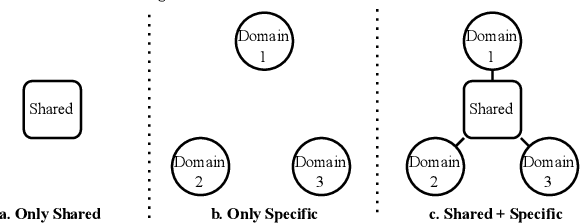
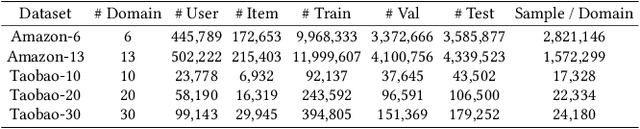
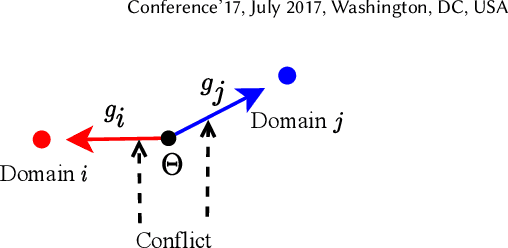
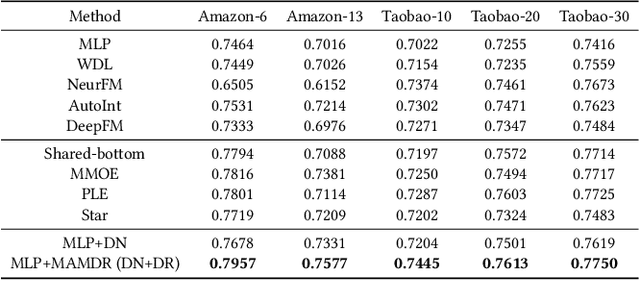
Large-scale e-commercial platforms in the real-world usually contain various recommendation scenarios (domains) to meet demands of diverse customer groups. Multi-Domain Recommendation (MDR), which aims to jointly improve recommendations on all domains, has attracted increasing attention from practitioners and researchers. Existing MDR methods often employ a shared structure to leverage reusable features for all domains and several specific parts to capture domain-specific information. However, data from different domains may conflict with each other and cause shared parameters to stay at a compromised position on the optimization landscape. This could deteriorate the overall performance. Despite the specific parameters are separately learned for each domain, they can easily overfit on data sparsity domains. Furthermore, data distribution differs across domains, making it challenging to develop a general model that can be applied to all circumstances. To address these problems, we propose a novel model agnostic learning method, namely MAMDR, for the multi-domain recommendation. Specifically, we first propose a Domain Negotiation (DN) strategy to alleviate the conflict between domains and learn better shared parameters. Then, we develop a Domain Regularization (DR) scheme to improve the generalization ability of specific parameters by learning from other domains. Finally, we integrate these components into a unified framework and present MAMDR which can be applied to any model structure to perform multi-domain recommendation. Extensive experiments on various real-world datasets and online applications demonstrate both the effectiveness and generalizability of MAMDR.