 Add to Chrome
 Add to Firefox
 Add to Edge
SubZero+: Efficient Zeroth-Order LLM Fine-Tuning via Large Learning Rates
Aug 16, 2026
Zeroth-order (ZO) optimization enables backpropagation-free fine-tuning of large language models, but existing ZO methods suffer from high-variance gradient estimators, making convergence unstable and highly sensitive to learning rates. We propose SubZero+, an improved SubZero framework that improves stability in three complementary ways: (i) multi-query gradient estimation within layer-specific low-rank subspaces to reduce variance without exhibiting the multi-query paradox; (ii) a subspace Adam optimizer that performs adaptive updates using in-subspace multi-query gradient statistics; and (iii) a sign correction for QR-based subspace construction to ensure Haar-distributed projection matrices, eliminating implementation-dependent orientation ambiguity. Experiments on models from 1.3B to 32B across SuperGLUE, under both full-parameter tuning and LoRA, show that SubZero+ consistently outperforms prior ZO baselines, enlarges the stable learning-rate range, and narrows the gap to first-order methods with minimal extra memory overhead.

CanniUplift: A Holistic Framework for Mitigating Seller and Incentive Cannibalization in E-commerce Uplift Modeling
Jul 06, 2026Personalized incentive allocation is vital for e-commerce, where uplift modeling is the standard for estimating Individual Treatment Effects (ITE). However, traditional models often fail in complex multi-seller environments with violations of the Stable Unit Treatment Value Assumption (SUTVA). We identify two critical challenges: Seller-level Cannibalization, where incentives shift expenditure between shops without growing the platform, and Incentive-level Cannibalization, where organic conversions or alternative rewards introduce significant noise into incrementality estimation. In this paper, we propose CanniUplift, a unified framework to mitigate these dual-source cannibalization effects. Specifically, we design Platform-level Global Alignment (PGA) to capture cross-shop substitution through global GMV consistency constraints. To tackle incentive-driven noise, we introduce Redemption-based Decomposition Denoising (RDD), which uses redemption behavior to decompose treated outcomes and reduce attribution noise within an entire-space framework. Furthermore, a Treat-Attention mechanism is designed to model intricate interactions between users' historical behaviors and current treatment options. Extensive experiments on both synthetic and large-scale industrial datasets demonstrate that CanniUplift significantly outperforms state-of-the-art baselines. Ablation studies confirm that the integration of PGA and RDD consistently improves wAUUC and wQINI. Successfully deployed online, our framework achieved a 4.08% relative increase in platform-wide incremental GMV (Delta GMV) over the production baseline and improved ROI in online A/B tests, proving effective in driving global platform growth.
AR1-ZO: Topology-Aware Rank-1 Zeroth-Order Queries for High-Rank LoRA Fine-Tuning
May 19, 2026Zeroth-order (ZO) optimization enables large-language-model fine-tuning without storing backpropagation activations, while LoRA supplies compact trainable adapters. Combining them creates a rank paradox: increasing LoRA rank improves adapter capacity, but standard two-point ZO either perturbs a rank-dependent number of coordinates or, under atomwise updates, can make the finite-difference signal unobservable. This paper shows that the bottleneck is a measurement-topology problem rather than a need for an external subspace. LoRA already decomposes into matched rank-$1$ atoms, each a complete factor-coordinate block of dimension $d_\text{out}+d_\text{in}$. Querying one atom per step keeps the stored adapter rank $r$ while removing $r$ from the single-query perturbation dimension. The naive atomwise query is still miscalibrated: if it inherits canonical LoRA scaling $α/r$, the active finite-difference signal shrinks as $1/r$ and the active finite-difference signal-to-noise ratio (FD-SNR) as $1/r^2$, producing directional collapse under a fixed residual evaluation-noise floor. AR1-ZO pairs alternating rank-$1$ atom queries with topology-aware scaling $γ=αr$, restoring rank-invariant active signal without auxiliary bases, activation hooks, curvature estimates, or extra forward queries. Theory proves atom minimality, rank-independent active query dimension, directional collapse and restoration, and the remaining rank dependence as an amortized coverage cost. Experiments on OPT and Qwen3 models validate the signal mechanism and show that AR1-ZO makes high-rank LoRA effective among matched-budget ZO methods under the standard two-forward-pass query budget.
Zeroth-Order Optimization is Secretly Single-Step Policy Optimization
Jun 17, 2025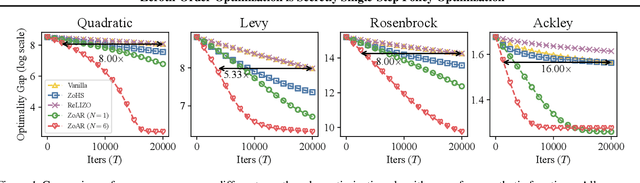
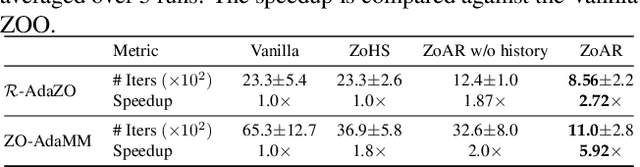
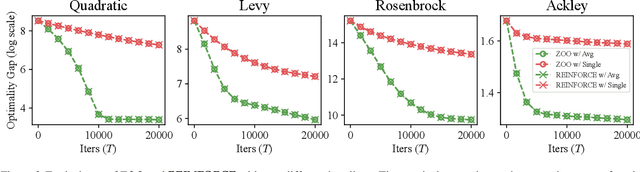
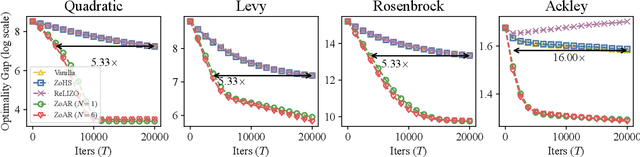
Zeroth-Order Optimization (ZOO) provides powerful tools for optimizing functions where explicit gradients are unavailable or expensive to compute. However, the underlying mechanisms of popular ZOO methods, particularly those employing randomized finite differences, and their connection to other optimization paradigms like Reinforcement Learning (RL) are not fully elucidated. This paper establishes a fundamental and previously unrecognized connection: ZOO with finite differences is equivalent to a specific instance of single-step Policy Optimization (PO). We formally unveil that the implicitly smoothed objective function optimized by common ZOO algorithms is identical to a single-step PO objective. Furthermore, we show that widely used ZOO gradient estimators, are mathematically equivalent to the REINFORCE gradient estimator with a specific baseline function, revealing the variance-reducing mechanism in ZOO from a PO perspective.Built on this unified framework, we propose ZoAR (Zeroth-Order Optimization with Averaged Baseline and Query Reuse), a novel ZOO algorithm incorporating PO-inspired variance reduction techniques: an averaged baseline from recent evaluations and query reuse analogous to experience replay. Our theoretical analysis further substantiates these techniques reduce variance and enhance convergence. Extensive empirical studies validate our theory and demonstrate that ZoAR significantly outperforms other methods in terms of convergence speed and final performance. Overall, our work provides a new theoretical lens for understanding ZOO and offers practical algorithmic improvements derived from its connection to PO.