 Add to Chrome
 Add to Firefox
 Add to Edge
Dive into the Scene: Breaking the Perceptual Bottleneck in Vision-Language Decision Making via Focus Plan Generation
Jun 02, 2026
In embodied vision-language decision making tasks such as robotic manipulation and navigation, Vision-Language and Vision-Language-Action Models (VLMs & VLAs) are powerful tools with different benefits: VLMs are better at long-term planning, while VLAs are better at reactive control. However, their performance is limited by the same perceptual bottleneck: visual hallucinations arise due to the models' inability to distinguish task-relevant objects from distractors. In principle, accurate identification and focus on critical objects while filtering out irrelevant ones is the key to break this limitation. A straightforward solution is one-step focus: directly attending to essential objects. However, this approach proves ineffective because effective focus inherently requires deep scene understanding. To this end, we propose SceneDiver, a coarse-to-fine focus plan generation method for VLMs leveraging their long-term planning abilities, that first constructs a holistic scene graph to establish initial comprehension, then progressively decomposes the task into simpler sub-problems through an iterative cycle of recognition, understanding, and analysis. To enable reactive control, we also design a lightweight adapter for distilling the deliberate focus ability into VLAs. Evaluations on standard embodied AI benchmarks confirm that our method substantially reduces visual hallucinations for both VLMs and VLAs, while preserving computational efficiency in tasks requiring fast execution. Our code and data are released at: https://future-item.github.io/SceneDiver.

Enhancing Visual Reasoning with Autonomous Imagination in Multimodal Large Language Models
Nov 27, 2024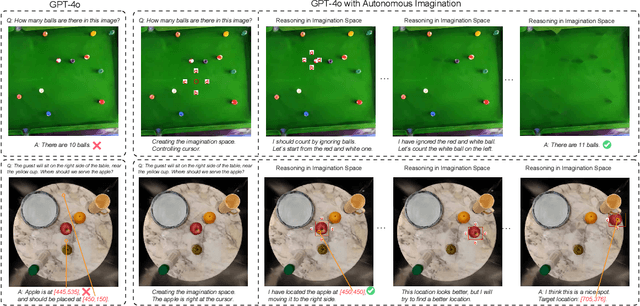

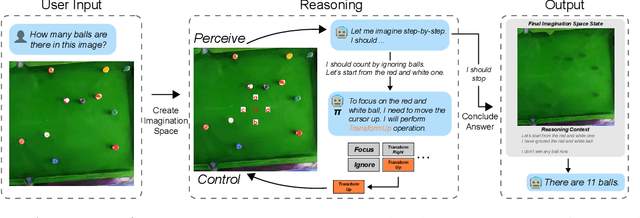
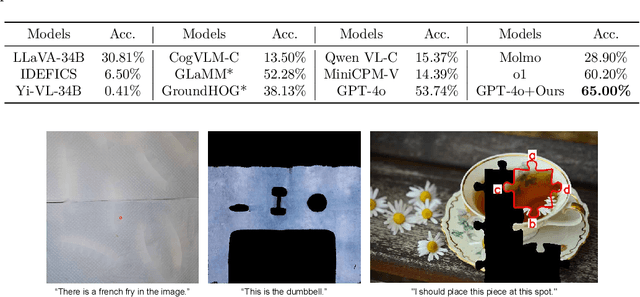
There have been recent efforts to extend the Chain-of-Thought (CoT) paradigm to Multimodal Large Language Models (MLLMs) by finding visual clues in the input scene, advancing the visual reasoning ability of MLLMs. However, current approaches are specially designed for the tasks where clue finding plays a major role in the whole reasoning process, leading to the difficulty in handling complex visual scenes where clue finding does not actually simplify the whole reasoning task. To deal with this challenge, we propose a new visual reasoning paradigm enabling MLLMs to autonomously modify the input scene to new ones based on its reasoning status, such that CoT is reformulated as conducting simple closed-loop decision-making and reasoning steps under a sequence of imagined visual scenes, leading to natural and general CoT construction. To implement this paradigm, we introduce a novel plug-and-play imagination space, where MLLMs conduct visual modifications through operations like focus, ignore, and transform based on their native reasoning ability without specific training. We validate our approach through a benchmark spanning dense counting, simple jigsaw puzzle solving, and object placement, challenging the reasoning ability beyond clue finding. The results verify that while existing techniques fall short, our approach enables MLLMs to effectively reason step by step through autonomous imagination. Project page: https://future-item.github.io/autoimagine-site.