 Add to Chrome
 Add to Firefox
 Add to Edge
Scene and Human in One World: Reconstruction in a Feedforward Pass
Jun 26, 2026
Reconstructing humans in dynamic scenes from moving monocular cameras remains challenging due to scale ambiguity, human-scene misalignment, and occlusion interference. Rather than treating human mesh recovery and scene reconstruction as separate tasks, we believe that accurate human-scene reconstruction requires the two tasks to mutually inform each other: parametric human models offer semantic structure and metric-scale priors, while scene geometry provides spatial context for human localization and alignment. Built on this insight, we introduce SHOW, a mask-promptable human mesh recovery framework that couples feed-forward 3D scene reconstruction with Human Mesh Recovery in a unified metric space. SHOW injects human semantics and scale priors from parametric human models into normalized point-map prediction, enabling metric-scale scene reconstruction from inherently scale-ambiguous monocular input. In turn, the recovered scene geometry constrains human mesh estimation, encouraging spatially consistent human placement and improved human-scene alignment. To handle complex multi-person and cluttered scenes, SHOW further incorporates a promptable masking mechanism that enables flexible target-human selection while suppressing background distractions and occlusion interference. Through joint training, the model learns both human-aware geometric features and geometry-constrained human features, producing aligned metric-scale reconstructions from monocular human-centric videos. Extensive experiments demonstrate that SHOW improves metric-scale consistency, human-scene alignment, and reconstruction accuracy under challenging camera motion, occlusion, and cluttered backgrounds.

ARKS: Active Retrieval in Knowledge Soup for Code Generation
Feb 19, 2024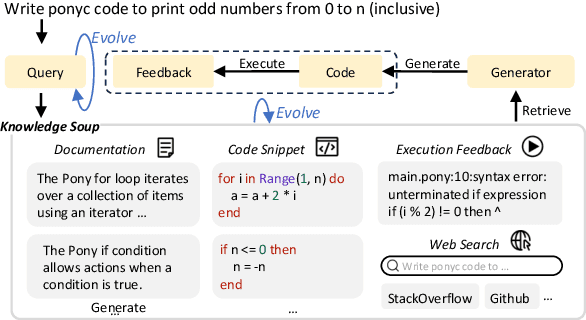
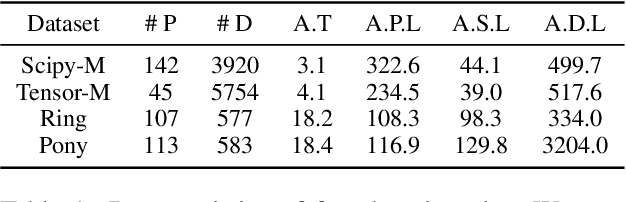
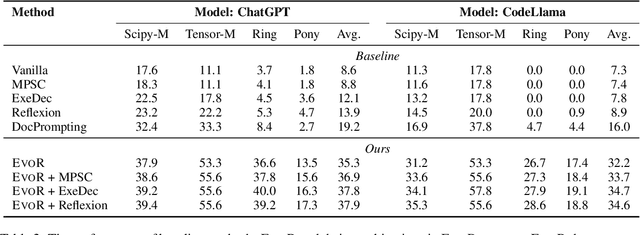
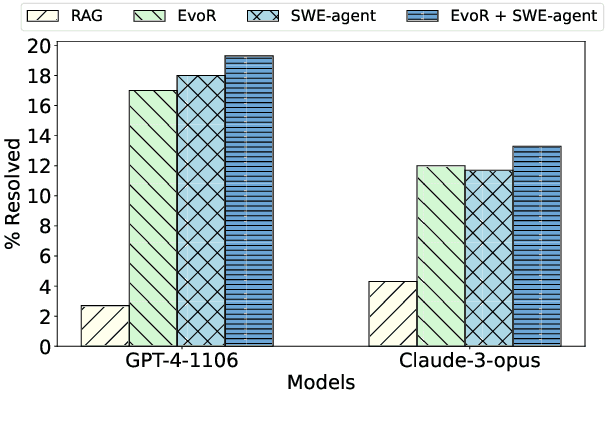
Recently the retrieval-augmented generation (RAG) paradigm has raised much attention for its potential in incorporating external knowledge into large language models (LLMs) without further training. While widely explored in natural language applications, its utilization in code generation remains under-explored. In this paper, we introduce Active Retrieval in Knowledge Soup (ARKS), an advanced strategy for generalizing large language models for code. In contrast to relying on a single source, we construct a knowledge soup integrating web search, documentation, execution feedback, and evolved code snippets. We employ an active retrieval strategy that iteratively refines the query and updates the knowledge soup. To assess the performance of ARKS, we compile a new benchmark comprising realistic coding problems associated with frequently updated libraries and long-tail programming languages. Experimental results on ChatGPT and CodeLlama demonstrate a substantial improvement in the average execution accuracy of ARKS on LLMs. The analysis confirms the effectiveness of our proposed knowledge soup and active retrieval strategies, offering rich insights into the construction of effective retrieval-augmented code generation (RACG) pipelines. Our model, code, and data are available at https://arks-codegen.github.io.