 Add to Chrome
 Add to Firefox
 Add to Edge
UG-UMRE: Uncertainty-Guided Modality Augmentation and Distributional Calibration for Unified Multimodal Relation Extraction
Aug 05, 2026
Unified Multimodal Relation Extraction (UMRE) aims to identify intra-modal and cross-modal relations between textual entities and visual objects. However, existing UMRE studies still encounter two critical issues: ignoring inherent aleatoric uncertainty causes noise propagation, and deep-seated heterogeneity between distinct modal distributions hinders alignment. To address these issues, we propose the Uncertainty-Guided UMRE Network (UG-UMRE). Specifically, we design an Uncertainty-Driven Unimodal Augmentation (UDUA) module, which models features as Gaussian distributions based on the Variational Information Bottleneck. By incorporating an uncertainty-aware self-supervised contrastive learning mechanism, UDUA effectively filters out noise while maintaining semantic consistency. Furthermore, we introduce the Joint Aleatoric Uncertainty Alignment (JAUA) module as a global semantic pre-calibration mechanism. JAUA leverages probabilistic distribution consistency to construct a shared latent space, eliminating the distributional gap by synchronizing cross-modal statistical properties, thereby laying a robust foundation for fine-grained interaction. Experiments on three benchmark datasets (UMRE, MORE, and MNRE) demonstrate that UG-UMRE achieves state-of-the-art performance. Further analysis validates the pluggable and effective performance of the proposed UDUA and JAUA modules.

Generative Recommendation for Large-Scale Advertising
Feb 26, 2026Generative recommendation has recently attracted widespread attention in industry due to its potential for scaling and stronger model capacity. However, deploying real-time generative recommendation in large-scale advertising requires designs beyond large-language-model (LLM)-style training and serving recipes. We present a production-oriented generative recommender co-designed across architecture, learning, and serving, named GR4AD (Generative Recommendation for ADdvertising). As for tokenization, GR4AD proposes UA-SID (Unified Advertisement Semantic ID) to capture complicated business information. Furthermore, GR4AD introduces LazyAR, a lazy autoregressive decoder that relaxes layer-wise dependencies for short, multi-candidate generation, preserving effectiveness while reducing inference cost, which facilitates scaling under fixed serving budgets. To align optimization with business value, GR4AD employs VSL (Value-Aware Supervised Learning) and proposes RSPO (Ranking-Guided Softmax Preference Optimization), a ranking-aware, list-wise reinforcement learning algorithm that optimizes value-based rewards under list-level metrics for continual online updates. For online inference, we further propose dynamic beam serving, which adapts beam width across generation levels and online load to control compute. Large-scale online A/B tests show up to 4.2% ad revenue improvement over an existing DLRM-based stack, with consistent gains from both model scaling and inference-time scaling. GR4AD has been fully deployed in Kuaishou advertising system with over 400 million users and achieves high-throughput real-time serving.
Referring Remote Sensing Image Segmentation via Bidirectional Alignment Guided Joint Prediction
Feb 12, 2025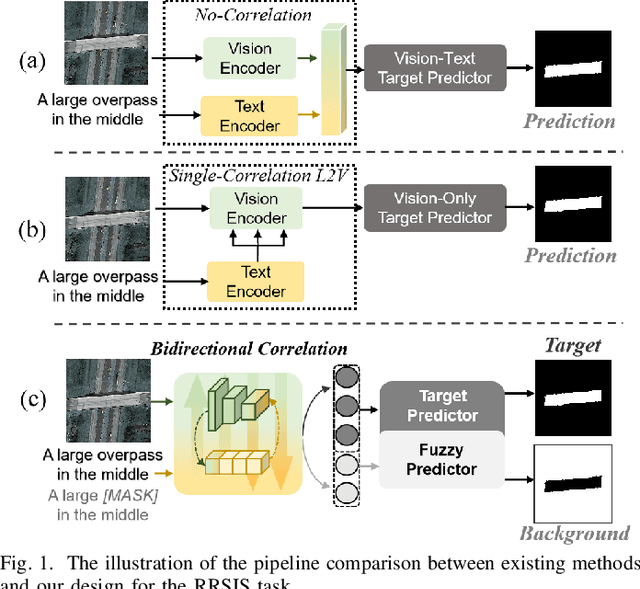
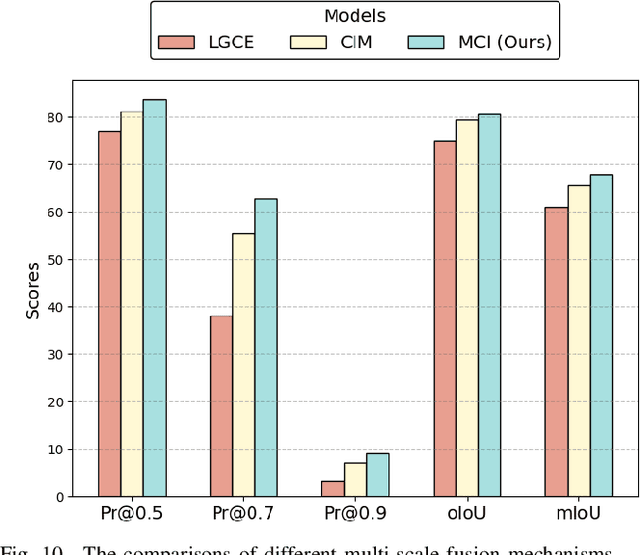
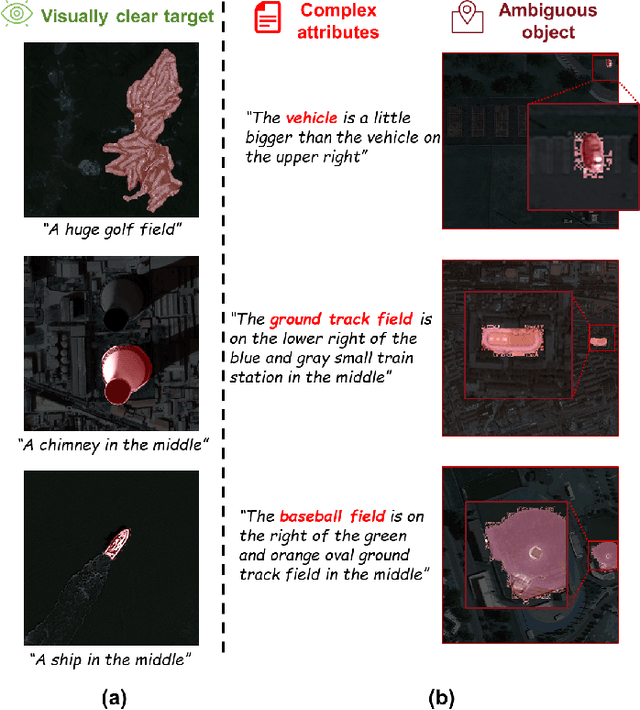
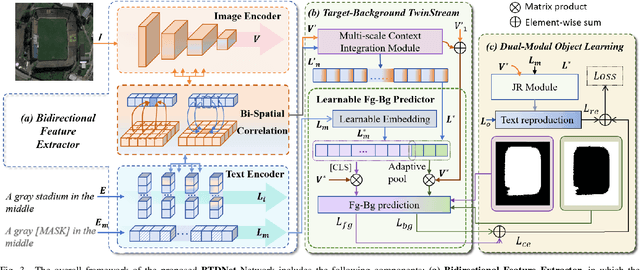
Referring Remote Sensing Image Segmentation (RRSIS) is critical for ecological monitoring, urban planning, and disaster management, requiring precise segmentation of objects in remote sensing imagery guided by textual descriptions. This task is uniquely challenging due to the considerable vision-language gap, the high spatial resolution and broad coverage of remote sensing imagery with diverse categories and small targets, and the presence of clustered, unclear targets with blurred edges. To tackle these issues, we propose \ours, a novel framework designed to bridge the vision-language gap, enhance multi-scale feature interaction, and improve fine-grained object differentiation. Specifically, \ours introduces: (1) the Bidirectional Spatial Correlation (BSC) for improved vision-language feature alignment, (2) the Target-Background TwinStream Decoder (T-BTD) for precise distinction between targets and non-targets, and (3) the Dual-Modal Object Learning Strategy (D-MOLS) for robust multimodal feature reconstruction. Extensive experiments on the benchmark datasets RefSegRS and RRSIS-D demonstrate that \ours achieves state-of-the-art performance. Specifically, \ours improves the overall IoU (oIoU) by 3.76 percentage points (80.57) and 1.44 percentage points (79.23) on the two datasets, respectively. Additionally, it outperforms previous methods in the mean IoU (mIoU) by 5.37 percentage points (67.95) and 1.84 percentage points (66.04), effectively addressing the core challenges of RRSIS with enhanced precision and robustness.