 Add to Chrome
 Add to Firefox
 Add to Edge
Model-Agnostic Lifelong LLM Safety via Externalized Attack-Defense Co-Evolution
May 13, 2026
Large language models remain vulnerable to adversarial prompts that elicit harmful outputs. Existing safety paradigms typically couple red-teaming and post-training in a closed, policy-centric loop, causing attack discovery to suffer from rapid saturation and limiting the exposure of novel failure modes, while leaving defenses inefficient, rigid, and difficult to transfer across victim models. To this end, we propose EvoSafety, an LLM safety framework built around persistent, inspectable, and reusable external structures. For red teaming, EvoSafety equips the attack policy with an adversarial skill library, enabling continued vulnerability probing through simple library expansion after saturation, while supporting the evolution of adversarial vectors. For defense learning, EvoSafety replaces model-specific safety fine-tuning with a lightweight auxiliary defense model augmented with memory retrieval. This enables efficient, transferable, and model-agnostic safety improvements, while allowing robustness to be enhanced solely through memory updates. With a single training procedure, the defense policy can operate in both Steer and Guard modes: the former activates the victim model's intrinsic defense mechanisms, while the latter directly filters harmful inputs. Extensive experiments demonstrate the superiority of EvoSafety: in Guard mode, it achieves a 99.61% defense success rate, outperforming Qwen3Guard-8B by 14.13% with only 37.5% of its parameters, while preserving reasoning performance on benign queries. Warning: This paper contains potentially harmful text.

Rectification Reimagined: A Unified Mamba Model for Image Correction and Rectangling with Prompts
Dec 21, 2025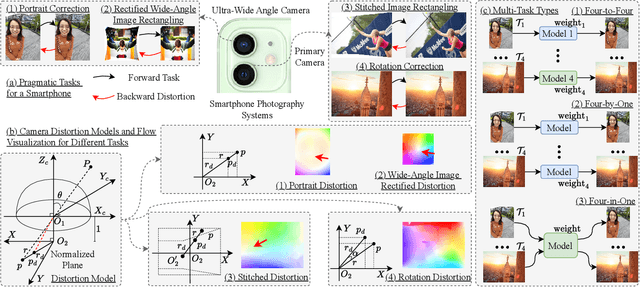
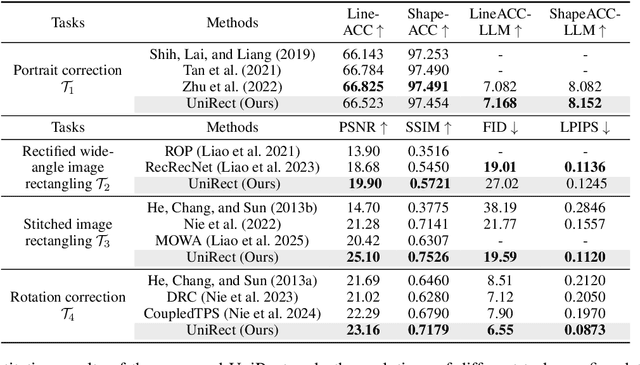
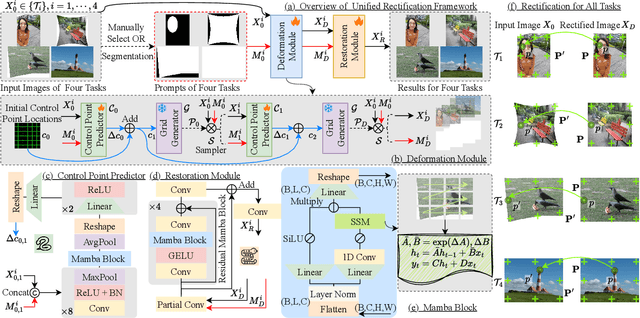
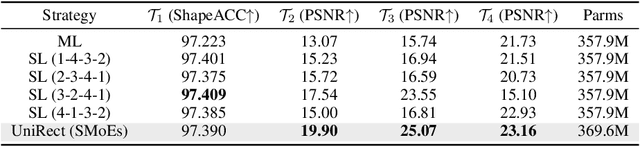
Image correction and rectangling are valuable tasks in practical photography systems such as smartphones. Recent remarkable advancements in deep learning have undeniably brought about substantial performance improvements in these fields. Nevertheless, existing methods mainly rely on task-specific architectures. This significantly restricts their generalization ability and effective application across a wide range of different tasks. In this paper, we introduce the Unified Rectification Framework (UniRect), a comprehensive approach that addresses these practical tasks from a consistent distortion rectification perspective. Our approach incorporates various task-specific inverse problems into a general distortion model by simulating different types of lenses. To handle diverse distortions, UniRect adopts one task-agnostic rectification framework with a dual-component structure: a {Deformation Module}, which utilizes a novel Residual Progressive Thin-Plate Spline (RP-TPS) model to address complex geometric deformations, and a subsequent Restoration Module, which employs Residual Mamba Blocks (RMBs) to counteract the degradation caused by the deformation process and enhance the fidelity of the output image. Moreover, a Sparse Mixture-of-Experts (SMoEs) structure is designed to circumvent heavy task competition in multi-task learning due to varying distortions. Extensive experiments demonstrate that our models have achieved state-of-the-art performance compared with other up-to-date methods.
Adapt CLIP as Aggregation Instructor for Image Dehazing
Aug 22, 2024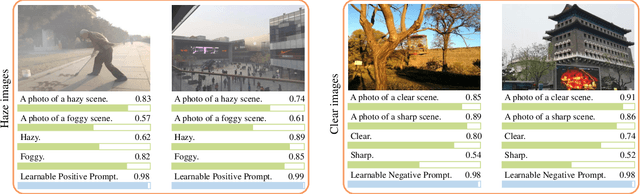
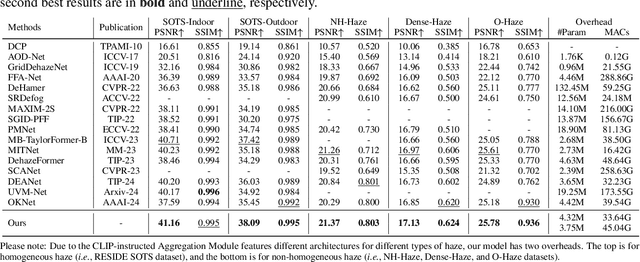
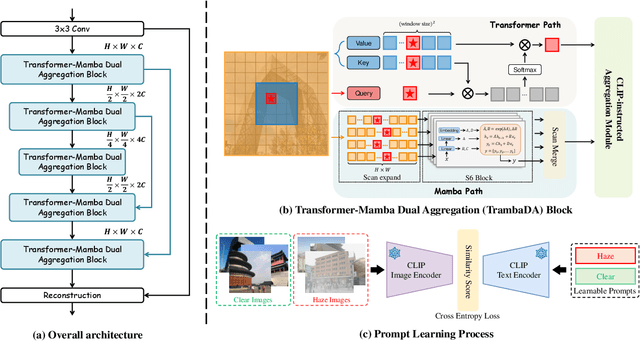
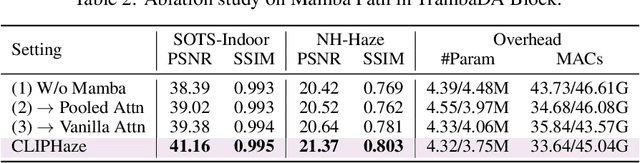
Most dehazing methods suffer from limited receptive field and do not explore the rich semantic prior encapsulated in vision-language models, which have proven effective in downstream tasks. In this paper, we introduce CLIPHaze, a pioneering hybrid framework that synergizes the efficient global modeling of Mamba with the prior knowledge and zero-shot capabilities of CLIP to address both issues simultaneously. Specifically, our method employs parallel state space model and window-based self-attention to obtain global contextual dependency and local fine-grained perception, respectively. To seamlessly aggregate information from both paths, we introduce CLIP-instructed Aggregation Module (CAM). For non-homogeneous and homogeneous haze, CAM leverages zero-shot estimated haze density map and high-quality image embedding without degradation information to explicitly and implicitly determine the optimal neural operation range for each pixel, thereby adaptively fusing two paths with different receptive fields. Extensive experiments on various benchmarks demonstrate that CLIPHaze achieves state-of-the-art (SOTA) performance, particularly in non-homogeneous haze. Code will be publicly after acceptance.