 Add to Chrome
 Add to Firefox
 Add to Edge
Automated Straight-line Sewing of Stretchable Fabrics with Different Lengths
Jul 31, 2026
Different Length Alignment Sewing (DLAS), which involves stretching the shorter fabric to match the longer one and sewing them together in a straight line, is a challenging task that needs to satisfy several requirements when automating the sewing process. To address the challenges, this research proposes a novel robotic sewing system, Different Length Robotic Sewing System (DLRoSS), which consists of a roller type end-effector, attached to a 6-DoF manipulator. The end-effector composed of active shorter and longer fabric rollers, and a passive press-roller attached to the shorter-fabric roller. Assuming that one end of the two fabric layers are initially positioned under the sewing machine's presser foot, the system automates DLAS by operating in four distinct phases. (P1) Fabric wrapping: Individual fabric layers are picked, held, and wrapped from the other end onto the feed rollers. (P2) Sewing: During the sewing, the shorter fabric is stretched and aligned with the longer fabric in real-time using roller velocity control based on the sewing speed and apriori known length ratio. (P3) Sewing completion: In the final sewing round on the fabric rollers, the press roller is engaged to prevent the stretched fabric from slipping off due to internal tension. (P4) Sewing fabric release: At the end of sewing, the fabric edge moves past the press roller, and the fabric releases from the rollers. Experimental results demonstrate that DLRoSS achieves consistent, high-quality sewing of stretchable fabrics of different materials and lengths.
* 9 pages. Published in IEEE Robotics and Automation Letters, 2025

Maximize the Foot Clearance for a Hopping Robotic Leg Considering Motor Saturation
Jul 30, 2021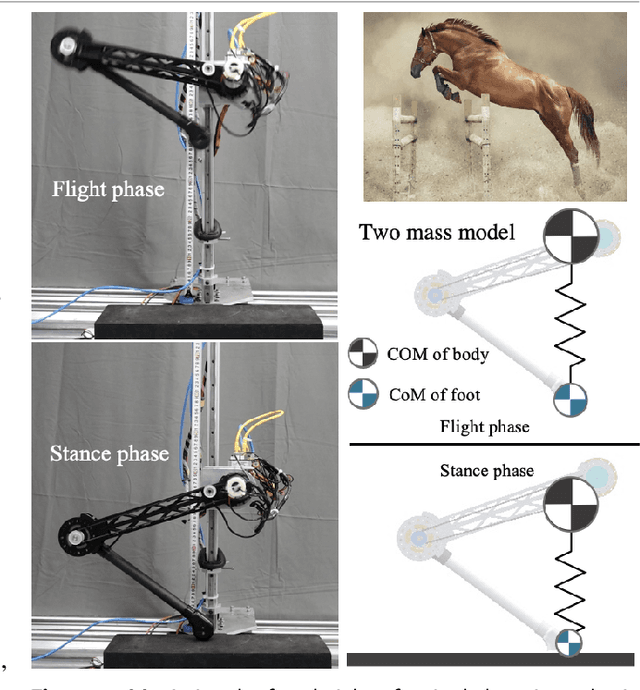
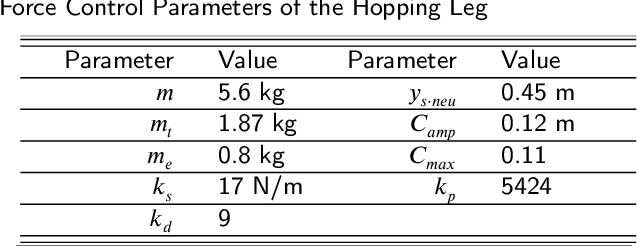
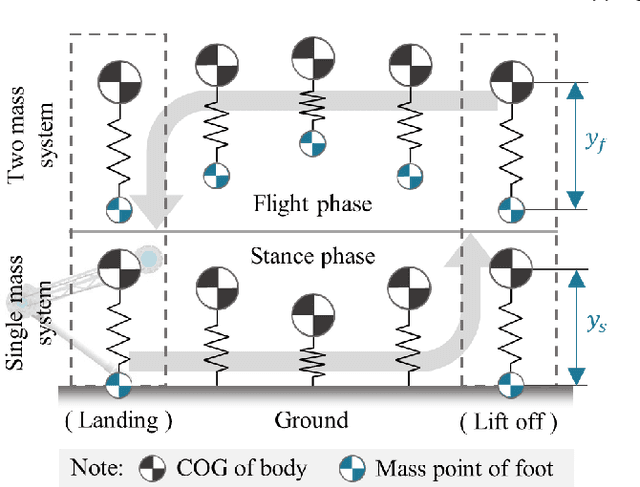
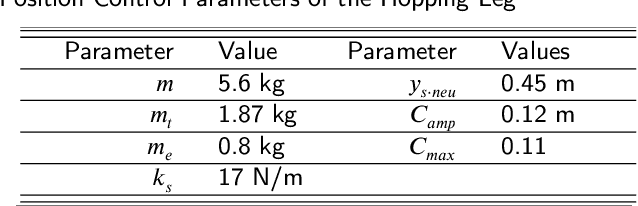
A hopping leg, no matter in legged animals or humans, usually behaves like a spring during the periodic hopping. Hopping like a spring is efficient and without the requirement of complicated control algorithms. Position and force control are two main methods to realize such a spring-like behaviour. The position control usually consumes the torque resources to ensure the position accuracy and compensate the tracking errors. In comparison, the force control strategy is able to maintain a high elasticity. Currently, the position and force control both leads to the discount of motor saturation ratio as well as the bandwidth of the control system, and thus attenuates the performance of the actuator. To augment the performance, this letter proposes a motor saturation strategy based on the force control to maximize the output torque of the actuator and realize the continuous hopping motion with natural dynamics. The proposed strategy is able to maximize the saturation ratio of motor and thus maximize the foot clearance of the single leg. The dynamics of the two-mass model is utilized to increase the force bandwidth and the performance of the actuator. A single leg with two degrees of freedom is designed as the experiment platform. The actuator consists of a powerful electric motor, a harmonic gear and encoder. The effectiveness of this method is verified through simulations and experiments using a robotic leg actuated by powerful high reduction ratio actuators.
High-Payload Online Identification and Adaptive Control for an Electrically-actuated Quadruped Robot
Jul 26, 2021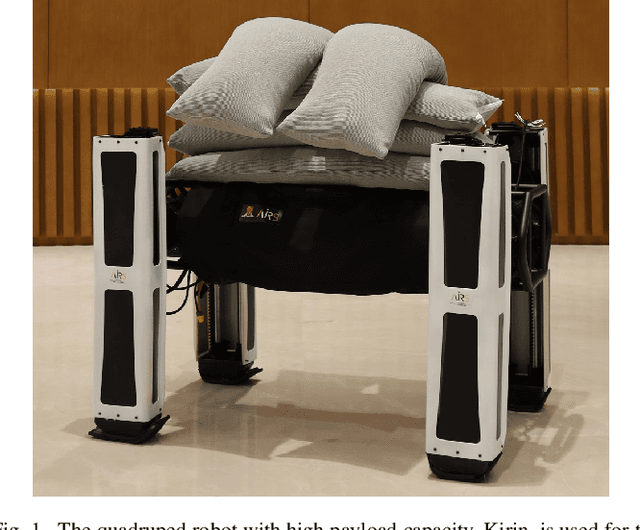
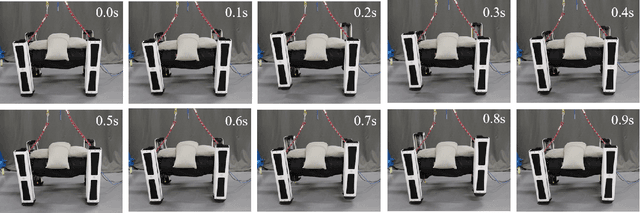
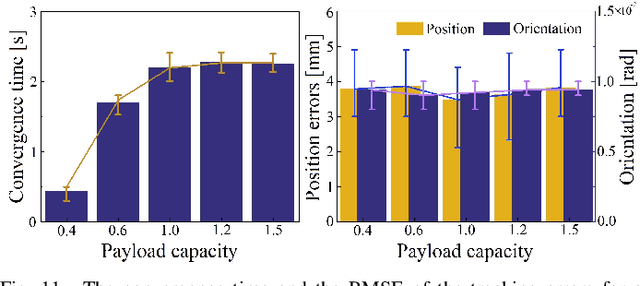
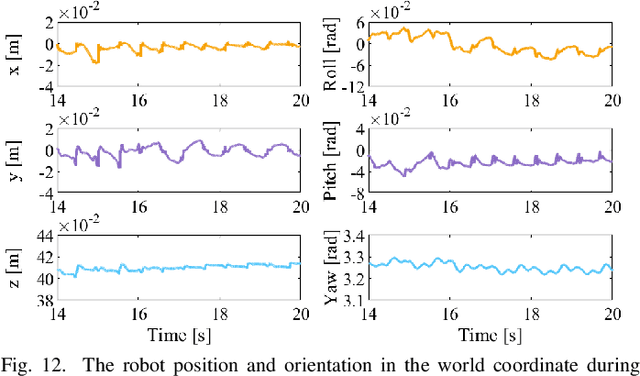
Quadruped robots manifest great potential to traverse rough terrains with payload. Numerous traditional control methods for legged dynamic locomotion are model-based and exhibit high sensitivity to model uncertainties and payload variations. Therefore, high-performance model parameter estimation becomes indispensable. However, the inertia parameters of payload are usually unknown and dynamically changing when the quadruped robot is deployed in versatile tasks. To address this problem, online identification of the inertia parameters and the Center of Mass (CoM) position of the payload for the quadruped robots draw an increasing interest. This study presents an adaptive controller based on the online payload identification for the high payload capacity (the ratio between payload and robot's self-weight) quadruped locomotion. We name it as Adaptive Controller for Quadruped Locomotion (ACQL), which consists of a recursive update law and a control law. ACQL estimates the external forces and torques induced by the payload online. The estimation is incorporated in inverse-dynamics-based Quadratic Programming (QP) to realize a trotting gait. As such, the tracking accuracy of the robot's CoM and orientation trajectories are improved. The proposed method, ACQL, is verified in a real quadruped robot platform. Experiments prove the estimation efficacy for the payload weighing from 20 kg to 75 kg and loaded at different locations of the robot's torso.