 Add to Chrome
 Add to Firefox
 Add to Edge
Efficient Dataset Selection for Continual Adaptation of Generative Recommenders
Apr 09, 2026
Recommendation systems must continuously adapt to evolving user behavior, yet the volume of data generated in large-scale streaming environments makes frequent full retraining impractical. This work investigates how targeted data selection can mitigate performance degradation caused by temporal distributional drift while maintaining scalability. We evaluate a range of representation choices and sampling strategies for curating small but informative subsets of user interaction data. Our results demonstrate that gradient-based representations, coupled with distribution-matching, improve downstream model performance, achieving training efficiency gains while preserving robustness to drift. These findings highlight data curation as a practical mechanism for scalable monitoring and adaptive model updates in production-scale recommendation systems.

Deploying Semantic ID-based Generative Retrieval for Large-Scale Podcast Discovery at Spotify
Mar 18, 2026Podcast listening is often grounded in a set of favorite shows, while listener intent can evolve over time. This combination of stable preferences and changing intent motivates recommendation approaches that support both familiarity and exploration. Traditional recommender systems typically emphasize long-term interaction patterns, and are less explicitly designed to incorporate rich contextual signals or flexible, intent-aware discovery objectives. In this setting, models that can jointly reason over semantics, context, and user state offer a promising direction. Large Language Models (LLMs) provide strong semantic reasoning and contextual conditioning for discovery-oriented recommendation, but deploying them in production introduces challenges in catalog grounding, user-level personalization, and latency-critical serving. We address these challenges with GLIDE, a production-scale generative recommender for podcast discovery at Spotify. GLIDE formulates recommendation as an instruction-following task over a discretized catalog using Semantic IDs, enabling grounded generation over a large inventory. The model conditions on recent listening history and lightweight user context, while injecting long-term user embeddings as soft prompts to capture stable preferences under strict inference constraints. We evaluate GLIDE using offline retrieval metrics, human judgments, and LLM-based evaluation, and validate its impact through large-scale online A/B testing. Across experiments involving millions of users, GLIDE increases non-habitual podcast streaming on Spotify home surface by up to 5.4% and new-show discovery by up to 14.3%, while meeting production cost and latency constraints.
B-Script: Transcript-based B-roll Video Editing with Recommendations
Feb 28, 2019

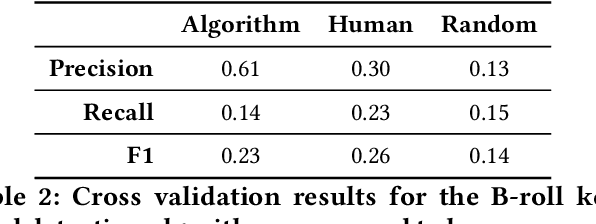
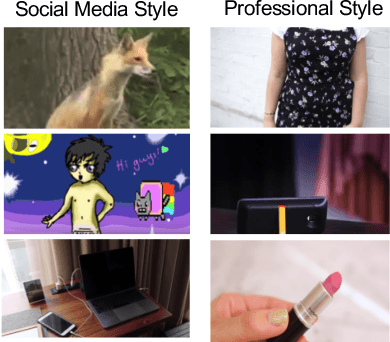
In video production, inserting B-roll is a widely used technique to enrich the story and make a video more engaging. However, determining the right content and positions of B-roll and actually inserting it within the main footage can be challenging, and novice producers often struggle to get both timing and content right. We present B-Script, a system that supports B-roll video editing via interactive transcripts. B-Script has a built-in recommendation system trained on expert-annotated data, recommending users B-roll position and content. To evaluate the system, we conducted a within-subject user study with 110 participants, and compared three interface variations: a timeline-based editor, a transcript-based editor, and a transcript-based editor with recommendations. Users found it easier and were faster to insert B-roll using the transcript-based interface, and they created more engaging videos when recommendations were provided.