 Add to Chrome
 Add to Firefox
 Add to Edge
Investigating Calibration Challenges in Probabilistic Electricity Price Forecasting
Jun 08, 2026
As renewable energy integration increases market volatility, probabilistic electricity price forecasting has become essential for effective risk management. However, current-proper-scoring rules often prioritize forecast sharpness at the expense of calibration, leading to overconfident and statistically unreliable uncertainty estimates. This work highlights the critical gap between theoretical scoring and practical calibration, demonstrating that models can become mere proxies for deterministic forecasts when reliability is neglected. We conclude that future research must shift toward calibration-aware objectives and architectures to ensure the distributional integrity of energy market forecasts.

Explainable Data-driven Deep Reinforcement Learning Methods for Optimal Energy Management in Buildings
Jun 01, 2026The increasing integration of renewable energy sources into power systems, particularly in buildings equipped with photovoltaic (PV) panels and energy storage systems, introduces significant complexity in energy systems. Volatile power generation, varying electricity tariffs, and increased entities, e.g., PV systems, and heat pumps, have increased the complexity and made the system harder to operate. This leads to the demand for additional control and optimization routes including data-based controls, such as reinforcement learning. While deep reinforcement learning (DRL) has emerged as a promising solution to optimize building operations in dynamic and ever more complex environments, its black-box nature impedes user trust and practical adoption. This paper presents a framework for explainable deep reinforcement learning (XRL) applied to energy management in residential buildings. We demonstrate its usage on both synthetic data but also on real-world data from the Living Lab Energy Campus (LLEC) at KIT. We train and compare both on-policy and off-policy DRL agents on an expanded state space that incorporates real-time measurements (demand, PV generation, battery power, state of charge), external signals (dynamic electricity price, local weather data), calendrical and holiday indicators, and forecasts for demand and price. Our experimental results indicate that on-policy algorithms, particularly Advantage Actor Critic (A2C) and Proximal Policy Optimization (PPO), outperform off-policy methods in terms of cumulative rewards and policy stability. To explain these models, we employ post-hoc interpretation techniques to elaborate the learned control policies. Our findings demonstrate that the XRL framework not only reduces electricity costs through optimal battery management, but also provides transparent, actionable insights into the agent's decision-making process.
BuilDyn: Excitation-Driven Data Generation for Building Thermal Dynamics Modeling and Control
May 28, 2026Machine learning (ML) is increasingly used for data-driven modeling of buildings to enable downstream tasks such as fault detection and diagnosis, and energy-efficient control. While recent work improves generalization across building characteristics, weather, and occupancy, generalization also depends on sufficient exploration of the control-driven system state space. Existing real-world datasets and simulation environments predominantly reflect stationary operation under fixed control policies, resulting in limited excitation and reduced robustness to unseen operating conditions. This paper introduces BuilDyn, a package based on BuilDa that enables customizable excitation strategies for control-oriented data generation. BuilDyn further supports sampling from representative building distributions and provides a Python interface for easy integration into machine learning pipelines. We demonstrate the benefits of BuilDyn by comparing the performance of data-driven ML models trained on non-excited and excited data for one building. With BuilDyn, we hope to advance scalable control-oriented modeling and support future directions such as transfer learning and building-specific foundation models.
Assessing the Performance-Efficiency Trade-off of Foundation Models in Probabilistic Electricity Price Forecasting
Apr 16, 2026Large-scale renewable energy deployment introduces pronounced volatility into the electricity system, turning grid operation into a complex stochastic optimization problem. Accurate electricity price forecasting (EPF) is essential not only to support operational decisions, such as optimal bidding strategies and balancing power preparation, but also to reduce economic risk and improve market efficiency. Probabilistic forecasts are particularly valuable because they quantify uncertainty stemming from renewable intermittency, market coupling, and regulatory changes, enabling market participants to make informed decisions that minimize losses and optimize expected revenues. However, it remains an open question which models to employ to produce accurate forecasts. Should these be task-specific machine learning (ML) models or Time Series Foundation Models (TSFMs)? In this work, we compare four models for day-ahead probabilistic EPF (PEPF) in European bidding zones: a deterministic NHITS backbone with Quantile-Regression Averaging (NHITS+QRA) and a conditional Normalizing-Flow forecaster (NF) are compared with two TSFMs, namely Moirai and ChronosX. On the one hand, we find that TSFMs outperform task-specific deep learning models trained from scratch in terms of CRPS, Energy Score, and predictive interval calibration across market conditions. On the other hand, we find that well-configured task-specific models, particularly NHITS combined with QRA, achieve performance very close to TSFMs, and in some scenarios, such as when supplied with additional informative feature groups or adapted via few-shot learning from other European markets, they can even surpass TSFMs. Overall, our findings show that while TSFMs offer expressive modeling capabilities, conventional models remain highly competitive, emphasizing the need to weigh computational expense against marginal performance improvements in PEPF.
Explainable time-series forecasting with sampling-free SHAP for Transformers
Dec 23, 2025
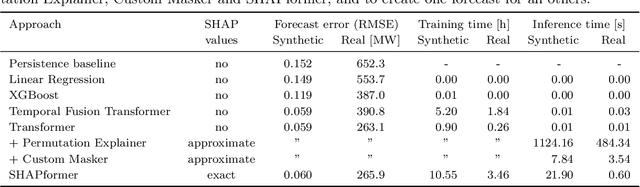
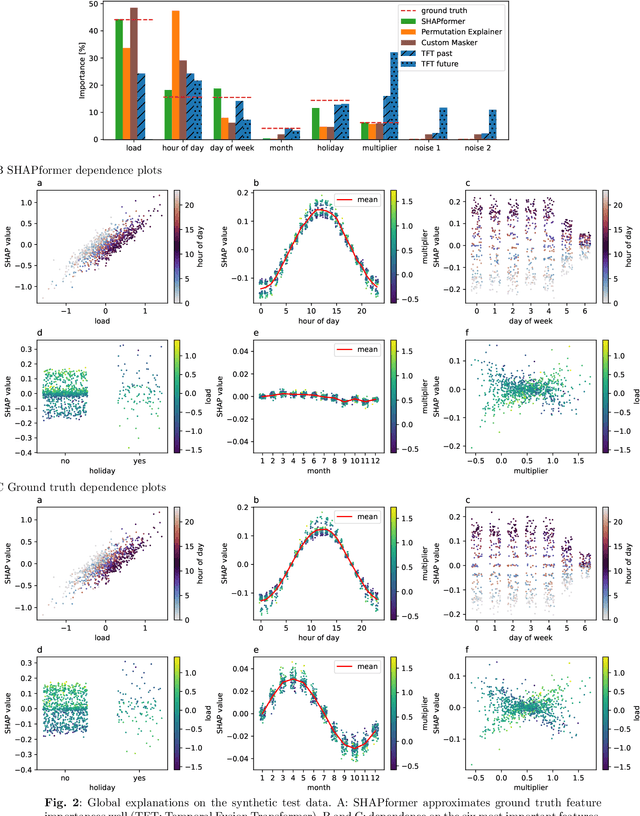
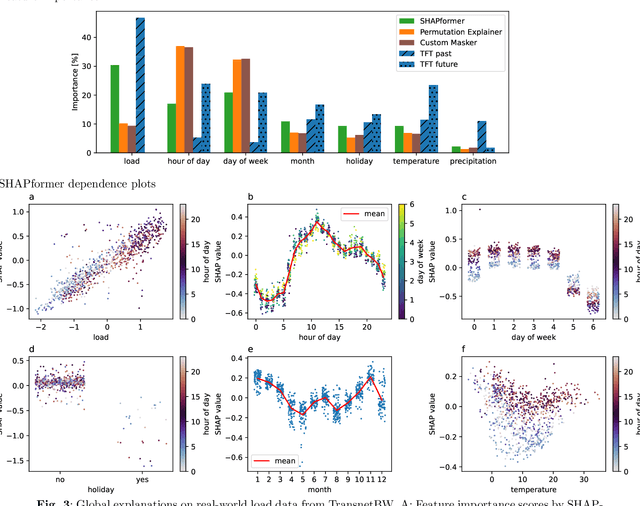
Time-series forecasts are essential for planning and decision-making in many domains. Explainability is key to building user trust and meeting transparency requirements. Shapley Additive Explanations (SHAP) is a popular explainable AI framework, but it lacks efficient implementations for time series and often assumes feature independence when sampling counterfactuals. We introduce SHAPformer, an accurate, fast and sampling-free explainable time-series forecasting model based on the Transformer architecture. It leverages attention manipulation to make predictions based on feature subsets. SHAPformer generates explanations in under one second, several orders of magnitude faster than the SHAP Permutation Explainer. On synthetic data with ground truth explanations, SHAPformer provides explanations that are true to the data. Applied to real-world electrical load data, it achieves competitive predictive performance and delivers meaningful local and global insights, such as identifying the past load as the key predictor and revealing a distinct model behavior during the Christmas period.
Analyzing Spatio-Temporal Dynamics of Dissolved Oxygen for the River Thames using Superstatistical Methods and Machine Learning
Jan 10, 2025By employing superstatistical methods and machine learning, we analyze time series data of water quality indicators for the River Thames, with a specific focus on the dynamics of dissolved oxygen. After detrending, the probability density functions of dissolved oxygen fluctuations exhibit heavy tails that are effectively modeled using $q$-Gaussian distributions. Our findings indicate that the multiplicative Empirical Mode Decomposition method stands out as the most effective detrending technique, yielding the highest log-likelihood in nearly all fittings. We also observe that the optimally fitted width parameter of the $q$-Gaussian shows a negative correlation with the distance to the sea, highlighting the influence of geographical factors on water quality dynamics. In the context of same-time prediction of dissolved oxygen, regression analysis incorporating various water quality indicators and temporal features identify the Light Gradient Boosting Machine as the best model. SHapley Additive exPlanations reveal that temperature, pH, and time of year play crucial roles in the predictions. Furthermore, we use the Transformer to forecast dissolved oxygen concentrations. For long-term forecasting, the Informer model consistently delivers superior performance, achieving the lowest MAE and SMAPE with the 192 historical time steps that we used. This performance is attributed to the Informer's ProbSparse self-attention mechanism, which allows it to capture long-range dependencies in time-series data more effectively than other machine learning models. It effectively recognizes the half-life cycle of dissolved oxygen, with particular attention to key intervals. Our findings provide valuable insights for policymakers involved in ecological health assessments, aiding in accurate predictions of river water quality and the maintenance of healthy aquatic ecosystems.
Why Reinforcement Learning in Energy Systems Needs Explanations
May 29, 2024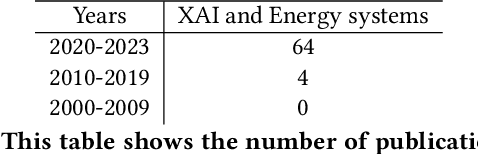
With economic development, the complexity of infrastructure has increased drastically. Similarly, with the shift from fossil fuels to renewable sources of energy, there is a dire need for such systems that not only predict and forecast with accuracy but also help in understanding the process of predictions. Artificial intelligence and machine learning techniques have helped in finding out wellperforming solutions to different problems in the energy sector. However, the usage of state-of-the-art techniques like reinforcement learning is not surprisingly convincing. This paper discusses the application of reinforcement techniques in energy systems and how explanations of these models can be helpful
An Explainable Framework for Machine learning-Based Reactive Power Optimization of Distribution Network
Nov 07, 2023


To reduce the heavy computational burden of reactive power optimization of distribution networks, machine learning models are receiving increasing attention. However, most machine learning models (e.g., neural networks) are usually considered as black boxes, making it challenging for power system operators to identify and comprehend potential biases or errors in the decision-making process of machine learning models. To address this issue, an explainable machine-learning framework is proposed to optimize the reactive power in distribution networks. Firstly, a Shapley additive explanation framework is presented to measure the contribution of each input feature to the solution of reactive power optimizations generated from machine learning models. Secondly, a model-agnostic approximation method is developed to estimate Shapley values, so as to avoid the heavy computational burden associated with direct calculations of Shapley values. The simulation results show that the proposed explainable framework can accurately explain the solution of the machine learning model-based reactive power optimization by using visual analytics, from both global and instance perspectives. Moreover, the proposed explainable framework is model-agnostic, and thus applicable to various models (e.g., neural networks).
Probabilistic Forecasting of Day-Ahead Electricity Prices and their Volatility with LSTMs
Oct 05, 2023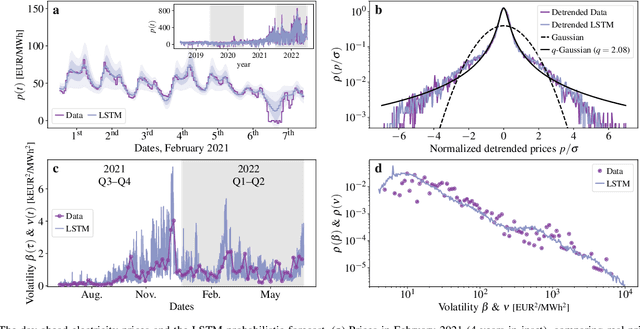
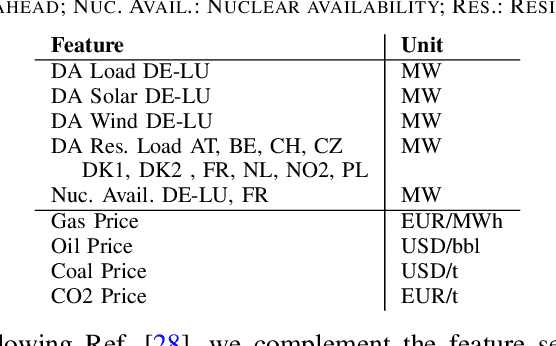
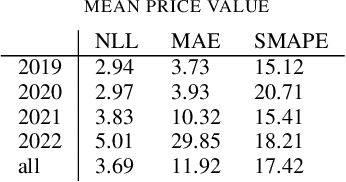
Accurate forecasts of electricity prices are crucial for the management of electric power systems and the development of smart applications. European electricity prices have risen substantially and became highly volatile after the Russian invasion of Ukraine, challenging established forecasting methods. Here, we present a Long Short-Term Memory (LSTM) model for the German-Luxembourg day-ahead electricity prices addressing these challenges. The recurrent structure of the LSTM allows the model to adapt to trends, while the joint prediction of both mean and standard deviation enables a probabilistic prediction. Using a physics-inspired approach - superstatistics - to derive an explanation for the statistics of prices, we show that the LSTM model faithfully reproduces both prices and their volatility.
Transformer Training Strategies for Forecasting Multiple Load Time Series
Jun 19, 2023Recent work uses Transformers for load forecasting, which are the state of the art for sequence modeling tasks in data-rich domains. In the smart grid of the future, accurate load forecasts must be provided on the level of individual clients of an energy supplier. While the total amount of electrical load data available to an energy supplier will increase with the ongoing smart meter rollout, the amount of data per client will always be limited. We test whether the Transformer benefits from a transfer learning strategy, where a global model is trained on the load time series data from multiple clients. We find that the global model is superior to two other training strategies commonly used in related work: multivariate models and local models. A comparison to linear models and multi-layer perceptrons shows that Transformers are effective for electrical load forecasting when they are trained with the right strategy.