 Add to Chrome
 Add to Firefox
 Add to Edge
Dear Algo: A Precision-First Agentic Intent Layer for Unified Search and Recommendation
Aug 16, 2026
Search and recommendation serve a shared discovery objective but encode intent differently. We study this boundary through Dear Algo on Threads, a deployed product where open-ended requests such as \emph{more NBA news} or \emph{less politics} steer subsequent feed recommendations rather than return a one-shot result list. Its agentic intent layer compiles explicit, inferred, negative, and compound intent into a grounded executable plan, then invokes conventional retrieval and optional semantic or multimodal reranking. The layer shares an intent-to-retrieval contract without requiring one model or serving path across search-like and recommendation-like modes. We evaluate Dear Algo under a precision-first objective. In a blinded audit of 300 public request-item pairs (296 evaluable), a strict categorical LLM-as-a-judge gate achieved 94.4\% exact-Relevant precision [88.8\%, 98.9\%]. Across 72 normalized request clusters, the full configuration produced 7.73 judge-qualified candidates per 20 slots versus 6.61 for an LLM-derived-query baseline, a gain of 1.11 [0.12, 2.12]. In a candidate-randomized serving-path study restricted to the reranker path's first 72 eligible hours, the user-weighted judge-Irrelevant share among judged admissions was 2.80\% versus 4.78\% off (-1.97 points [-3.02, -0.94]), while Exact-Relevant share was 2.24 points higher [0.08, 4.41]. Together, these studies show how explicit natural-language intent can be carried into feed recommendation under a precision-first evaluation framework

Predicting Parameters in Deep Learning
Oct 27, 2014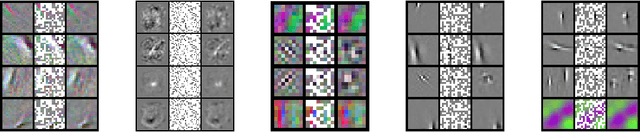
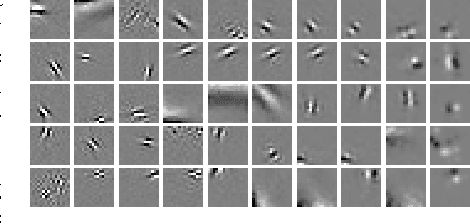
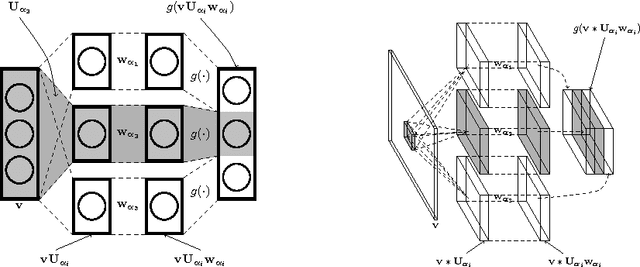
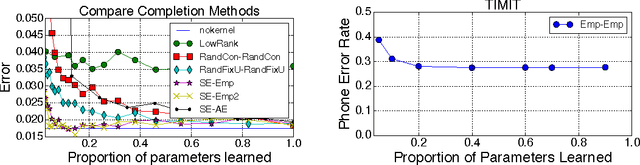
We demonstrate that there is significant redundancy in the parameterization of several deep learning models. Given only a few weight values for each feature it is possible to accurately predict the remaining values. Moreover, we show that not only can the parameter values be predicted, but many of them need not be learned at all. We train several different architectures by learning only a small number of weights and predicting the rest. In the best case we are able to predict more than 95% of the weights of a network without any drop in accuracy.
Bayesian Multi-Scale Optimistic Optimization
Feb 27, 2014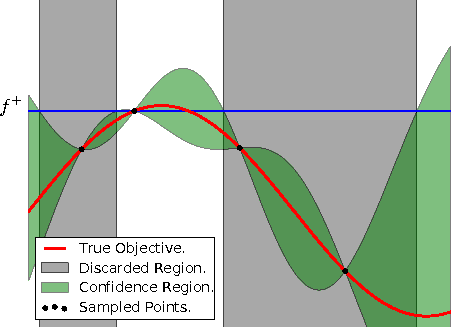

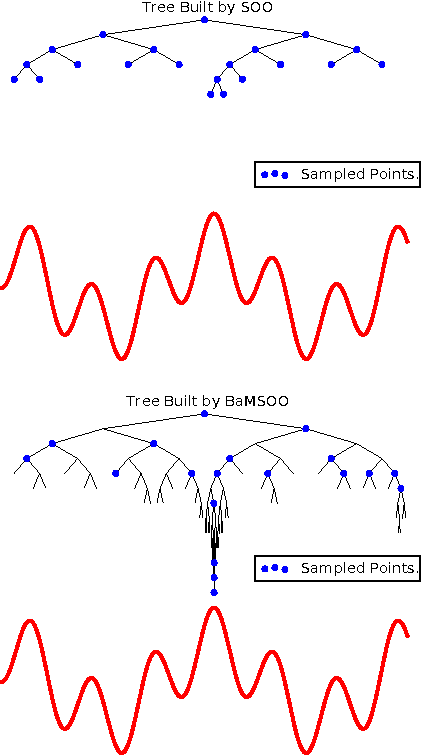
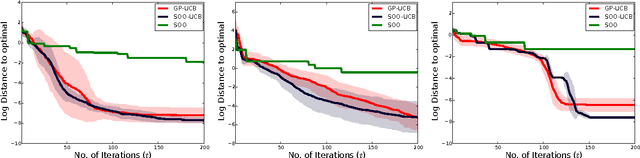
Bayesian optimization is a powerful global optimization technique for expensive black-box functions. One of its shortcomings is that it requires auxiliary optimization of an acquisition function at each iteration. This auxiliary optimization can be costly and very hard to carry out in practice. Moreover, it creates serious theoretical concerns, as most of the convergence results assume that the exact optimum of the acquisition function can be found. In this paper, we introduce a new technique for efficient global optimization that combines Gaussian process confidence bounds and treed simultaneous optimistic optimization to eliminate the need for auxiliary optimization of acquisition functions. The experiments with global optimization benchmarks and a novel application to automatic information extraction demonstrate that the resulting technique is more efficient than the two approaches from which it draws inspiration. Unlike most theoretical analyses of Bayesian optimization with Gaussian processes, our finite-time convergence rate proofs do not require exact optimization of an acquisition function. That is, our approach eliminates the unsatisfactory assumption that a difficult, potentially NP-hard, problem has to be solved in order to obtain vanishing regret rates.