 Add to Chrome
 Add to Firefox
 Add to Edge
Integrating Explainable Machine Learning and Mixed-Integer Optimization for Personalized Sleep Quality Intervention
Mar 14, 2026
Sleep quality is influenced by a complex interplay of behavioral, environmental, and psychosocial factors, yet most computational studies focus mainly on predictive risk identification rather than actionable intervention design. Although machine learning models can accurately predict subjective sleep outcomes, they rarely translate predictive insights into practical intervention strategies. To address this gap, we propose a personalized predictive-prescriptive framework that integrates interpretable machine learning with mixed-integer optimization. A supervised classifier trained on survey data predicts sleep quality, while SHAP-based feature attribution quantifies the influence of modifiable factors. These importance measures are incorporated into a mixed-integer optimization model that identifies minimal and feasible behavioral adjustments, while modelling resistance to change through a penalty mechanism. The framework achieves strong predictive performance, with a test F1-score of 0.9544 and an accuracy of 0.9366. Sensitivity and Pareto analyses reveal a clear trade-off between expected improvement and intervention intensity, with diminishing returns as additional changes are introduced. At the individual level, the model generates concise recommendations, often suggesting one or two high-impact behavioral adjustments and sometimes recommending no change when expected gains are minimal. By integrating prediction, explanation, and constrained optimization, this framework demonstrates how data-driven insights can be translated into structured and personalized decision support for sleep improvement.

ST-ResGAT: Explainable Spatio-Temporal Graph Neural Network for Road Condition Prediction and Priority-Driven Maintenance
Mar 14, 2026Climate-vulnerable road networks require a paradigm shift from reactive, fix-on-failure repairs to predictive, decision-ready maintenance. This paper introduces ST-ResGAT, a novel Spatio-Temporal Residual Graph Attention Network that fuses residual graph-attention encoding with GRU temporal aggregation to forecast pavement deterioration. Engineered for resource-constrained deployment, the framework translates continuous Pavement Condition Index (PCI) forecasts directly into the American Society for Testing and Materials (ASTM)-compliant maintenance priorities. Using a real-world inspection dataset of 750 segments in Sylhet, Bangladesh (2021-2024), ST-ResGAT significantly outperforms traditional non-spatial machine learning baselines, achieving exceptional predictive fidelity (R2 = 0.93, RMSE = 2.72). Crucially, ablation testing confirmed the mathematical necessity of modeling topological neighbor effects, proving that structural decay acts as a spatial contagion. Uniquely, we integrate GNNExplainer to unbox the model, demonstrating that its learned priorities align perfectly with established physical engineering theory. Furthermore, we quantify classification safety: achieving 85.5% exact ASTM class agreement and 100% adjacent-class containment, ensuring bounded, engineer-safe predictions. To connect model outputs to policy, we generate localized longitudinal maintenance profiles, perform climate stress-testing, and derive Pareto sustainability frontiers. ST-ResGAT therefore offers a practical, explainable, and sustainable blueprint for intelligent infrastructure management in high-risk, low-resource geological settings.
SpatiaLab: Can Vision-Language Models Perform Spatial Reasoning in the Wild?
Feb 03, 2026Spatial reasoning is a fundamental aspect of human cognition, yet it remains a major challenge for contemporary vision-language models (VLMs). Prior work largely relied on synthetic or LLM-generated environments with limited task designs and puzzle-like setups, failing to capture the real-world complexity, visual noise, and diverse spatial relationships that VLMs encounter. To address this, we introduce SpatiaLab, a comprehensive benchmark for evaluating VLMs' spatial reasoning in realistic, unconstrained contexts. SpatiaLab comprises 1,400 visual question-answer pairs across six major categories: Relative Positioning, Depth & Occlusion, Orientation, Size & Scale, Spatial Navigation, and 3D Geometry, each with five subcategories, yielding 30 distinct task types. Each subcategory contains at least 25 questions, and each main category includes at least 200 questions, supporting both multiple-choice and open-ended evaluation. Experiments across diverse state-of-the-art VLMs, including open- and closed-source models, reasoning-focused, and specialized spatial reasoning models, reveal a substantial gap in spatial reasoning capabilities compared with humans. In the multiple-choice setup, InternVL3.5-72B achieves 54.93% accuracy versus 87.57% for humans. In the open-ended setting, all models show a performance drop of around 10-25%, with GPT-5-mini scoring highest at 40.93% versus 64.93% for humans. These results highlight key limitations in handling complex spatial relationships, depth perception, navigation, and 3D geometry. By providing a diverse, real-world evaluation framework, SpatiaLab exposes critical challenges and opportunities for advancing VLMs' spatial reasoning, offering a benchmark to guide future research toward robust, human-aligned spatial understanding. SpatiaLab is available at: https://spatialab-reasoning.github.io/.
CommonLID: Re-evaluating State-of-the-Art Language Identification Performance on Web Data
Jan 25, 2026Language identification (LID) is a fundamental step in curating multilingual corpora. However, LID models still perform poorly for many languages, especially on the noisy and heterogeneous web data often used to train multilingual language models. In this paper, we introduce CommonLID, a community-driven, human-annotated LID benchmark for the web domain, covering 109 languages. Many of the included languages have been previously under-served, making CommonLID a key resource for developing more representative high-quality text corpora. We show CommonLID's value by using it, alongside five other common evaluation sets, to test eight popular LID models. We analyse our results to situate our contribution and to provide an overview of the state of the art. In particular, we highlight that existing evaluations overestimate LID accuracy for many languages in the web domain. We make CommonLID and the code used to create it available under an open, permissive license.
Kaleidoscope: In-language Exams for Massively Multilingual Vision Evaluation
Apr 09, 2025The evaluation of vision-language models (VLMs) has mainly relied on English-language benchmarks, leaving significant gaps in both multilingual and multicultural coverage. While multilingual benchmarks have expanded, both in size and languages, many rely on translations of English datasets, failing to capture cultural nuances. In this work, we propose Kaleidoscope, as the most comprehensive exam benchmark to date for the multilingual evaluation of vision-language models. Kaleidoscope is a large-scale, in-language multimodal benchmark designed to evaluate VLMs across diverse languages and visual inputs. Kaleidoscope covers 18 languages and 14 different subjects, amounting to a total of 20,911 multiple-choice questions. Built through an open science collaboration with a diverse group of researchers worldwide, Kaleidoscope ensures linguistic and cultural authenticity. We evaluate top-performing multilingual vision-language models and find that they perform poorly on low-resource languages and in complex multimodal scenarios. Our results highlight the need for progress on culturally inclusive multimodal evaluation frameworks.
Preserving Cultural Identity with Context-Aware Translation Through Multi-Agent AI Systems
Mar 05, 2025Language is a cornerstone of cultural identity, yet globalization and the dominance of major languages have placed nearly 3,000 languages at risk of extinction. Existing AI-driven translation models prioritize efficiency but often fail to capture cultural nuances, idiomatic expressions, and historical significance, leading to translations that marginalize linguistic diversity. To address these challenges, we propose a multi-agent AI framework designed for culturally adaptive translation in underserved language communities. Our approach leverages specialized agents for translation, interpretation, content synthesis, and bias evaluation, ensuring that linguistic accuracy and cultural relevance are preserved. Using CrewAI and LangChain, our system enhances contextual fidelity while mitigating biases through external validation. Comparative analysis shows that our framework outperforms GPT-4o, producing contextually rich and culturally embedded translations, a critical advancement for Indigenous, regional, and low-resource languages. This research underscores the potential of multi-agent AI in fostering equitable, sustainable, and culturally sensitive NLP technologies, aligning with the AI Governance, Cultural NLP, and Sustainable NLP pillars of Language Models for Underserved Communities. Our full experimental codebase is publicly available at: https://github.com/ciol-researchlab/Context-Aware_Translation_MAS
IITR-CIOL@NLU of Devanagari Script Languages 2025: Multilingual Hate Speech Detection and Target Identification in Devanagari-Scripted Languages
Dec 23, 2024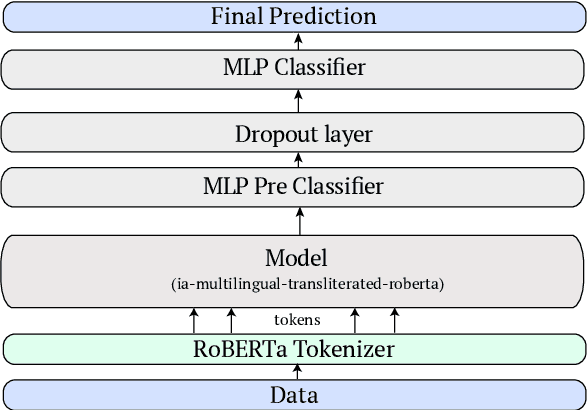
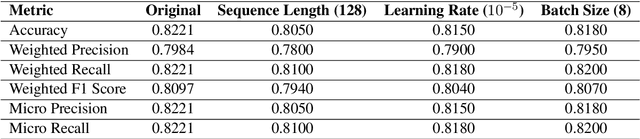
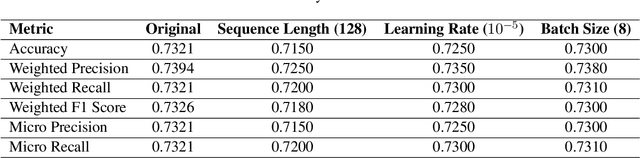
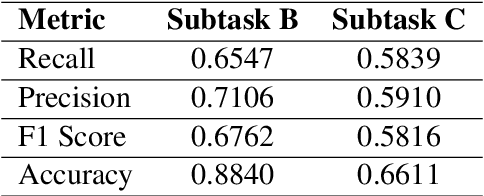
This work focuses on two subtasks related to hate speech detection and target identification in Devanagari-scripted languages, specifically Hindi, Marathi, Nepali, Bhojpuri, and Sanskrit. Subtask B involves detecting hate speech in online text, while Subtask C requires identifying the specific targets of hate speech, such as individuals, organizations, or communities. We propose the MultilingualRobertaClass model, a deep neural network built on the pretrained multilingual transformer model ia-multilingual-transliterated-roberta, optimized for classification tasks in multilingual and transliterated contexts. The model leverages contextualized embeddings to handle linguistic diversity, with a classifier head for binary classification. We received 88.40% accuracy in Subtask B and 66.11% accuracy in Subtask C, in the test set.
INCLUDE: Evaluating Multilingual Language Understanding with Regional Knowledge
Nov 29, 2024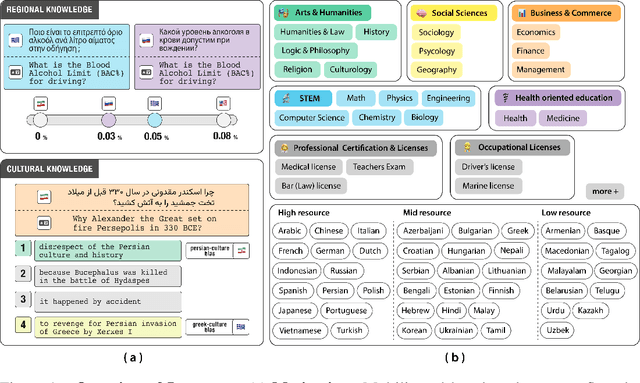
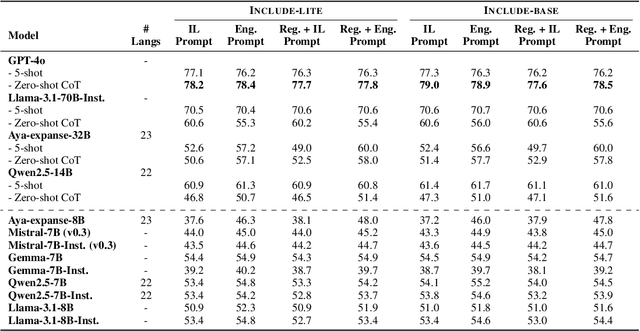
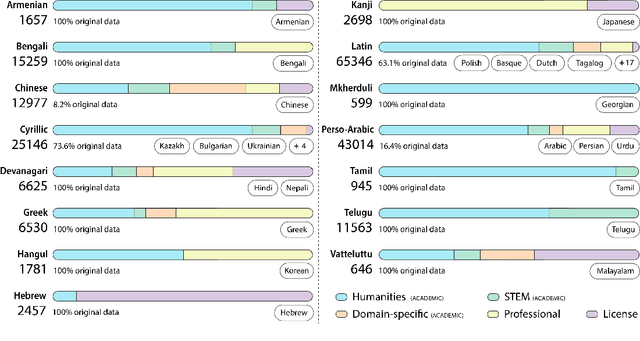

The performance differential of large language models (LLM) between languages hinders their effective deployment in many regions, inhibiting the potential economic and societal value of generative AI tools in many communities. However, the development of functional LLMs in many languages (\ie, multilingual LLMs) is bottlenecked by the lack of high-quality evaluation resources in languages other than English. Moreover, current practices in multilingual benchmark construction often translate English resources, ignoring the regional and cultural knowledge of the environments in which multilingual systems would be used. In this work, we construct an evaluation suite of 197,243 QA pairs from local exam sources to measure the capabilities of multilingual LLMs in a variety of regional contexts. Our novel resource, INCLUDE, is a comprehensive knowledge- and reasoning-centric benchmark across 44 written languages that evaluates multilingual LLMs for performance in the actual language environments where they would be deployed.
Graph Neural Networks in Supply Chain Analytics and Optimization: Concepts, Perspectives, Dataset and Benchmarks
Nov 13, 2024Graph Neural Networks (GNNs) have recently gained traction in transportation, bioinformatics, language and image processing, but research on their application to supply chain management remains limited. Supply chains are inherently graph-like, making them ideal for GNN methodologies, which can optimize and solve complex problems. The barriers include a lack of proper conceptual foundations, familiarity with graph applications in SCM, and real-world benchmark datasets for GNN-based supply chain research. To address this, we discuss and connect supply chains with graph structures for effective GNN application, providing detailed formulations, examples, mathematical definitions, and task guidelines. Additionally, we present a multi-perspective real-world benchmark dataset from a leading FMCG company in Bangladesh, focusing on supply chain planning. We discuss various supply chain tasks using GNNs and benchmark several state-of-the-art models on homogeneous and heterogeneous graphs across six supply chain analytics tasks. Our analysis shows that GNN-based models consistently outperform statistical Machine Learning and other Deep Learning models by around 10-30% in regression, 10-30% in classification and detection tasks, and 15-40% in anomaly detection tasks on designated metrics. With this work, we lay the groundwork for solving supply chain problems using GNNs, supported by conceptual discussions, methodological insights, and a comprehensive dataset.
Balancing Power and Ethics: A Framework for Addressing Human Rights Concerns in Military AI
Nov 10, 2024AI has made significant strides recently, leading to various applications in both civilian and military sectors. The military sees AI as a solution for developing more effective and faster technologies. While AI offers benefits like improved operational efficiency and precision targeting, it also raises serious ethical and legal concerns, particularly regarding human rights violations. Autonomous weapons that make decisions without human input can threaten the right to life and violate international humanitarian law. To address these issues, we propose a three-stage framework (Design, In Deployment, and During/After Use) for evaluating human rights concerns in the design, deployment, and use of military AI. Each phase includes multiple components that address various concerns specific to that phase, ranging from bias and regulatory issues to violations of International Humanitarian Law. By this framework, we aim to balance the advantages of AI in military operations with the need to protect human rights.
* Accepted for oral (only 3 papers are selected!) Harms and Risks of AI in the Military Workshop (HRAIM 2024) at Mila Quebec (https://www.harms-risks-ai-military.org/accepted-abstracts.html#:~:text=Balancing%20Power%20and%20Ethics)