 Add to Chrome
 Add to Firefox
 Add to Edge
Feature-Aware Anisotropic Local Differential Privacy for Utility-Preserving Graph Representation Learning in Metal Additive Manufacturing
Apr 06, 2026
Metal additive manufacturing (AM) enables the fabrication of safety-critical components, but reliable quality assurance depends on high-fidelity sensor streams containing proprietary process information, limiting collaborative data sharing. Existing defect-detection models typically treat melt-pool observations as independent samples, ignoring layer-wise physical couplings. Moreover, conventional privacy-preserving techniques, particularly Local Differential Privacy (LDP), lead to severe utility degradation because they inject uniform noise across all feature dimensions. To address these interrelated challenges, we propose FI-LDP-HGAT. This computational framework combines two methodological components: a stratified Hierarchical Graph Attention Network (HGAT) that captures spatial and thermal dependencies across scan tracks and deposited layers, and a feature-importance-aware anisotropic Gaussian mechanism (FI-LDP) for non-interactive feature privatization. Unlike isotropic LDP, FI-LDP redistributes the privacy budget across embedding coordinates using an encoder-derived importance prior, assigning lower noise to task-critical thermal signatures and higher noise to redundant dimensions while maintaining formal LDP guarantees. Experiments on a Directed Energy Deposition (DED) porosity dataset demonstrate that FI-LDP-HGAT achieves 81.5% utility recovery at a moderate privacy budget (epsilon = 4) and maintains defect recall of 0.762 under strict privacy (epsilon = 2), while outperforming classical ML, standard GNNs, and alternative privacy mechanisms, including DP-SGD across all evaluated metrics. Mechanistic analysis confirms a strong negative correlation (Spearman = -0.81) between feature importance and noise magnitude, providing interpretable evidence that the privacy-utility gains are driven by principled anisotropic allocation.

Graph Neural Networks in Supply Chain Analytics and Optimization: Concepts, Perspectives, Dataset and Benchmarks
Nov 13, 2024Graph Neural Networks (GNNs) have recently gained traction in transportation, bioinformatics, language and image processing, but research on their application to supply chain management remains limited. Supply chains are inherently graph-like, making them ideal for GNN methodologies, which can optimize and solve complex problems. The barriers include a lack of proper conceptual foundations, familiarity with graph applications in SCM, and real-world benchmark datasets for GNN-based supply chain research. To address this, we discuss and connect supply chains with graph structures for effective GNN application, providing detailed formulations, examples, mathematical definitions, and task guidelines. Additionally, we present a multi-perspective real-world benchmark dataset from a leading FMCG company in Bangladesh, focusing on supply chain planning. We discuss various supply chain tasks using GNNs and benchmark several state-of-the-art models on homogeneous and heterogeneous graphs across six supply chain analytics tasks. Our analysis shows that GNN-based models consistently outperform statistical Machine Learning and other Deep Learning models by around 10-30% in regression, 10-30% in classification and detection tasks, and 15-40% in anomaly detection tasks on designated metrics. With this work, we lay the groundwork for solving supply chain problems using GNNs, supported by conceptual discussions, methodological insights, and a comprehensive dataset.
Exploring Possibilities of AI-Powered Legal Assistance in Bangladesh through Large Language Modeling
Oct 22, 2024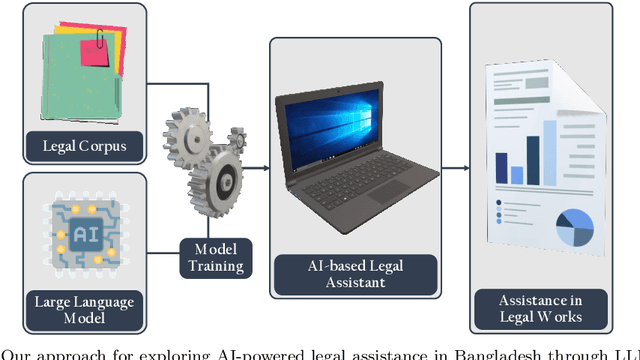
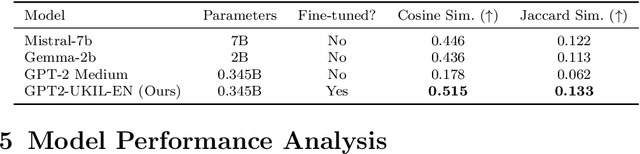
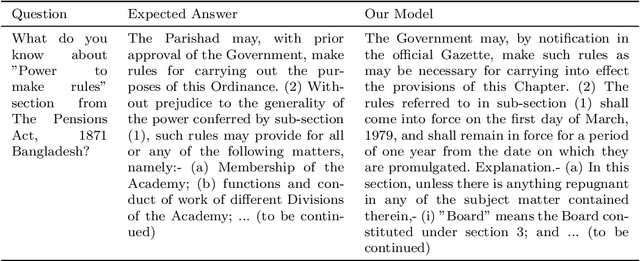
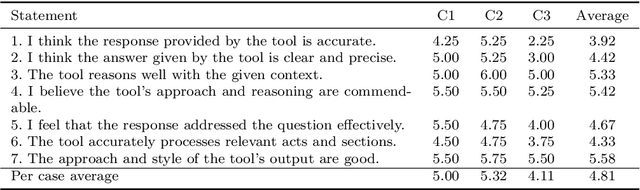
Purpose: Bangladesh's legal system struggles with major challenges like delays, complexity, high costs, and millions of unresolved cases, which deter many from pursuing legal action due to lack of knowledge or financial constraints. This research seeks to develop a specialized Large Language Model (LLM) to assist in the Bangladeshi legal system. Methods: We created UKIL-DB-EN, an English corpus of Bangladeshi legal documents, by collecting and scraping data on various legal acts. We fine-tuned the GPT-2 model on this dataset to develop GPT2-UKIL-EN, an LLM focused on providing legal assistance in English. Results: The model was rigorously evaluated using semantic assessments, including case studies supported by expert opinions. The evaluation provided promising results, demonstrating the potential for the model to assist in legal matters within Bangladesh. Conclusion: Our work represents the first structured effort toward building an AI-based legal assistant for Bangladesh. While the results are encouraging, further refinements are necessary to improve the model's accuracy, credibility, and safety. This is a significant step toward creating a legal AI capable of serving the needs of a population of 180 million.