 Add to Chrome
 Add to Firefox
 Add to Edge
Z-FLoc: Zero-Shot Floorplan Localization via Geometric Primitives
Jun 03, 2026
Visual localization -- estimating a camera pose within a pre-existing map -- is a fundamental problem in computer vision. Floorplans are an attractive map representation: they are readily available for most buildings, compact, and inherently invariant to visual appearance changes. However, bridging the severe domain gap between camera observations and floorplan geometry remains challenging. Existing methods address this gap through data-driven learning, yet they require large-scale training data and environment-specific retraining, limiting their practical deployment. We propose a zero-shot floorplan localization method that generalizes to novel environments without any retraining. Our key insight is that dominant geometric primitives -- lines and circles -- are ubiquitous in human-made environments and provide appearance-invariant structural constraints. We extract these primitives from a bird's-eye-view (BEV) projection of monocular 3D reconstructions and match them to the floorplan via dedicated minimal solvers within a robust estimation framework. Experiments on both simulated and real-world datasets show that our approach outperforms state-of-the-art learning-based methods on unseen environments, while using a single fixed set of hyperparameters across all experiments. The source code will be made publicly available.

Discrete Fourier Transform-based Point Cloud Compression for Efficient SLAM in Featureless Terrain
Jan 08, 2026Simultaneous Localization and Mapping (SLAM) is an essential technology for the efficiency and reliability of unmanned robotic exploration missions. While the onboard computational capability and communication bandwidth are critically limited, the point cloud data handled by SLAM is large in size, attracting attention to data compression methods. To address such a problem, in this paper, we propose a new method for compressing point cloud maps by exploiting the Discrete Fourier Transform (DFT). The proposed technique converts the Digital Elevation Model (DEM) to the frequency-domain 2D image and omits its high-frequency components, focusing on the exploration of gradual terrains such as planets and deserts. Unlike terrains with detailed structures such as artificial environments, high-frequency components contribute little to the representation of gradual terrains. Thus, this method is effective in compressing data size without significant degradation of the point cloud. We evaluated the method in terms of compression rate and accuracy using camera sequences of two terrains with different elevation profiles.
Enabling Faster Locomotion of Planetary Rovers with a Mechanically-Hybrid Suspension
Jul 10, 2023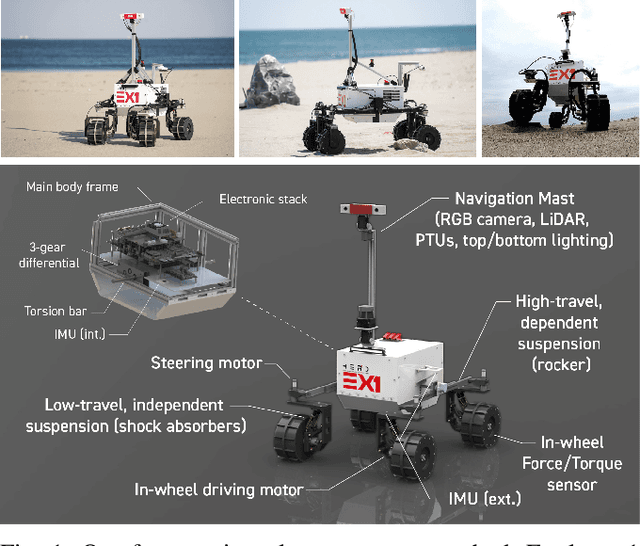
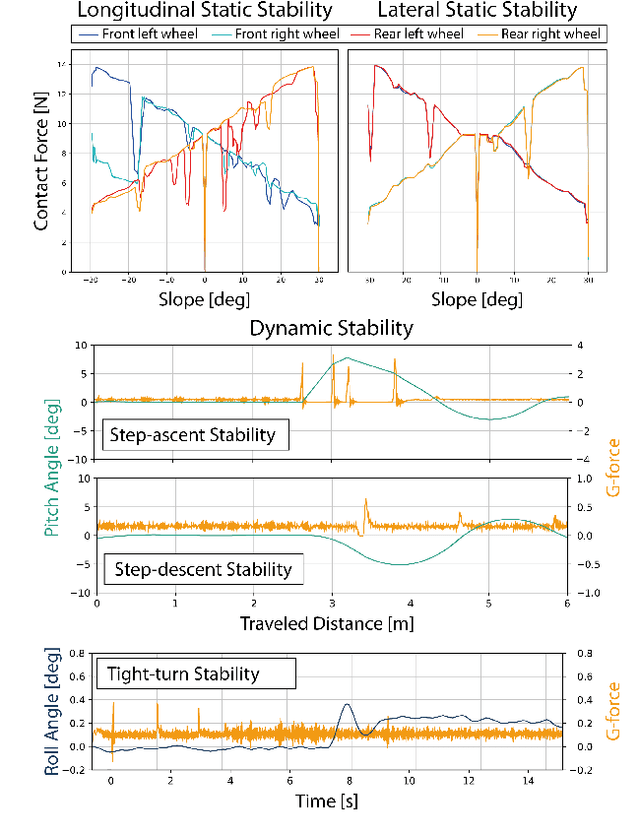


The exploration of the lunar poles and the collection of samples from the martian surface are characterized by shorter time windows demanding increased autonomy and speeds. Autonomous mobile robots must intrinsically cope with a wider range of disturbances. Faster off-road navigation has been explored for terrestrial applications but the combined effects of increased speeds and reduced gravity fields are yet to be fully studied. In this paper, we design and demonstrate a novel fully passive suspension design for wheeled planetary robots, which couples a high-range passive rocker with elastic in-wheel coil-over shock absorbers. The design was initially conceived and verified in a reduced-gravity (1.625 m/s$^2$) simulated environment, where three different passive suspension configurations were evaluated against a set of challenges--climbing steep slopes and surmounting unexpected obstacles like rocks and outcrops--and later prototyped and validated in a series of field tests. The proposed mechanically-hybrid suspension proves to mitigate more effectively the negative effects (high-frequency/high-amplitude vibrations and impact loads) of faster locomotion (>1 m/s) over unstructured terrains under varied gravity fields. This lowers the demand on navigation and control systems, impacting the efficiency of exploration missions in the years to come.