 Add to Chrome
 Add to Firefox
 Add to Edge
A Self-Supervised Approach for Minimal-Annotation Hydroacoustic Data Exploration
Jul 07, 2026
Passive hydroacoustic monitoring often generates large volumes of continuous recordings that are only partially exploited due to the cost of manual annotation. Supervised detection methods perform well but require large labeled datasets, seldom available for rare signals or understudied environments. This work proposes a self-supervised exploration pipeline to address this limitation in low-frequency settings. A Masked AutoEncoder (MAE) is pre-trained on a reconstruction pretext task, then used to extract patch-level representations from spectrograms. Within each spectrogram, adjacent informative patches are aggregated into event-level embeddings, enabling the disentanglement of overlapping events. These embeddings are then clustered at the dataset scale using the dimension reduction algorithm UMAP and the clustering algorithm HDBSCAN to identify hydroacoustic patterns. The pipeline was applied to a multi-year hydroacoustic dataset collected near Mayotte Island, Indian Ocean, containing marine mammal vocalizations, seismo-volcanic signals, and anthropogenic noise. The 317 clusters were manually mapped to 15 hydroacoustic classes or noise in less than one hour. The method was evaluated in two ways. Quantitatively, when used as a classifier, it achieved performance comparable to two existing detectors. Qualitatively, it recovered known seasonal patterns of marine mammal acoustic activity. It also identified patterns of previously unstudied signals, thereby demonstrating its practical value.

Gegelati: Lightweight Artificial Intelligence through Generic and Evolvable Tangled Program Graphs
Dec 15, 2020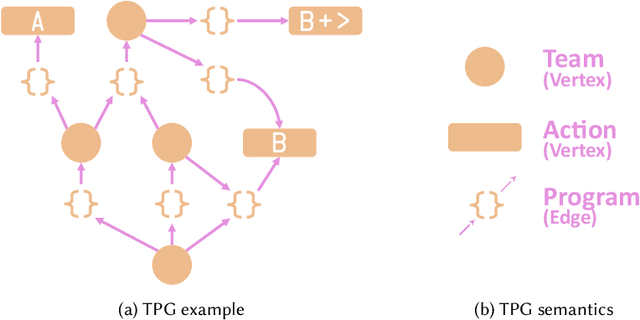
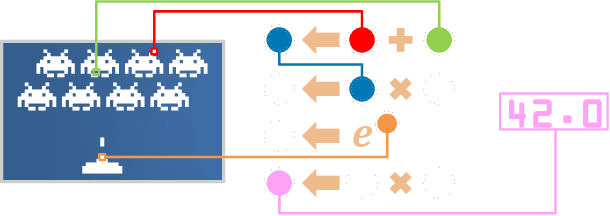
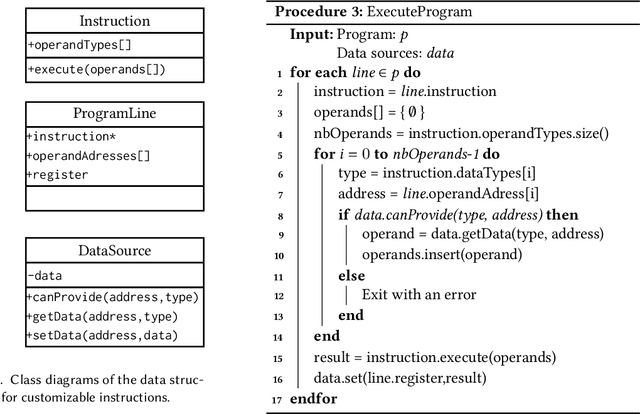
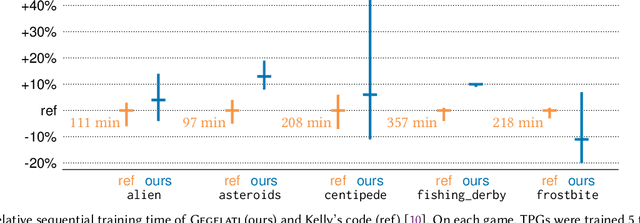
Tangled Program Graph (TPG) is a reinforcement learning technique based on genetic programming concepts. On state-of-the-art learning environments, TPGs have been shown to offer comparable competence with Deep Neural Networks (DNNs), for a fraction of their computational and storage cost. This lightness of TPGs, both for training and inference, makes them an interesting model to implement Artificial Intelligences (AIs) on embedded systems with limited computational and storage resources. In this paper, we introduce the Gegelati library for TPGs. Besides introducing the general concepts and features of the library, two main contributions are detailed in the paper: 1/ The parallelization of the deterministic training process of TPGs, for supporting heterogeneous Multiprocessor Systems-on-Chips (MPSoCs). 2/ The support for customizable instruction sets and data types within the genetically evolved programs of the TPG model. The scalability of the parallel training process is demonstrated through experiments on architectures ranging from a high-end 24-core processor to a low-power heterogeneous MPSoC. The impact of customizable instructions on the outcome of a training process is demonstrated on a state-of-the-art reinforcement learning environment. CCS Concepts: $\bullet$ Computer systems organization $\rightarrow$ Embedded systems; $\bullet$ Computing methodologies $\rightarrow$ Machine learning.