 Add to Chrome
 Add to Firefox
 Add to Edge
A Self-Supervised Approach for Minimal-Annotation Hydroacoustic Data Exploration
Jul 07, 2026
Passive hydroacoustic monitoring often generates large volumes of continuous recordings that are only partially exploited due to the cost of manual annotation. Supervised detection methods perform well but require large labeled datasets, seldom available for rare signals or understudied environments. This work proposes a self-supervised exploration pipeline to address this limitation in low-frequency settings. A Masked AutoEncoder (MAE) is pre-trained on a reconstruction pretext task, then used to extract patch-level representations from spectrograms. Within each spectrogram, adjacent informative patches are aggregated into event-level embeddings, enabling the disentanglement of overlapping events. These embeddings are then clustered at the dataset scale using the dimension reduction algorithm UMAP and the clustering algorithm HDBSCAN to identify hydroacoustic patterns. The pipeline was applied to a multi-year hydroacoustic dataset collected near Mayotte Island, Indian Ocean, containing marine mammal vocalizations, seismo-volcanic signals, and anthropogenic noise. The 317 clusters were manually mapped to 15 hydroacoustic classes or noise in less than one hour. The method was evaluated in two ways. Quantitatively, when used as a classifier, it achieved performance comparable to two existing detectors. Qualitatively, it recovered known seasonal patterns of marine mammal acoustic activity. It also identified patterns of previously unstudied signals, thereby demonstrating its practical value.

Multi-Modal Learning-based Reconstruction of High-Resolution Spatial Wind Speed Fields
Dec 14, 2023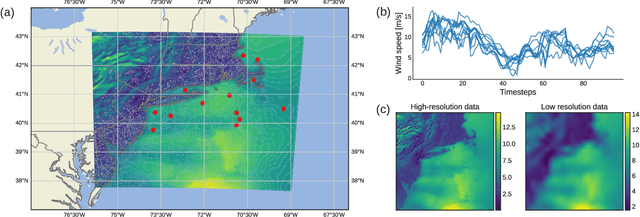


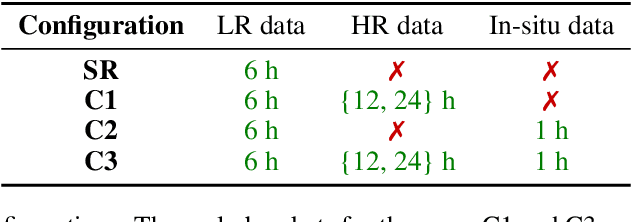
Wind speed at sea surface is a key quantity for a variety of scientific applications and human activities. Due to the non-linearity of the phenomenon, a complete description of such variable is made infeasible on both the small scale and large spatial extents. Methods relying on Data Assimilation techniques, despite being the state-of-the-art for Numerical Weather Prediction, can not provide the reconstructions with a spatial resolution that can compete with satellite imagery. In this work we propose a framework based on Variational Data Assimilation and Deep Learning concepts. This framework is applied to recover rich-in-time, high-resolution information on sea surface wind speed. We design our experiments using synthetic wind data and different sampling schemes for high-resolution and low-resolution versions of original data to emulate the real-world scenario of spatio-temporally heterogeneous observations. Extensive numerical experiments are performed to assess systematically the impact of low and high-resolution wind fields and in-situ observations on the model reconstruction performance. We show that in-situ observations with richer temporal resolution represent an added value in terms of the model reconstruction performance. We show how a multi-modal approach, that explicitly informs the model about the heterogeneity of the available observations, can improve the reconstruction task by exploiting the complementary information in spatial and local point-wise data. To conclude, we propose an analysis to test the robustness of the chosen framework against phase delay and amplitude biases in low-resolution data and against interruptions of in-situ observations supply at evaluation time
Learning-based estimation of in-situ wind speed from underwater acoustics
Aug 18, 2022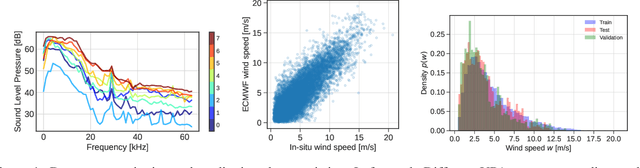
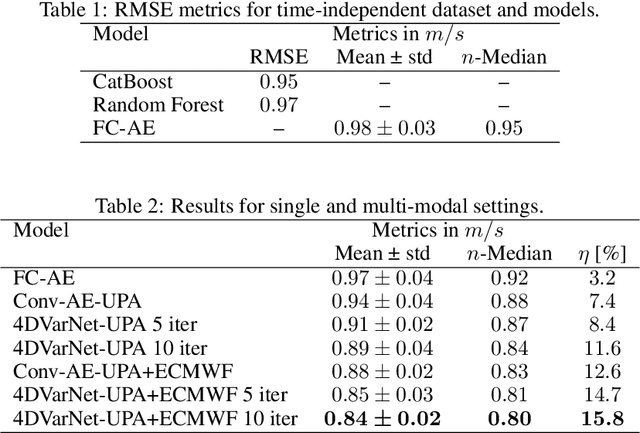
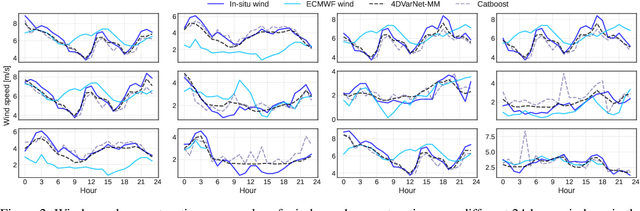
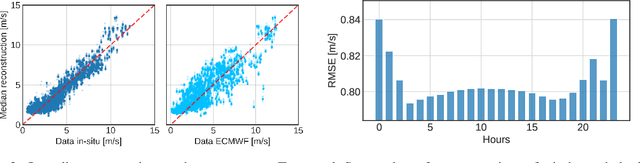
Wind speed retrieval at sea surface is of primary importance for scientific and operational applications. Besides weather models, in-situ measurements and remote sensing technologies, especially satellite sensors, provide complementary means to monitor wind speed. As sea surface winds produce sounds that propagate underwater, underwater acoustics recordings can also deliver fine-grained wind-related information. Whereas model-driven schemes, especially data assimilation approaches, are the state-of-the-art schemes to address inverse problems in geoscience, machine learning techniques become more and more appealing to fully exploit the potential of observation datasets. Here, we introduce a deep learning approach for the retrieval of wind speed time series from underwater acoustics possibly complemented by other data sources such as weather model reanalyses. Our approach bridges data assimilation and learning-based frameworks to benefit both from prior physical knowledge and computational efficiency. Numerical experiments on real data demonstrate that we outperform the state-of-the-art data-driven methods with a relative gain up to 16% in terms of RMSE. Interestingly, these results support the relevance of the time dynamics of underwater acoustic data to better inform the time evolution of wind speed. They also show that multimodal data, here underwater acoustics data combined with ECMWF reanalysis data, may further improve the reconstruction performance, including the robustness with respect to missing underwater acoustics data.