 Add to Chrome
 Add to Firefox
 Add to Edge
Search over the Visual World: Persistent Visual Memory, Layered Indexes, and Source-Grounded Evidence
Aug 08, 2026
Most video-retrieval systems assume a bounded corpus and return ranked files or timestamps. Agents operating over cameras, screens, streams, and archives face a different systems problem: observations arrive continuously; models interpret them at different temporal granularities; context must be selected without replaying the complete visual record; and results must stay connected to inspectable source evidence. We argue that search over such a corpus is an infrastructure problem that cannot be reduced to ranking video files. We develop a conceptual and formal model of search over the visual world built on analyzer-defined scenes, persistent understanding artifacts, visual memory as coexisting scene spaces over shared source time, and capability-declared indexes, distinguishing memory (everything retained), context (what is selected for a task), and evidence (the source intervals that ground it). The VideoDB data format (VDB) realizes this model in production, exposed through a typed search surface spanning planned retrieval, stateful investigation, direct access, and grounded synthesis. We contrast this model-agnostic infrastructure, where segmentation, sampling, model choice, embeddings, and ranking are system decisions and live streams are first-class sources, with video-native foundation models offered as fixed APIs. In a semantic-retrieval comparison against a commercial video-native engine spanning 9,800+ queries over four public datasets, a pipeline of general-purpose components achieves higher macro-averaged Recall@1/@3/@10 (73.09/83.39/91.20 versus 65.75/77.13/89.10), while the baseline is higher at Recall@50 (96.42 versus 96.07). Retrieval quality over the visual world is today governed more by system design than by video-specific pretraining, and visual-memory infrastructure can deliver it while keeping playable, source-grounded evidence first-class.

Do Thought Streams Matter? Evaluating Reasoning in Gemini Vision-Language Models for Video Scene Understanding
Apr 13, 2026We benchmark how internal reasoning traces, which we call thought streams, affect video scene understanding in vision-language models. Using four configurations of Google's Gemini 2.5 Flash and Flash Lite across scenes extracted from 100 hours of video, we ask three questions: does more thinking lead to better outputs, where do the gains stop, and what do these models actually think about? We introduce three evaluation metrics. Contentfulness measures how much of the thought stream is useful scene content versus meta-commentary. Thought-Final Coverage measures how faithfully the thought stream translates into the final output. Dominant Entity Analysis identifies which subjects, actions, and settings the model focuses on. GPT-5 serves as an independent judge. We find that quality gains from additional thinking plateau quickly, with most improvement occurring in the first few hundred tokens. Flash Lite offers the best balance between quality and token usage. Tight reasoning budgets cause the model to add content in the final output that it never reasoned about, a form of compression-step hallucination. Despite being different model tiers, Flash and Flash Lite produce similar thought streams, though they differ in style: Flash discusses its reasoning process, while Lite focuses on describing the scene.
Benchmarking Vision-Language Models on Optical Character Recognition in Dynamic Video Environments
Feb 10, 2025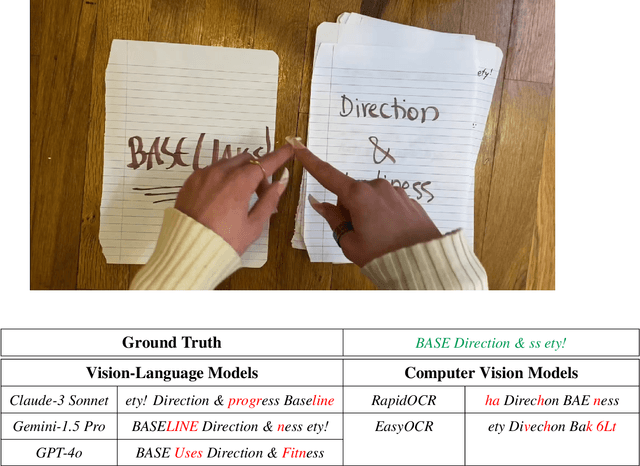
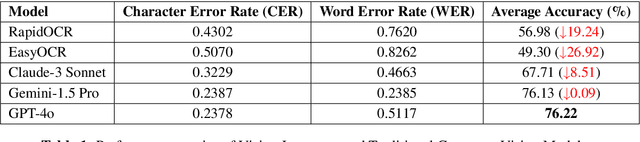
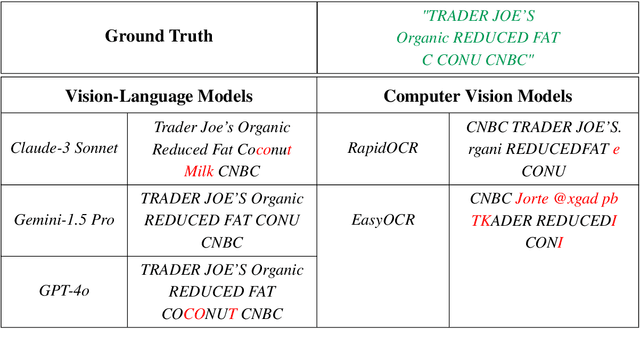
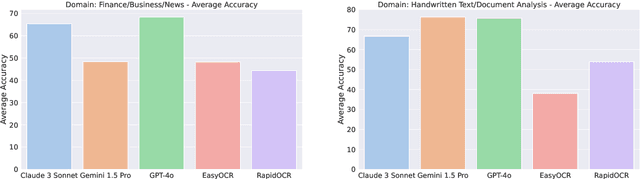
This paper introduces an open-source benchmark for evaluating Vision-Language Models (VLMs) on Optical Character Recognition (OCR) tasks in dynamic video environments. We present a curated dataset containing 1,477 manually annotated frames spanning diverse domains, including code editors, news broadcasts, YouTube videos, and advertisements. Three state of the art VLMs - Claude-3, Gemini-1.5, and GPT-4o are benchmarked against traditional OCR systems such as EasyOCR and RapidOCR. Evaluation metrics include Word Error Rate (WER), Character Error Rate (CER), and Accuracy. Our results highlight the strengths and limitations of VLMs in video-based OCR tasks, demonstrating their potential to outperform conventional OCR models in many scenarios. However, challenges such as hallucinations, content security policies, and sensitivity to occluded or stylized text remain. The dataset and benchmarking framework are publicly available to foster further research.