 Add to Chrome
 Add to Firefox
 Add to Edge
Towards Conversational Medical AI with Eyes, Ears and a Voice
May 10, 2026
The practice of medicine relies not only upon skillful dialogue but also on the nuanced exchange and interpretation of rich auditory and visual cues between doctors and patients. Building on the low-latency voice and video processing capabilities of Gemini, we introduce AI co-clinician, a first-of-its-kind conversational AI system utilizing continuous streams of audio-visual data from live patient conversations to inform real-time clinical decisions. Its dual-agent architecture balances deep clinical reasoning with the low latency required for natural dialogue. To assess this system, we implemented a video-based interface emulating telemedicine consultations. We crafted 20 standardized outpatient scenarios requiring proactive real-time auditory and visual reasoning and designed "TelePACES" evaluation criteria alongside case-specific rubrics. In a randomized, interface-blinded, crossover simulation study (n = 120 encounters) with 10 internal medicine residents as patient actors, we compared AI co-clinician with primary care physicians (PCPs), GPT-Realtime, and a baseline agent. AI co-clinician approached PCPs in key TelePACES dimensions, including management plans and differential diagnosis, while significantly outperforming GPT-Realtime across all general criteria. While our agent demonstrated parity with PCPs in case-specific triage measures, physicians maintained superior overall performance in case-specific assessments. Although AI co-clinician marks a significant advance in real-time telemedical AI, gaps remain in physical examination and disease-specific reasoning. Our work shows that text-only approaches fail to capture the true challenges of medical consultation and suggests that high-stakes real-time diagnostic AI is most safely advanced in collaborative, triadic models where AI can be a supportive co-clinician for doctors and patients.

Grounded Test-Time Adaptation for LLM Agents
Nov 06, 2025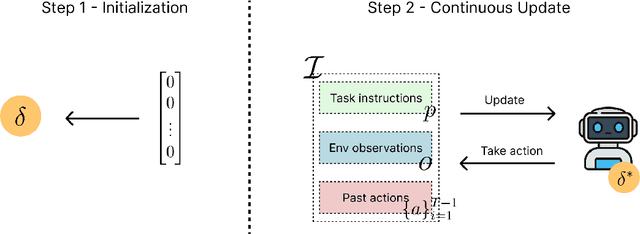
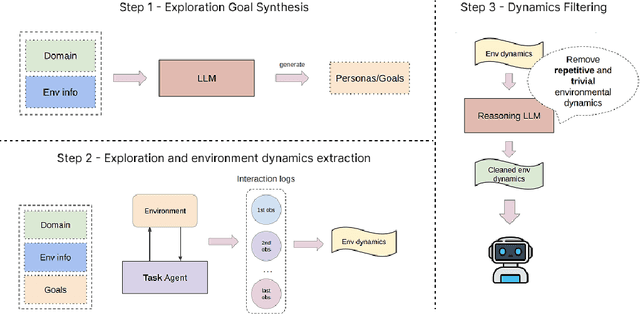
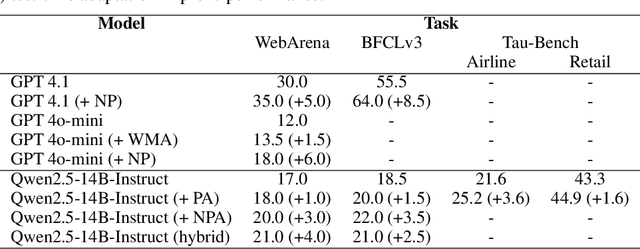
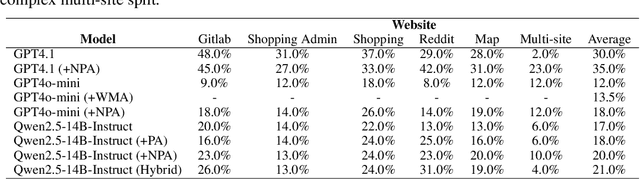
Large language model (LLM)-based agents struggle to generalize to novel and complex environments, such as unseen websites or new sets of functions, due to a fundamental mismatch between their pre-training and test-time conditions. This challenge stems from two distinct failure modes: a syntactic misunderstanding of environment-specific components like observation formats, and a semantic misunderstanding of state-transition dynamics, which are only revealed at test time. To address these issues, we propose two distinct and complementary strategies for adapting LLM agents by leveraging environment-specific information available during deployment. First, an online distributional adaptation method parameterizes environmental nuances by learning a lightweight adaptation vector that biases the model's output distribution, enabling rapid alignment with an environment response format. Second, a deployment-time dynamics grounding method employs a persona-driven exploration phase to systematically probe and learn the environment's causal dynamics before task execution, equipping the agent with a nonparametric world model. We evaluate these strategies across diverse agentic benchmarks, including function calling and web navigation. Our empirical results show the effectiveness of both strategies across all benchmarks with minimal computational cost. We find that dynamics grounding is particularly effective in complex environments where unpredictable dynamics pose a major obstacle, demonstrating a robust path toward more generalizable and capable LLM-based agents. For example, on the WebArena multi-site split, this method increases the agent's success rate from 2% to 23%.
SynQuE: Estimating Synthetic Dataset Quality Without Annotations
Nov 06, 2025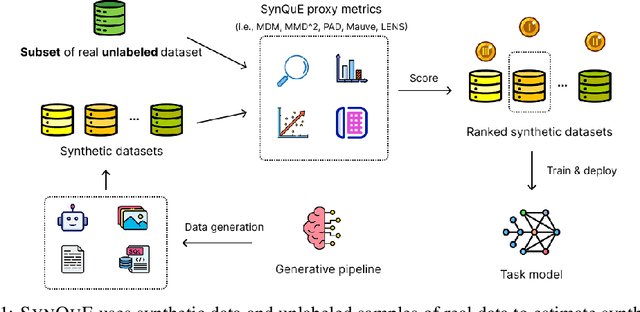
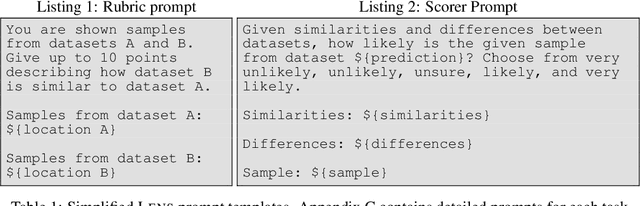
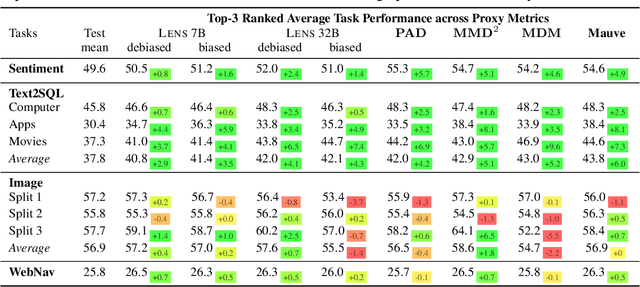
We introduce and formalize the Synthetic Dataset Quality Estimation (SynQuE) problem: ranking synthetic datasets by their expected real-world task performance using only limited unannotated real data. This addresses a critical and open challenge where data is scarce due to collection costs or privacy constraints. We establish the first comprehensive benchmarks for this problem by introducing and evaluating proxy metrics that choose synthetic data for training to maximize task performance on real data. We introduce the first proxy metrics for SynQuE by adapting distribution and diversity-based distance measures to our context via embedding models. To address the shortcomings of these metrics on complex planning tasks, we propose LENS, a novel proxy that leverages large language model reasoning. Our results show that SynQuE proxies correlate with real task performance across diverse tasks, including sentiment analysis, Text2SQL, web navigation, and image classification, with LENS consistently outperforming others on complex tasks by capturing nuanced characteristics. For instance, on text-to-SQL parsing, training on the top-3 synthetic datasets selected via SynQuE proxies can raise accuracy from 30.4% to 38.4 (+8.1)% on average compared to selecting data indiscriminately. This work establishes SynQuE as a practical framework for synthetic data selection under real-data scarcity and motivates future research on foundation model-based data characterization and fine-grained data selection.
UVGS: Reimagining Unstructured 3D Gaussian Splatting using UV Mapping
Feb 03, 20253D Gaussian Splatting (3DGS) has demonstrated superior quality in modeling 3D objects and scenes. However, generating 3DGS remains challenging due to their discrete, unstructured, and permutation-invariant nature. In this work, we present a simple yet effective method to overcome these challenges. We utilize spherical mapping to transform 3DGS into a structured 2D representation, termed UVGS. UVGS can be viewed as multi-channel images, with feature dimensions as a concatenation of Gaussian attributes such as position, scale, color, opacity, and rotation. We further find that these heterogeneous features can be compressed into a lower-dimensional (e.g., 3-channel) shared feature space using a carefully designed multi-branch network. The compressed UVGS can be treated as typical RGB images. Remarkably, we discover that typical VAEs trained with latent diffusion models can directly generalize to this new representation without additional training. Our novel representation makes it effortless to leverage foundational 2D models, such as diffusion models, to directly model 3DGS. Additionally, one can simply increase the 2D UV resolution to accommodate more Gaussians, making UVGS a scalable solution compared to typical 3D backbones. This approach immediately unlocks various novel generation applications of 3DGS by inherently utilizing the already developed superior 2D generation capabilities. In our experiments, we demonstrate various unconditional, conditional generation, and inpainting applications of 3DGS based on diffusion models, which were previously non-trivial.