 Add to Chrome
 Add to Firefox
 Add to Edge
ORCESTRA: VLM-driven Visual Robot programming in Mixed Reality
Aug 01, 2026
ORCESTRA is a mixed-reality system for programming robot digital twins through no-code waypoint teaching and language-guided control. In a passthrough mixed-reality workspace, users place robot twins on real surfaces, teach trajectories, save robot-relative episodes, or issue spoken/typed commands that a vision-language model converts into structured digital-twin plans. Both interaction modes share a backend for metric grounding, embodiment-aware validation, preview, confirmation, and digital-twin execution. The system supports heterogeneous robot embodiments, including fixed-base manipulators, a mobile base, and a humanoid robot, demonstrating MR validation as a safety layer for language-guided robot programming before physical deployment.

AgenticFocus: Object-Preserving Mixed Reality Synthesis from Human FPV Video for Dexterous Humanoid Learning
Jul 13, 2026Human egocentric video is a scalable supervision source for humanoid policy learning, but current pipelines struggle with hand-object occlusion, oversimplified motion, or specialized capture hardware. We introduce AgenticFocus, a Mixed Reality synthesis pipeline that converts ordinary first-person-view human videos into robot-trainable demonstrations by restoring occluded object geometry, reconstructing full-hand motion, and retargeting it to a humanoid embodiment through camera-relative alignment and layered compositing. The resulting dataset pairs focused visual observations with synchronized robot actions and states. AgenticFocus achieves lower trajectory error and smoother wrist motion than cross-embodiment baselines, with SPARC scores of -5.18 versus -5.56 and -6.05.
DiffusionCinema: Text-to-Aerial Cinematography
Jan 24, 2026We propose a novel Unmanned Aerial Vehicles (UAV) assisted creative capture system that leverages diffusion models to interpret high-level natural language prompts and automatically generate optimal flight trajectories for cinematic video recording. Instead of manually piloting the drone, the user simply describes the desired shot (e.g., "orbit around me slowly from the right and reveal the background waterfall"). Our system encodes the prompt along with an initial visual snapshot from the onboard camera, and a diffusion model samples plausible spatio-temporal motion plans that satisfy both the scene geometry and shot semantics. The generated flight trajectory is then executed autonomously by the UAV to record smooth, repeatable video clips that match the prompt. User evaluation using NASA-TLX showed a significantly lower overall workload with our interface (M = 21.6) compared to a traditional remote controller (M = 58.1), demonstrating a substantial reduction in perceived effort. Mental demand (M = 11.5 vs. 60.5) and frustration (M = 14.0 vs. 54.5) were also markedly lower for our system, confirming clear usability advantages in autonomous text-driven flight control. This project demonstrates a new interaction paradigm: text-to-cinema flight, where diffusion models act as the "creative operator" converting story intentions directly into aerial motion.
FlightDiffusion: Revolutionising Autonomous Drone Training with Diffusion Models Generating FPV Video
Sep 19, 2025We present FlightDiffusion, a diffusion-model-based framework for training autonomous drones from first-person view (FPV) video. Our model generates realistic video sequences from a single frame, enriched with corresponding action spaces to enable reasoning-driven navigation in dynamic environments. Beyond direct policy learning, FlightDiffusion leverages its generative capabilities to synthesize diverse FPV trajectories and state-action pairs, facilitating the creation of large-scale training datasets without the high cost of real-world data collection. Our evaluation demonstrates that the generated trajectories are physically plausible and executable, with a mean position error of 0.25 m (RMSE 0.28 m) and a mean orientation error of 0.19 rad (RMSE 0.24 rad). This approach enables improved policy learning and dataset scalability, leading to superior performance in downstream navigation tasks. Results in simulated environments highlight enhanced robustness, smoother trajectory planning, and adaptability to unseen conditions. An ANOVA revealed no statistically significant difference between performance in simulation and reality (F(1, 16) = 0.394, p = 0.541), with success rates of M = 0.628 (SD = 0.162) and M = 0.617 (SD = 0.177), respectively, indicating strong sim-to-real transfer. The generated datasets provide a valuable resource for future UAV research. This work introduces diffusion-based reasoning as a promising paradigm for unifying navigation, action generation, and data synthesis in aerial robotics.
GestOS: Advanced Hand Gesture Interpretation via Large Language Models to control Any Type of Robot
Sep 17, 2025We present GestOS, a gesture-based operating system for high-level control of heterogeneous robot teams. Unlike prior systems that map gestures to fixed commands or single-agent actions, GestOS interprets hand gestures semantically and dynamically distributes tasks across multiple robots based on their capabilities, current state, and supported instruction sets. The system combines lightweight visual perception with large language model (LLM) reasoning: hand poses are converted into structured textual descriptions, which the LLM uses to infer intent and generate robot-specific commands. A robot selection module ensures that each gesture-triggered task is matched to the most suitable agent in real time. This architecture enables context-aware, adaptive control without requiring explicit user specification of targets or commands. By advancing gesture interaction from recognition to intelligent orchestration, GestOS supports scalable, flexible, and user-friendly collaboration with robotic systems in dynamic environments.
PhysicalAgent: Towards General Cognitive Robotics with Foundation World Models
Sep 17, 2025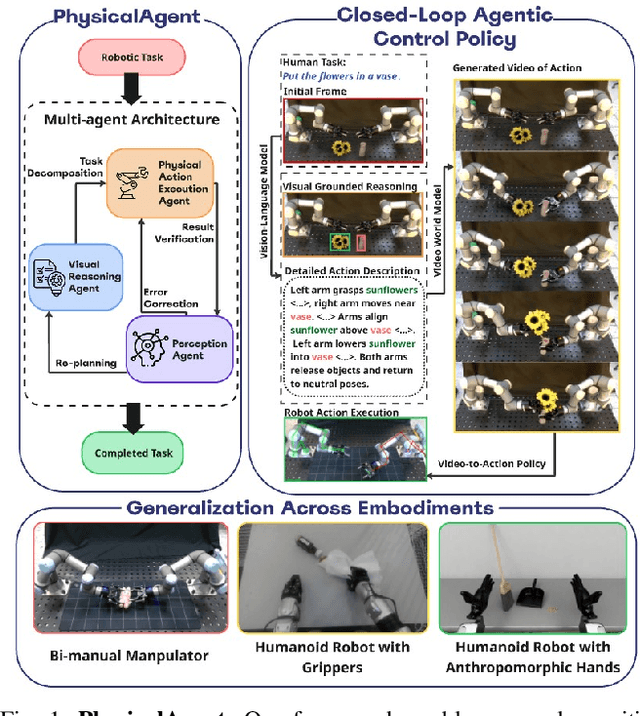
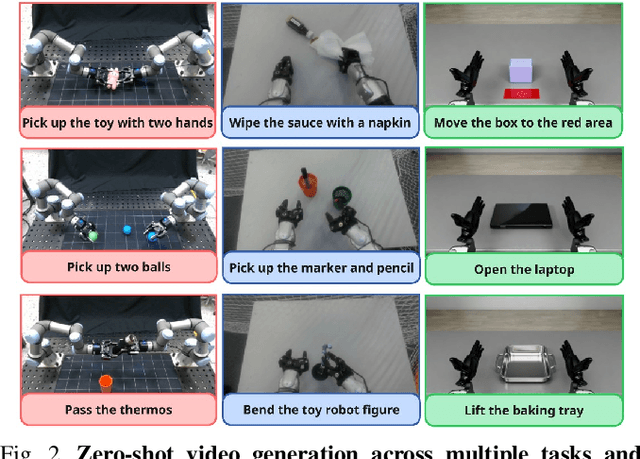
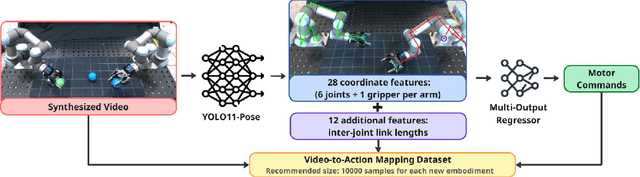
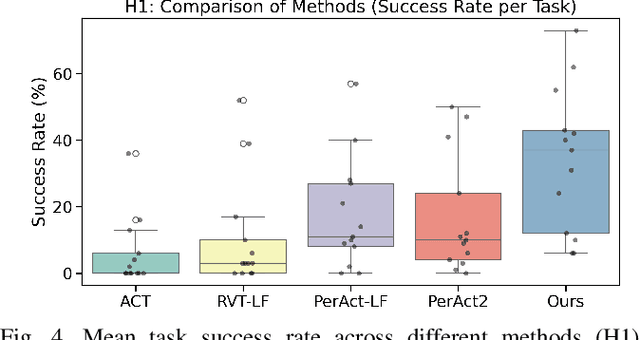
We introduce PhysicalAgent, an agentic framework for robotic manipulation that integrates iterative reasoning, diffusion-based video generation, and closed-loop execution. Given a textual instruction, our method generates short video demonstrations of candidate trajectories, executes them on the robot, and iteratively re-plans in response to failures. This approach enables robust recovery from execution errors. We evaluate PhysicalAgent across multiple perceptual modalities (egocentric, third-person, and simulated) and robotic embodiments (bimanual UR3, Unitree G1 humanoid, simulated GR1), comparing against state-of-the-art task-specific baselines. Experiments demonstrate that our method consistently outperforms prior approaches, achieving up to 83% success on human-familiar tasks. Physical trials reveal that first-attempt success is limited (20-30%), yet iterative correction increases overall success to 80% across platforms. These results highlight the potential of video-based generative reasoning for general-purpose robotic manipulation and underscore the importance of iterative execution for recovering from initial failures. Our framework paves the way for scalable, adaptable, and robust robot control.
UAV-CodeAgents: Scalable UAV Mission Planning via Multi-Agent ReAct and Vision-Language Reasoning
May 12, 2025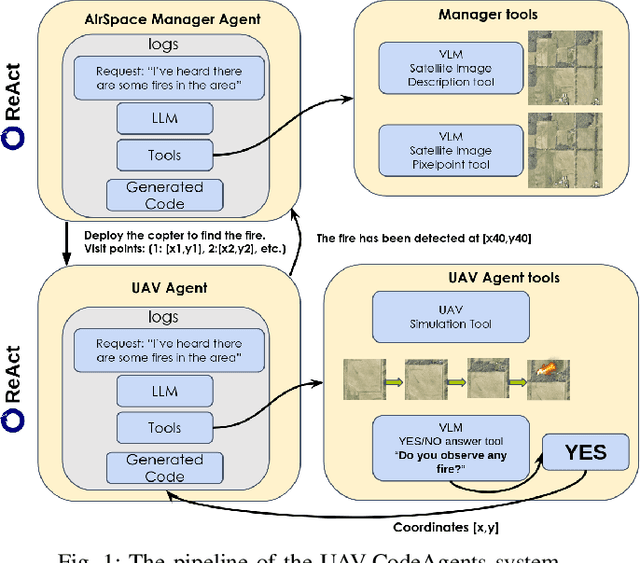
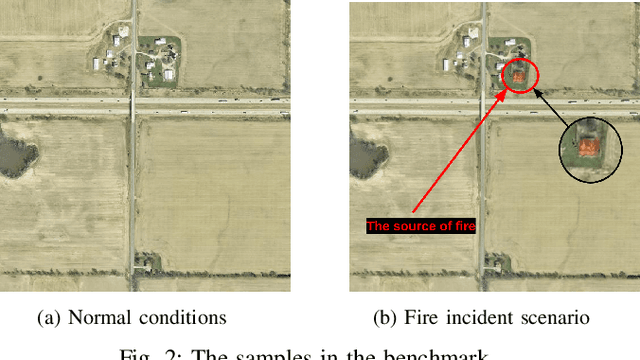
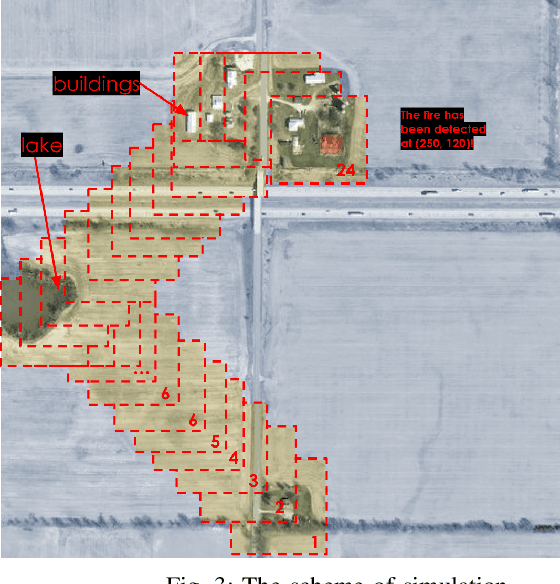
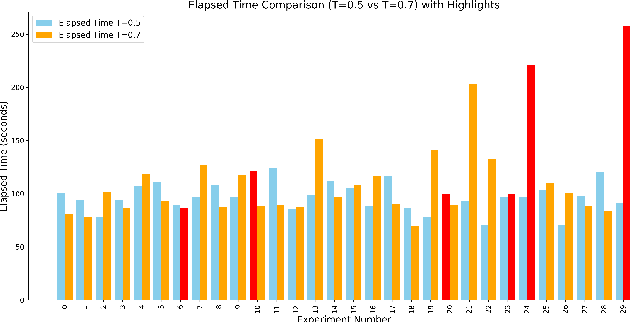
We present UAV-CodeAgents, a scalable multi-agent framework for autonomous UAV mission generation, built on large language and vision-language models (LLMs/VLMs). The system leverages the ReAct (Reason + Act) paradigm to interpret satellite imagery, ground high-level natural language instructions, and collaboratively generate UAV trajectories with minimal human supervision. A core component is a vision-grounded, pixel-pointing mechanism that enables precise localization of semantic targets on aerial maps. To support real-time adaptability, we introduce a reactive thinking loop, allowing agents to iteratively reflect on observations, revise mission goals, and coordinate dynamically in evolving environments. UAV-CodeAgents is evaluated on large-scale mission scenarios involving industrial and environmental fire detection. Our results show that a lower decoding temperature (0.5) yields higher planning reliability and reduced execution time, with an average mission creation time of 96.96 seconds and a success rate of 93%. We further fine-tune Qwen2.5VL-7B on 9,000 annotated satellite images, achieving strong spatial grounding across diverse visual categories. To foster reproducibility and future research, we will release the full codebase and a novel benchmark dataset for vision-language-based UAV planning.
UAV-VLPA*: A Vision-Language-Path-Action System for Optimal Route Generation on a Large Scales
Mar 04, 2025The UAV-VLPA* (Visual-Language-Planning-and-Action) system represents a cutting-edge advancement in aerial robotics, designed to enhance communication and operational efficiency for unmanned aerial vehicles (UAVs). By integrating advanced planning capabilities, the system addresses the Traveling Salesman Problem (TSP) to optimize flight paths, reducing the total trajectory length by 18.5\% compared to traditional methods. Additionally, the incorporation of the A* algorithm enables robust obstacle avoidance, ensuring safe and efficient navigation in complex environments. The system leverages satellite imagery processing combined with the Visual Language Model (VLM) and GPT's natural language processing capabilities, allowing users to generate detailed flight plans through simple text commands. This seamless fusion of visual and linguistic analysis empowers precise decision-making and mission planning, making UAV-VLPA* a transformative tool for modern aerial operations. With its unmatched operational efficiency, navigational safety, and user-friendly functionality, UAV-VLPA* sets a new standard in autonomous aerial robotics, paving the way for future innovations in the field.
RaceVLA: VLA-based Racing Drone Navigation with Human-like Behaviour
Mar 04, 2025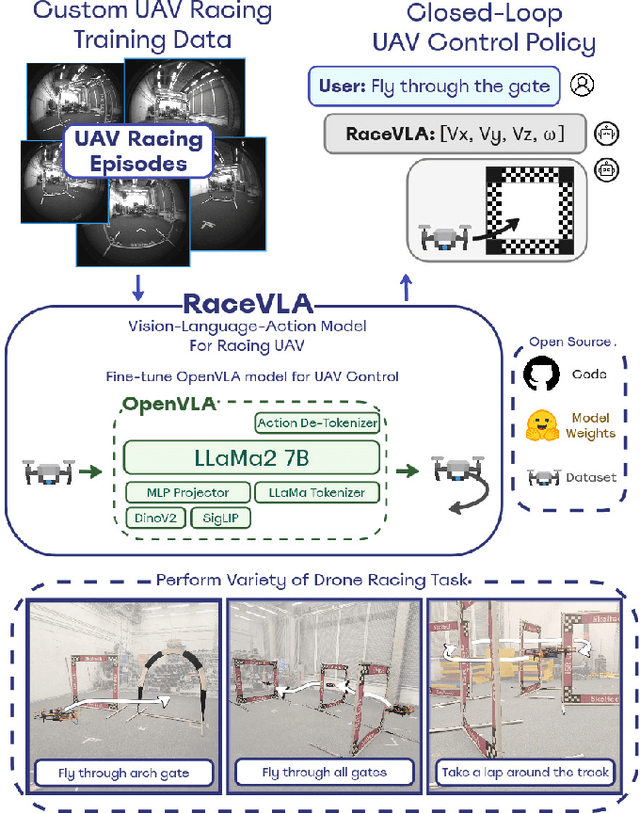

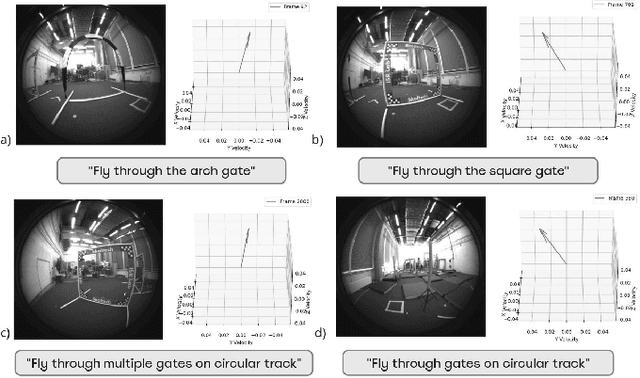
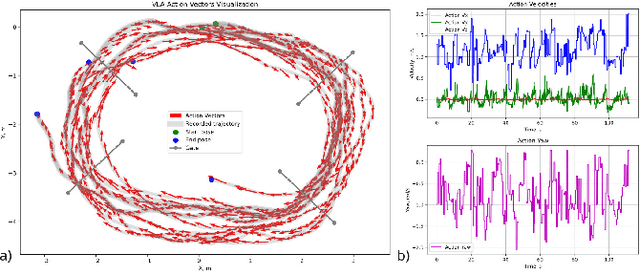
RaceVLA presents an innovative approach for autonomous racing drone navigation by leveraging Visual-Language-Action (VLA) to emulate human-like behavior. This research explores the integration of advanced algorithms that enable drones to adapt their navigation strategies based on real-time environmental feedback, mimicking the decision-making processes of human pilots. The model, fine-tuned on a collected racing drone dataset, demonstrates strong generalization despite the complexity of drone racing environments. RaceVLA outperforms OpenVLA in motion (75.0 vs 60.0) and semantic generalization (45.5 vs 36.3), benefiting from the dynamic camera and simplified motion tasks. However, visual (79.6 vs 87.0) and physical (50.0 vs 76.7) generalization were slightly reduced due to the challenges of maneuvering in dynamic environments with varying object sizes. RaceVLA also outperforms RT-2 across all axes - visual (79.6 vs 52.0), motion (75.0 vs 55.0), physical (50.0 vs 26.7), and semantic (45.5 vs 38.8), demonstrating its robustness for real-time adjustments in complex environments. Experiments revealed an average velocity of 1.04 m/s, with a maximum speed of 2.02 m/s, and consistent maneuverability, demonstrating RaceVLA's ability to handle high-speed scenarios effectively. These findings highlight the potential of RaceVLA for high-performance navigation in competitive racing contexts. The RaceVLA codebase, pretrained weights, and dataset are available at this http URL: https://racevla.github.io/
CognitiveDrone: A VLA Model and Evaluation Benchmark for Real-Time Cognitive Task Solving and Reasoning in UAVs
Mar 03, 2025This paper introduces CognitiveDrone, a novel Vision-Language-Action (VLA) model tailored for complex Unmanned Aerial Vehicles (UAVs) tasks that demand advanced cognitive abilities. Trained on a dataset comprising over 8,000 simulated flight trajectories across three key categories-Human Recognition, Symbol Understanding, and Reasoning-the model generates real-time 4D action commands based on first-person visual inputs and textual instructions. To further enhance performance in intricate scenarios, we propose CognitiveDrone-R1, which integrates an additional Vision-Language Model (VLM) reasoning module to simplify task directives prior to high-frequency control. Experimental evaluations using our open-source benchmark, CognitiveDroneBench, reveal that while a racing-oriented model (RaceVLA) achieves an overall success rate of 31.3%, the base CognitiveDrone model reaches 59.6%, and CognitiveDrone-R1 attains a success rate of 77.2%. These results demonstrate improvements of up to 30% in critical cognitive tasks, underscoring the effectiveness of incorporating advanced reasoning capabilities into UAV control systems. Our contributions include the development of a state-of-the-art VLA model for UAV control and the introduction of the first dedicated benchmark for assessing cognitive tasks in drone operations. The complete repository is available at cognitivedrone.github.io