 Add to Chrome
 Add to Firefox
 Add to Edge
AgenticRL: Self-Refining Agentic Reinforcement Learning for Vision-Conditioned UAV Navigation
Jun 03, 2026
Deep reinforcement learning has shown strong potential for enabling autonomous robots to learn complex navigational tasks. However, its practical use still depends heavily on human designed reward functions and repeated manual fine tuning, which is time consuming and does not guarantee high success in the desired task. This paper presents AgenticRL, agent guided reinforcement learning framework that increases autonomy in reward design, policy refinement, and real world deployment for unmanned aerial vehicles (UAV) navigation tasks. AgenticRL uses a multimodal generative pre-trained tansformer (GPT) agent to interpret task information and visual scene observations, generate task specific reward functions, train policies using Proximal Policy Optimization (PPO) algorithm, and then act as a critic by evaluating the trained policy through diagnosis packets to generate feedback. Based on this feedback, the agent identifies failure modes and refines the reward function in a closed loop self improvement process. To further leverage the multimodal GPT agent during inference, AgenticRL uses real world images and natural language task information to automatically identify the active scenario and select the appropriate trained policy for execution. The framework is evaluated on multiple navigational tasks, including gate traversal, obstacle avoidance, wall barrier crossing with landing, trajectory following, and motion behavior learning. Experimental results show that the closed loop refinement process improves policy behavior compared with initial rewards by 71%. We also demonstrate sim-to-real transfer of the proposed framework, achieving a real world success rate of 91% and a sim-to-real accuracy of 94%.

ImpedanceDiffusion: Diffusion-Based Global Path Planning for UAV Swarm Navigation with Generative Impedance Control
Mar 10, 2026Safe swarm navigation in cluttered indoor environment requires long-horizon planning, reactive obstacle avoidance, and adaptive compliance. We propose ImpedanceDiffusion, a hierarchical framework that leverages image-conditioned diffusion-based global path planning with Artificial Potential Field (APF) tracking and semantic-aware variable impedance control for aerial drone swarms. The diffusion model generates geometric global trajectories directly from RGB images without explicit map construction. These trajectories are tracked by an APF-based reactive layer, while a VLM-RAG module performs semantic obstacle classification with 90% retrieval accuracy to adapt impedance parameters for mixed obstacle environments during execution. Two diffusion planners are evaluated: (i) a top-view long-horizon planner using single-pass inference and (ii) a first-person-view (FPV) short-horizon planner deployed via a two-stage inference pipeline. Both planners achieve a 100% trajectory generation rate across twenty static and dynamic experimental configurations and are validated via zero-shot sim-to-real deployment on Crazyflie 2.1 drones through the hierarchical APF-impedance control stack. The top-view planner produces smoother trajectories that yield conservative tracking speeds of 1.0-1.2 m/s near hard obstacles and 0.6-1.0 m/s near soft obstacles. In contrast, the FPV planner generates trajectories with greater local clearance and typically higher speeds, reaching 1.4-2.0 m/s near hard obstacles and up to 1.6 m/s near soft obstacles. Across 20 experimental configurations (100 total runs), the framework achieved a 92% success rate while maintaining stable impedance-based formation control with bounded oscillations and no in-flight collisions, demonstrating reliable and adaptive swarm navigation in cluttered indoor environments.
HumanoidVLM: Vision-Language-Guided Impedance Control for Contact-Rich Humanoid Manipulation
Jan 21, 2026Humanoid robots must adapt their contact behavior to diverse objects and tasks, yet most controllers rely on fixed, hand-tuned impedance gains and gripper settings. This paper introduces HumanoidVLM, a vision-language driven retrieval framework that enables the Unitree G1 humanoid to select task-appropriate Cartesian impedance parameters and gripper configurations directly from an egocentric RGB image. The system couples a vision-language model for semantic task inference with a FAISS-based Retrieval-Augmented Generation (RAG) module that retrieves experimentally validated stiffness-damping pairs and object-specific grasp angles from two custom databases, and executes them through a task-space impedance controller for compliant manipulation. We evaluate HumanoidVLM on 14 visual scenarios and achieve a retrieval accuracy of 93%. Real-world experiments show stable interaction dynamics, with z-axis tracking errors typically within 1-3.5 cm and virtual forces consistent with task-dependent impedance settings. These results demonstrate the feasibility of linking semantic perception with retrieval-based control as an interpretable path toward adaptive humanoid manipulation.
SwarmVLM: VLM-Guided Impedance Control for Autonomous Navigation of Heterogeneous Robots in Dynamic Warehousing
Aug 11, 2025With the growing demand for efficient logistics, unmanned aerial vehicles (UAVs) are increasingly being paired with automated guided vehicles (AGVs). While UAVs offer the ability to navigate through dense environments and varying altitudes, they are limited by battery life, payload capacity, and flight duration, necessitating coordinated ground support. Focusing on heterogeneous navigation, SwarmVLM addresses these limitations by enabling semantic collaboration between UAVs and ground robots through impedance control. The system leverages the Vision Language Model (VLM) and the Retrieval-Augmented Generation (RAG) to adjust impedance control parameters in response to environmental changes. In this framework, the UAV acts as a leader using Artificial Potential Field (APF) planning for real-time navigation, while the ground robot follows via virtual impedance links with adaptive link topology to avoid collisions with short obstacles. The system demonstrated a 92% success rate across 12 real-world trials. Under optimal lighting conditions, the VLM-RAG framework achieved 8% accuracy in object detection and selection of impedance parameters. The mobile robot prioritized short obstacle avoidance, occasionally resulting in a lateral deviation of up to 50 cm from the UAV path, which showcases safe navigation in a cluttered setting.
UAV-CodeAgents: Scalable UAV Mission Planning via Multi-Agent ReAct and Vision-Language Reasoning
May 12, 2025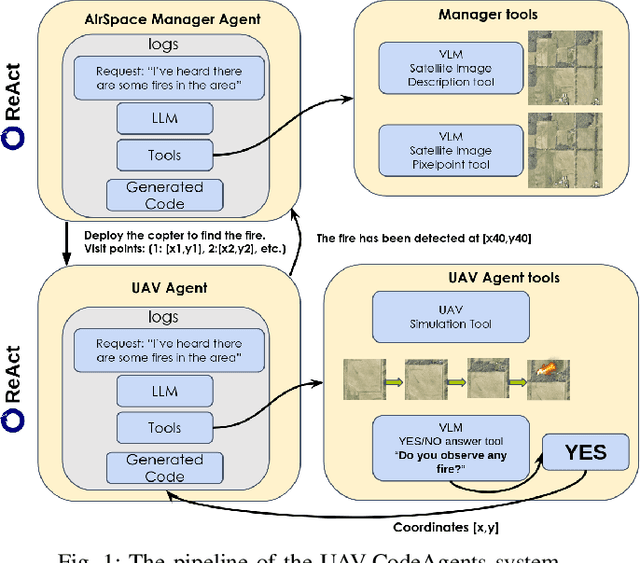
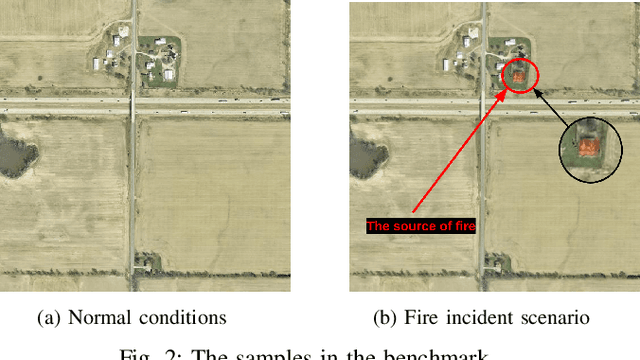
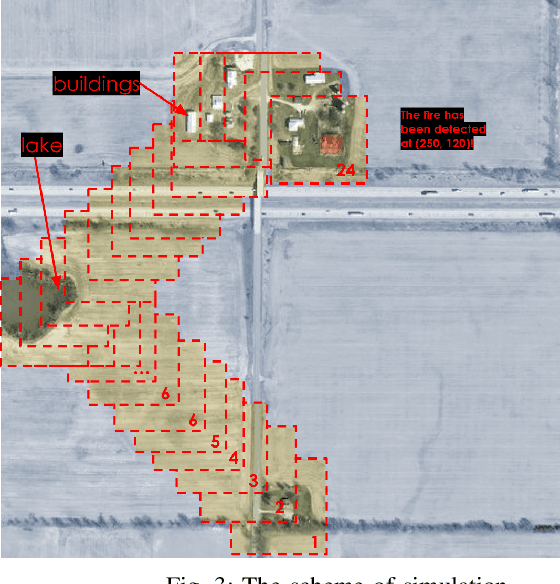
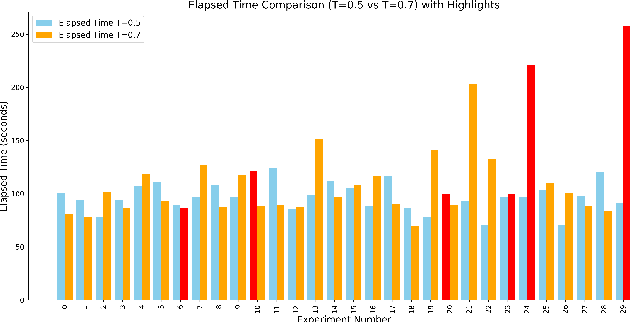
We present UAV-CodeAgents, a scalable multi-agent framework for autonomous UAV mission generation, built on large language and vision-language models (LLMs/VLMs). The system leverages the ReAct (Reason + Act) paradigm to interpret satellite imagery, ground high-level natural language instructions, and collaboratively generate UAV trajectories with minimal human supervision. A core component is a vision-grounded, pixel-pointing mechanism that enables precise localization of semantic targets on aerial maps. To support real-time adaptability, we introduce a reactive thinking loop, allowing agents to iteratively reflect on observations, revise mission goals, and coordinate dynamically in evolving environments. UAV-CodeAgents is evaluated on large-scale mission scenarios involving industrial and environmental fire detection. Our results show that a lower decoding temperature (0.5) yields higher planning reliability and reduced execution time, with an average mission creation time of 96.96 seconds and a success rate of 93%. We further fine-tune Qwen2.5VL-7B on 9,000 annotated satellite images, achieving strong spatial grounding across diverse visual categories. To foster reproducibility and future research, we will release the full codebase and a novel benchmark dataset for vision-language-based UAV planning.
UAV-VLPA*: A Vision-Language-Path-Action System for Optimal Route Generation on a Large Scales
Mar 04, 2025The UAV-VLPA* (Visual-Language-Planning-and-Action) system represents a cutting-edge advancement in aerial robotics, designed to enhance communication and operational efficiency for unmanned aerial vehicles (UAVs). By integrating advanced planning capabilities, the system addresses the Traveling Salesman Problem (TSP) to optimize flight paths, reducing the total trajectory length by 18.5\% compared to traditional methods. Additionally, the incorporation of the A* algorithm enables robust obstacle avoidance, ensuring safe and efficient navigation in complex environments. The system leverages satellite imagery processing combined with the Visual Language Model (VLM) and GPT's natural language processing capabilities, allowing users to generate detailed flight plans through simple text commands. This seamless fusion of visual and linguistic analysis empowers precise decision-making and mission planning, making UAV-VLPA* a transformative tool for modern aerial operations. With its unmatched operational efficiency, navigational safety, and user-friendly functionality, UAV-VLPA* sets a new standard in autonomous aerial robotics, paving the way for future innovations in the field.
ImpedanceGPT: VLM-driven Impedance Control of Swarm of Mini-drones for Intelligent Navigation in Dynamic Environment
Mar 04, 2025Swarm robotics plays a crucial role in enabling autonomous operations in dynamic and unpredictable environments. However, a major challenge remains ensuring safe and efficient navigation in environments filled with both dynamic alive (e.g., humans) and dynamic inanimate (e.g., non-living objects) obstacles. In this paper, we propose ImpedanceGPT, a novel system that combines a Vision-Language Model (VLM) with retrieval-augmented generation (RAG) to enable real-time reasoning for adaptive navigation of mini-drone swarms in complex environments. The key innovation of ImpedanceGPT lies in the integration of VLM and RAG, which provides the drones with enhanced semantic understanding of their surroundings. This enables the system to dynamically adjust impedance control parameters in response to obstacle types and environmental conditions. Our approach not only ensures safe and precise navigation but also improves coordination between drones in the swarm. Experimental evaluations demonstrate the effectiveness of the system. The VLM-RAG framework achieved an obstacle detection and retrieval accuracy of 80 % under optimal lighting. In static environments, drones navigated dynamic inanimate obstacles at 1.4 m/s but slowed to 0.7 m/s with increased separation around humans. In dynamic environments, speed adjusted to 1.0 m/s near hard obstacles, while reducing to 0.6 m/s with higher deflection to safely avoid moving humans.
UAV-VLRR: Vision-Language Informed NMPC for Rapid Response in UAV Search and Rescue
Mar 04, 2025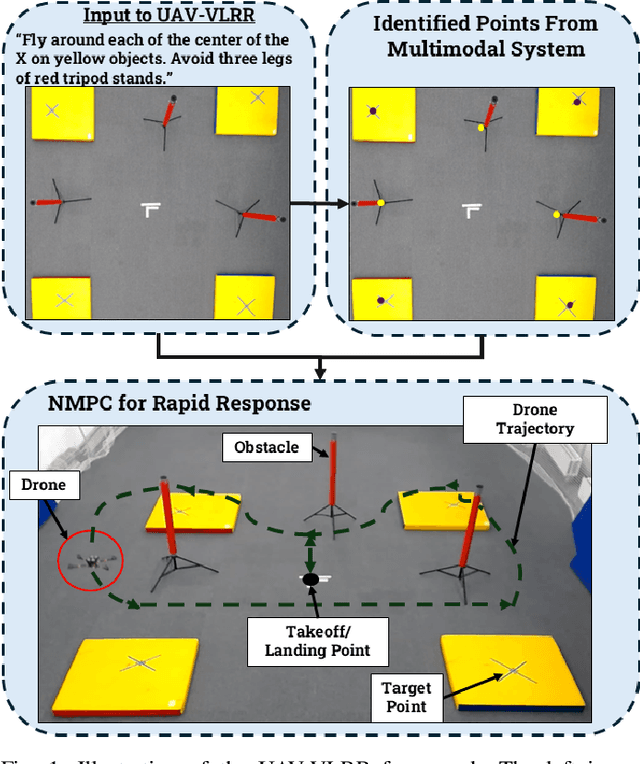
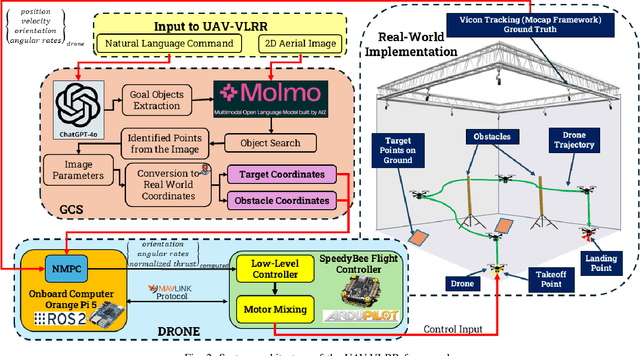
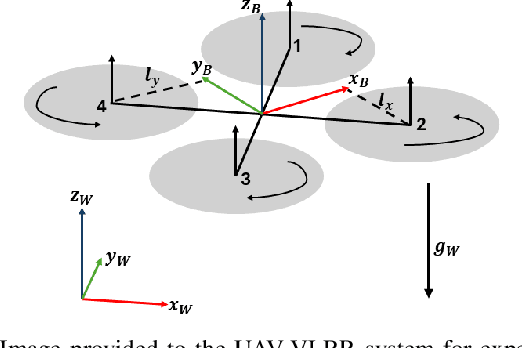
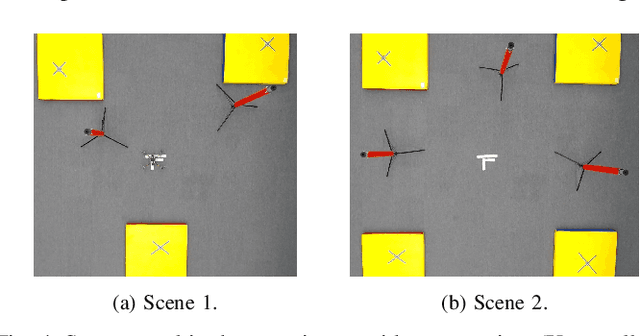
Emergency search and rescue (SAR) operations often require rapid and precise target identification in complex environments where traditional manual drone control is inefficient. In order to address these scenarios, a rapid SAR system, UAV-VLRR (Vision-Language-Rapid-Response), is developed in this research. This system consists of two aspects: 1) A multimodal system which harnesses the power of Visual Language Model (VLM) and the natural language processing capabilities of ChatGPT-4o (LLM) for scene interpretation. 2) A non-linearmodel predictive control (NMPC) with built-in obstacle avoidance for rapid response by a drone to fly according to the output of the multimodal system. This work aims at improving response times in emergency SAR operations by providing a more intuitive and natural approach to the operator to plan the SAR mission while allowing the drone to carry out that mission in a rapid and safe manner. When tested, our approach was faster on an average by 33.75% when compared with an off-the-shelf autopilot and 54.6% when compared with a human pilot. Video of UAV-VLRR: https://youtu.be/KJqQGKKt1xY
CognitiveDrone: A VLA Model and Evaluation Benchmark for Real-Time Cognitive Task Solving and Reasoning in UAVs
Mar 03, 2025This paper introduces CognitiveDrone, a novel Vision-Language-Action (VLA) model tailored for complex Unmanned Aerial Vehicles (UAVs) tasks that demand advanced cognitive abilities. Trained on a dataset comprising over 8,000 simulated flight trajectories across three key categories-Human Recognition, Symbol Understanding, and Reasoning-the model generates real-time 4D action commands based on first-person visual inputs and textual instructions. To further enhance performance in intricate scenarios, we propose CognitiveDrone-R1, which integrates an additional Vision-Language Model (VLM) reasoning module to simplify task directives prior to high-frequency control. Experimental evaluations using our open-source benchmark, CognitiveDroneBench, reveal that while a racing-oriented model (RaceVLA) achieves an overall success rate of 31.3%, the base CognitiveDrone model reaches 59.6%, and CognitiveDrone-R1 attains a success rate of 77.2%. These results demonstrate improvements of up to 30% in critical cognitive tasks, underscoring the effectiveness of incorporating advanced reasoning capabilities into UAV control systems. Our contributions include the development of a state-of-the-art VLA model for UAV control and the introduction of the first dedicated benchmark for assessing cognitive tasks in drone operations. The complete repository is available at cognitivedrone.github.io
UAV-VLA: Vision-Language-Action System for Large Scale Aerial Mission Generation
Jan 09, 2025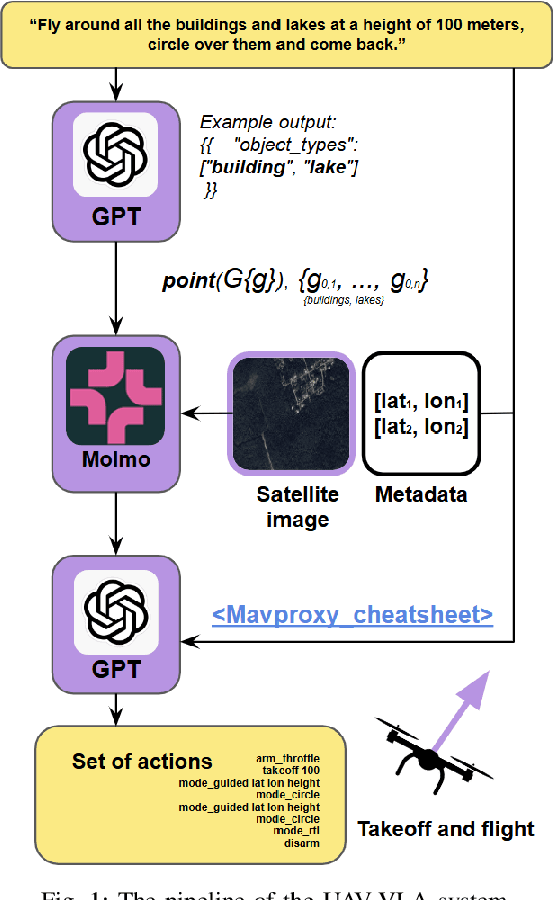
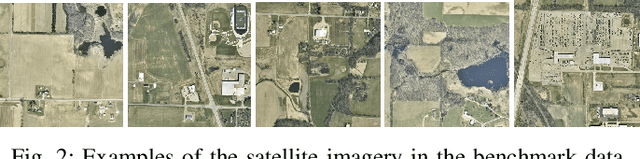
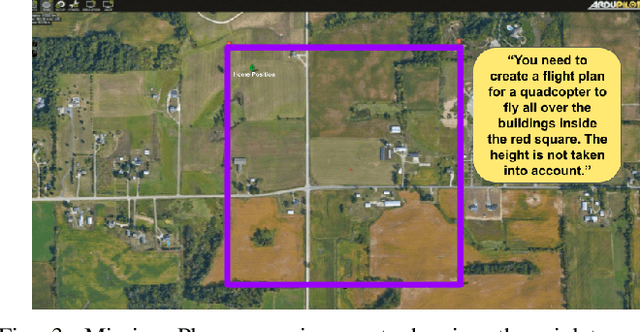
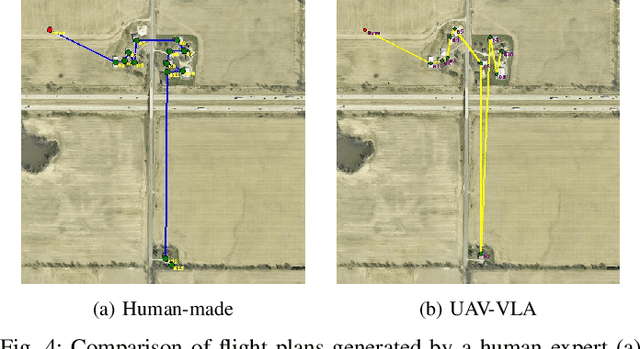
The UAV-VLA (Visual-Language-Action) system is a tool designed to facilitate communication with aerial robots. By integrating satellite imagery processing with the Visual Language Model (VLM) and the powerful capabilities of GPT, UAV-VLA enables users to generate general flight paths-and-action plans through simple text requests. This system leverages the rich contextual information provided by satellite images, allowing for enhanced decision-making and mission planning. The combination of visual analysis by VLM and natural language processing by GPT can provide the user with the path-and-action set, making aerial operations more efficient and accessible. The newly developed method showed the difference in the length of the created trajectory in 22% and the mean error in finding the objects of interest on a map in 34.22 m by Euclidean distance in the K-Nearest Neighbors (KNN) approach.