 Add to Chrome
 Add to Firefox
 Add to Edge
Contextual Bandits for Resource-Constrained Devices using Probabilistic Learning
May 13, 2026
Contextual bandits (CB) are online sequential decision-making problems under partial feedback that underpin many adaptive services. There is a growing demand to deploy CB agents directly on-device, under strict constraints on memory, compute, and energy. However, standard linear CB algorithms are often impractical for resource-constrained devices with their unfavorable scaling in computational and memory costs. Recently, HD-CB, a CB approach based on hyperdimensional computing principles, has been proposed to model and solve CB problems by moving into high-dimensional spaces. HD-CB offers faster convergence, favorable scalability, and improves memory efficiency compared to linear CB algorithms. However, its learning rule is accumulation-based: the values of action vectors grow over time, requiring high precision. While periodic binarization can prevent overflow in low-precision components, it may discard important information about magnitudes and degrade decision quality. This paper introduces probabilistic HD-CB, a low-precision variant that replaces deterministic accumulation with a probabilistic update rule. At each step, only a random subset of vector components is updated, with a time-decaying update probability, and component values are constrained to a predefined range [-k,+k]. This approach enables low-precision components, prevents overflow without periodic binarization, and reduces the expected update cost in proportion to the fraction of updated components. Off-policy evaluation on standardized synthetic CB benchmarks using the Open Bandit Pipeline shows that probabilistic HD-CB consistently outperforms binarized HD-CB at equal precision, while approaching the performance of HD-CB with as few as 3 bits per component.

How Embeddings Shape Graph Neural Networks: Classical vs Quantum-Oriented Node Representations
Apr 16, 2026Node embeddings act as the information interface for graph neural networks, yet their empirical impact is often reported under mismatched backbones, splits, and training budgets. This paper provides a controlled benchmark of embedding choices for graph classification, comparing classical baselines with quantum-oriented node representations under a unified pipeline. We evaluate two classical baselines alongside quantum-oriented alternatives, including a circuit-defined variational embedding and quantum-inspired embeddings computed via graph operators and linear-algebraic constructions. All variants are trained and tested with the same backbone, stratified splits, identical optimization and early stopping, and consistent metrics. Experiments on five different TU datasets and on QM9 converted to classification via target binning show clear dataset dependence: quantum-oriented embeddings yield the most consistent gains on structure-driven benchmarks, while social graphs with limited node attributes remain well served by classical baselines. The study highlights practical trade-offs between inductive bias, trainability, and stability under a fixed training budget, and offers a reproducible reference point for selecting quantum-oriented embeddings in graph learning.
Efficient Hyperdimensional Computing with Modular Composite Representations
Nov 12, 2025The modular composite representation (MCR) is a computing model that represents information with high-dimensional integer vectors using modular arithmetic. Originally proposed as a generalization of the binary spatter code model, it aims to provide higher representational power while remaining a lighter alternative to models requiring high-precision components. Despite this potential, MCR has received limited attention. Systematic analyses of its trade-offs and comparisons with other models are lacking, sustaining the perception that its added complexity outweighs the improved expressivity. In this work, we revisit MCR by presenting its first extensive evaluation, demonstrating that it achieves a unique balance of capacity, accuracy, and hardware efficiency. Experiments measuring capacity demonstrate that MCR outperforms binary and integer vectors while approaching complex-valued representations at a fraction of their memory footprint. Evaluation on 123 datasets confirms consistent accuracy gains and shows that MCR can match the performance of binary spatter codes using up to 4x less memory. We investigate the hardware realization of MCR by showing that it maps naturally to digital logic and by designing the first dedicated accelerator. Evaluations on basic operations and 7 selected datasets demonstrate a speedup of up to 3 orders of magnitude and significant energy reductions compared to software implementation. When matched for accuracy against binary spatter codes, MCR achieves on average 3.08x faster execution and 2.68x lower energy consumption. These findings demonstrate that, although MCR requires more sophisticated operations than binary spatter codes, its modular arithmetic and higher per-component precision enable lower dimensionality. When realized with dedicated hardware, this results in a faster, more energy-efficient, and high-precision alternative to existing models.
HD-CB: The First Exploration of Hyperdimensional Computing for Contextual Bandits Problems
Jan 28, 2025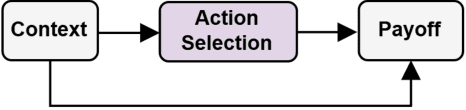
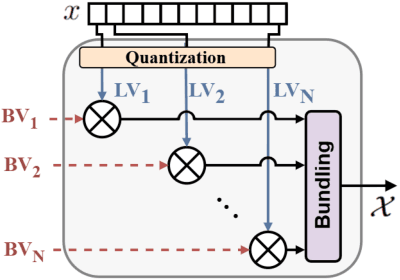
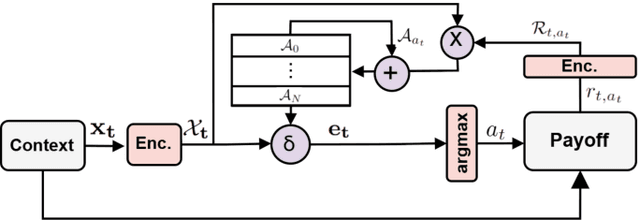
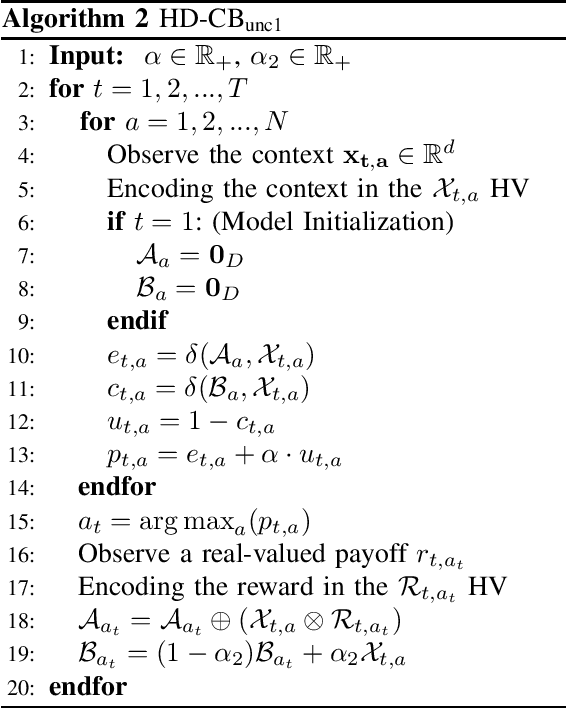
Hyperdimensional Computing (HDC), also known as Vector Symbolic Architectures, is a computing paradigm that combines the strengths of symbolic reasoning with the efficiency and scalability of distributed connectionist models in artificial intelligence. HDC has recently emerged as a promising alternative for performing learning tasks in resource-constrained environments thanks to its energy and computational efficiency, inherent parallelism, and resilience to noise and hardware faults. This work introduces the Hyperdimensional Contextual Bandits (HD-CB): the first exploration of HDC to model and automate sequential decision-making Contextual Bandits (CB) problems. The proposed approach maps environmental states in a high-dimensional space and represents each action with dedicated hypervectors (HVs). At each iteration, these HVs are used to select the optimal action for the given context and are updated based on the received reward, replacing computationally expensive ridge regression procedures required by traditional linear CB algorithms with simple, highly parallel vector operations. We propose four HD-CB variants, demonstrating their flexibility in implementing different exploration strategies, as well as techniques to reduce memory overhead and the number of hyperparameters. Extensive simulations on synthetic datasets and a real-world benchmark reveal that HD-CB consistently achieves competitive or superior performance compared to traditional linear CB algorithms, while offering faster convergence time, lower computational complexity, improved scalability, and high parallelism.
Hyperdimensional Computing for ADHD Classification using EEG Signals
Jan 09, 2025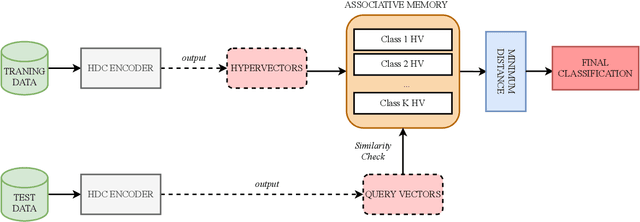
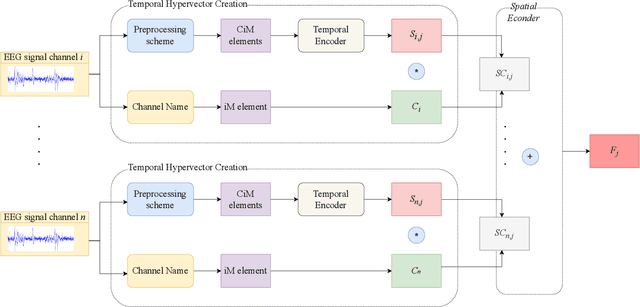


Following the recent interest in applying the Hyperdimensional Computing paradigm in medical context to power up the performance of general machine learning applied to biomedical data, this study represents the first attempt at employing such techniques to solve the problem of classification of Attention Deficit Hyperactivity Disorder using electroencephalogram signals. Making use of a spatio-temporal encoder, and leveraging the properties of HDC, the proposed model achieves an accuracy of 88.9%, outperforming traditional Deep Neural Networks benchmark models. The core of this research is not only to enhance the classification accuracy of the model but also to explore its efficiency in terms of the required training data: a critical finding of the study is the identification of the minimum number of patients needed in the training set to achieve a sufficient level of accuracy. To this end, the accuracy of our model trained with only $7$ of the $79$ patients is comparable to the one from benchmarks trained on the full dataset. This finding underscores the model's efficiency and its potential for quick and precise ADHD diagnosis in medical settings where large datasets are typically unattainable.
Q-SCALE: Quantum computing-based Sensor Calibration for Advanced Learning and Efficiency
Oct 03, 2024In a world burdened by air pollution, the integration of state-of-the-art sensor calibration techniques utilizing Quantum Computing (QC) and Machine Learning (ML) holds promise for enhancing the accuracy and efficiency of air quality monitoring systems in smart cities. This article investigates the process of calibrating inexpensive optical fine-dust sensors through advanced methodologies such as Deep Learning (DL) and Quantum Machine Learning (QML). The objective of the project is to compare four sophisticated algorithms from both the classical and quantum realms to discern their disparities and explore possible alternative approaches to improve the precision and dependability of particulate matter measurements in urban air quality surveillance. Classical Feed-Forward Neural Networks (FFNN) and Long Short-Term Memory (LSTM) models are evaluated against their quantum counterparts: Variational Quantum Regressors (VQR) and Quantum LSTM (QLSTM) circuits. Through meticulous testing, including hyperparameter optimization and cross-validation, the study assesses the potential of quantum models to refine calibration performance. Our analysis shows that: the FFNN model achieved superior calibration accuracy on the test set compared to the VQR model in terms of lower L1 loss function (2.92 vs 4.81); the QLSTM slightly outperformed the LSTM model (loss on the test set: 2.70 vs 2.77), despite using fewer trainable weights (66 vs 482).
From Graphs to Qubits: A Critical Review of Quantum Graph Neural Networks
Aug 12, 2024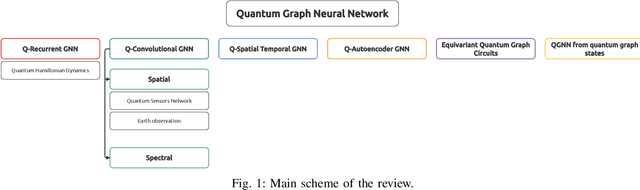
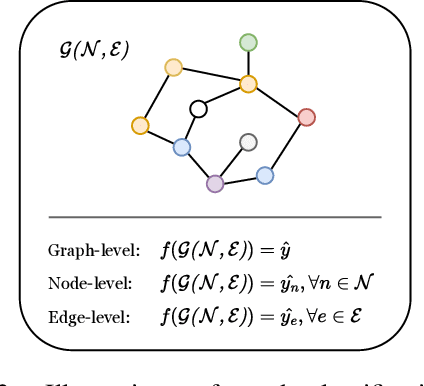
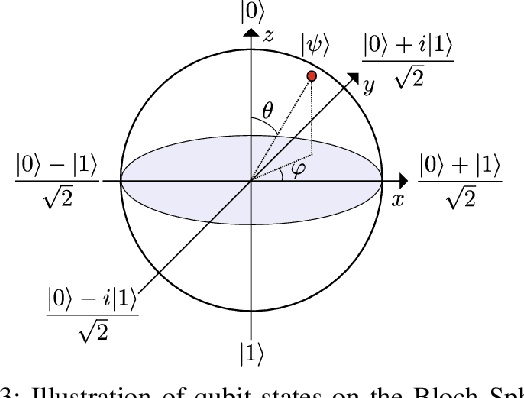

Quantum Graph Neural Networks (QGNNs) represent a novel fusion of quantum computing and Graph Neural Networks (GNNs), aimed at overcoming the computational and scalability challenges inherent in classical GNNs that are powerful tools for analyzing data with complex relational structures but suffer from limitations such as high computational complexity and over-smoothing in large-scale applications. Quantum computing, leveraging principles like superposition and entanglement, offers a pathway to enhanced computational capabilities. This paper critically reviews the state-of-the-art in QGNNs, exploring various architectures. We discuss their applications across diverse fields such as high-energy physics, molecular chemistry, finance and earth sciences, highlighting the potential for quantum advantage. Additionally, we address the significant challenges faced by QGNNs, including noise, decoherence, and scalability issues, proposing potential strategies to mitigate these problems. This comprehensive review aims to provide a foundational understanding of QGNNs, fostering further research and development in this promising interdisciplinary field.
An Explainable Fast Deep Neural Network for Emotion Recognition
Jul 20, 2024In the context of artificial intelligence, the inherent human attribute of engaging in logical reasoning to facilitate decision-making is mirrored by the concept of explainability, which pertains to the ability of a model to provide a clear and interpretable account of how it arrived at a particular outcome. This study explores explainability techniques for binary deep neural architectures in the framework of emotion classification through video analysis. We investigate the optimization of input features to binary classifiers for emotion recognition, with face landmarks detection using an improved version of the Integrated Gradients explainability method. The main contribution of this paper consists in the employment of an innovative explainable artificial intelligence algorithm to understand the crucial facial landmarks movements during emotional feeling, using this information also for improving the performances of deep learning-based emotion classifiers. By means of explainability, we can optimize the number and the position of the facial landmarks used as input features for facial emotion recognition, lowering the impact of noisy landmarks and thus increasing the accuracy of the developed models. In order to test the effectiveness of the proposed approach, we considered a set of deep binary models for emotion classification trained initially with a complete set of facial landmarks, which are progressively reduced based on a suitable optimization procedure. The obtained results prove the robustness of the proposed explainable approach in terms of understanding the relevance of the different facial points for the different emotions, also improving the classification accuracy and diminishing the computational cost.
Quasi-Chaotic Oscillators Based on Modular Quantum Circuits
Mar 26, 2022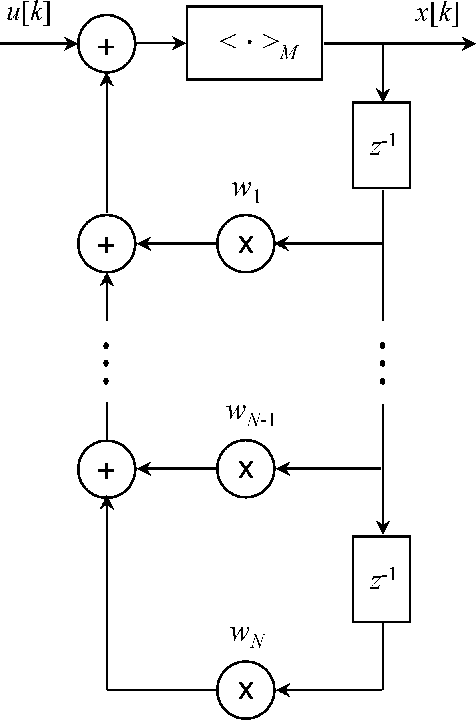
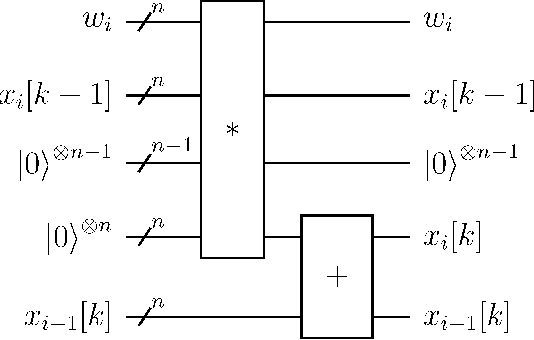
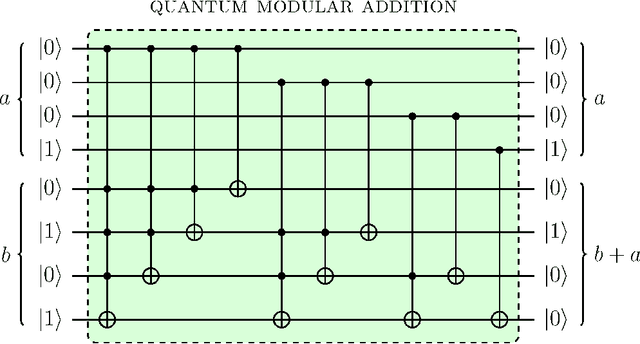
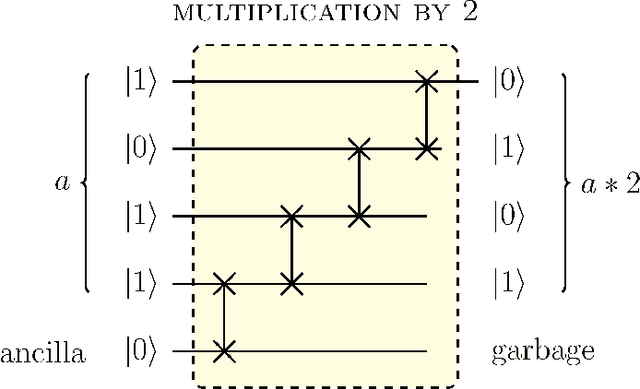
Digital circuits based on residue number systems have been considered to produce a pseudo-random behavior. The present work is an initial step towards the complete implementation of those systems for similar applications using quantum technology. We propose the implementation of a quasi-chaotic oscillator based on quantum modular addition and multiplication and we prove that quantum computing allows the parallel processing of data, paving the way for a fast and robust multi-channel encryption/decryption scheme. The resulting structure is assessed by several experiments in order to ascertain the desired noise-like behavior.
On Effects of Compression with Hyperdimensional Computing in Distributed Randomized Neural Networks
Jun 17, 2021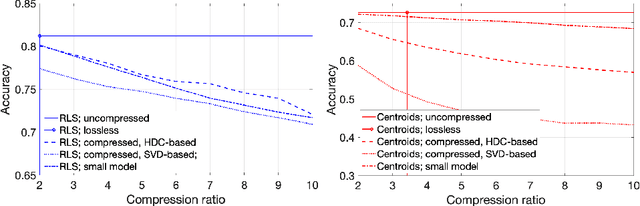
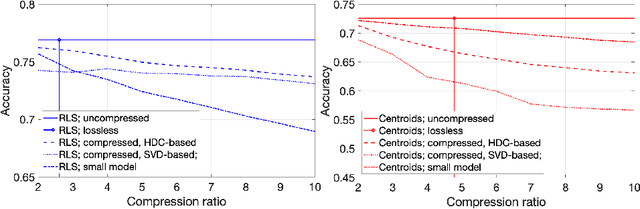
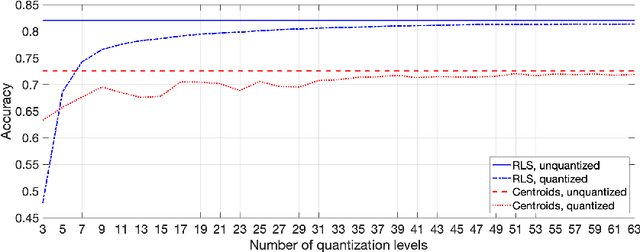
A change of the prevalent supervised learning techniques is foreseeable in the near future: from the complex, computational expensive algorithms to more flexible and elementary training ones. The strong revitalization of randomized algorithms can be framed in this prospect steering. We recently proposed a model for distributed classification based on randomized neural networks and hyperdimensional computing, which takes into account cost of information exchange between agents using compression. The use of compression is important as it addresses the issues related to the communication bottleneck, however, the original approach is rigid in the way the compression is used. Therefore, in this work, we propose a more flexible approach to compression and compare it to conventional compression algorithms, dimensionality reduction, and quantization techniques.