 Add to Chrome
 Add to Firefox
 Add to Edge
Hybrid Quantum CNN for Cross-Sensor Spaceborne Volcanic Thermal Activity Recognition Worldwide
Jul 29, 2026
As Earth Observation (EO) enters the Big Data era, the exponential volume of daily satellite imagery poses significant computational and storage challenges for classical Deep Learning (DL) models. Moreover, current approaches often struggle to generalize across heterogeneous sensors and volcanic environments while requiring large labeled datasets and substantial computational resources. These limitations are particularly critical for emerging On-Board Processing (OBP) applications, where memory, computational power, and annotated data are inherently limited. This work proposes a Hybrid Quantum AlexNet architecture for cross-sensor recognition of volcanic thermal activity at the global scale. The proposed model combines a classical convolutional backbone for high-level spatial features extraction with a parameterized quantum circuit (PQC) acting as a variational layer. By embedding high-level image representations into a high-dimensional Hilbert space, the quantum layer learns task-specific representations that enhance feature discrimination. Experimental results demonstrate that the proposed hybrid quantum model learns more discriminative feature representations, leading to improved cross-sensor transferability and robustness across heterogeneous volcanic environments using fewer trainable parameters and reduced training data than its classical counterpart.

Volcanic Clouds Detection through QCNN and Geostationary Satellite Multispectral Imagery
Jul 29, 2026Recent advances in quantum computing are opening new possibilities for Earth Observation (EO) data analysis. Quantum machine learning (QML) approaches offer novel ways to process information by exploiting quantum phenomena such as superposition and entanglement. These capabilities have motivated the exploration of whether quantum-enhanced models can address long-standing challenges in satellite remote sensing, where complex spectral and spatial signals often require sophisticated feature extraction. Among various fields of application, EO data allow the global monitoring of volcanic clouds and are crucial for aviation safety, hazard assessment, real-time eruption response, and evaluation of volcanic impacts on climate. Yet accurate detection of volcanic clouds remains difficult due to their similarity with meteorological clouds, the variability of eruption signatures, and the coarse spectral sampling of geostationary sensors. In this work, the potential of hybrid quantum convolutional neural networks (QCNNs) for the classification of satellite images containing volcanic clouds was investigated. These architectures integrate quantum computational layers into a classical convolutional framework. Two QCNN variants (with 2 and 4 qubits) have been considered to evaluate their ability to classify a dataset of SEVIRI images, including scenes with volcanic clouds (composed of ash, $SO_2$, or mixed components) as well as non-volcanic backgrounds. Finally, the performance of the hybrid QCNN models was compared with that of purely classical architectures.
On the impact of key design aspects in simulated Hybrid Quantum Neural Networks for Earth Observation
Oct 11, 2024
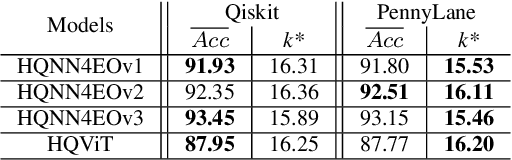
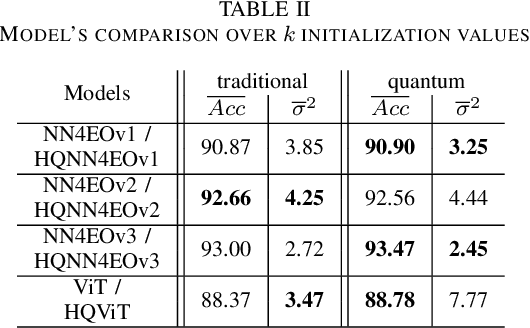
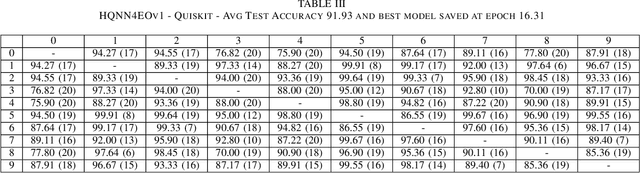
Quantum computing has introduced novel perspectives for tackling and improving machine learning tasks. Moreover, the integration of quantum technologies together with well-known deep learning (DL) architectures has emerged as a potential research trend gaining attraction across various domains, such as Earth Observation (EO) and many other research fields. However, prior related works in EO literature have mainly focused on convolutional architectural advancements, leaving several essential topics unexplored. Consequently, this research investigates through three cases of study fundamental aspects of hybrid quantum machine models for EO tasks aiming to provide a solid groundwork for future research studies towards more adequate simulations and looking at the post-NISQ era. More in detail, we firstly (1) investigate how different quantum libraries behave when training hybrid quantum models, assessing their computational efficiency and effectiveness. Secondly, (2) we analyze the stability/sensitivity to initialization values (i.e., seed values) in both traditional model and quantum-enhanced counterparts. Finally, (3) we explore the benefits of hybrid quantum attention-based models in EO applications, examining how integrating quantum circuits into ViTs can improve model performance.
Benchmarking of a new data splitting method on volcanic eruption data
Oct 08, 2024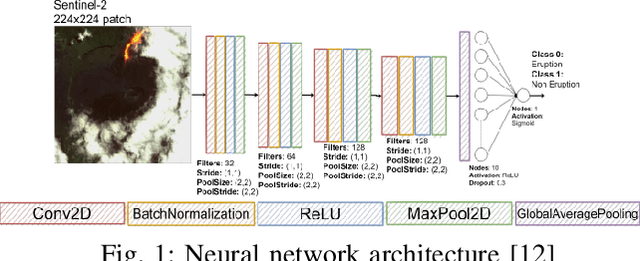
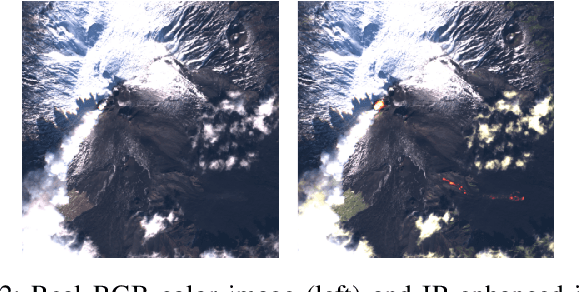
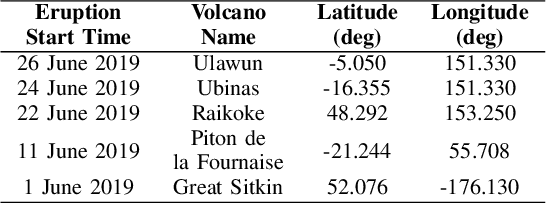

In this paper, a novel method for data splitting is presented: an iterative procedure divides the input dataset of volcanic eruption, chosen as the proposed use case, into two parts using a dissimilarity index calculated on the cumulative histograms of these two parts. The Cumulative Histogram Dissimilarity (CHD) index is introduced as part of the design. Based on the obtained results the proposed model in this case, compared to both Random splitting and K-means implemented over different configurations, achieves the best performance, with a slightly higher number of epochs. However, this demonstrates that the model can learn more deeply from the input dataset, which is attributable to the quality of the splitting. In fact, each model was trained with early stopping, suitable in case of overfitting, and the higher number of epochs in the proposed method demonstrates that early stopping did not detect overfitting, and consequently, the learning was optimal.
SEN12-WATER: A New Dataset for Hydrological Applications and its Benchmarking
Sep 25, 2024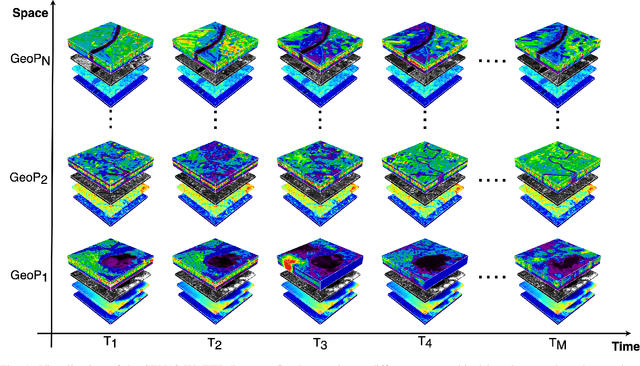

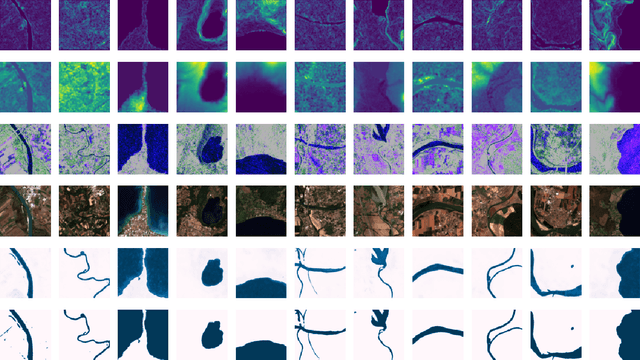

Climate change and increasing droughts pose significant challenges to water resource management around the world. These problems lead to severe water shortages that threaten ecosystems, agriculture, and human communities. To advance the fight against these challenges, we present a new dataset, SEN12-WATER, along with a benchmark using a novel end-to-end Deep Learning (DL) framework for proactive drought-related analysis. The dataset, identified as a spatiotemporal datacube, integrates SAR polarization, elevation, slope, and multispectral optical bands. Our DL framework enables the analysis and estimation of water losses over time in reservoirs of interest, revealing significant insights into water dynamics for drought analysis by examining temporal changes in physical quantities such as water volume. Our methodology takes advantage of the multitemporal and multimodal characteristics of the proposed dataset, enabling robust generalization and advancing understanding of drought, contributing to climate change resilience and sustainable water resource management. The proposed framework involves, among the several components, speckle noise removal from SAR data, a water body segmentation through a U-Net architecture, the time series analysis, and the predictive capability of a Time-Distributed-Convolutional Neural Network (TD-CNN). Results are validated through ground truth data acquired on-ground via dedicated sensors and (tailored) metrics, such as Precision, Recall, Intersection over Union, Mean Squared Error, Structural Similarity Index Measure and Peak Signal-to-Noise Ratio.
From Graphs to Qubits: A Critical Review of Quantum Graph Neural Networks
Aug 12, 2024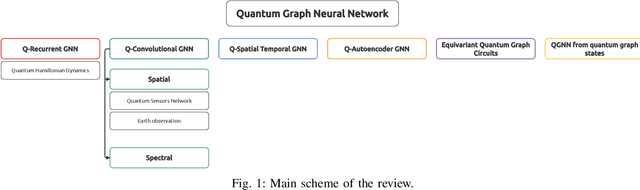
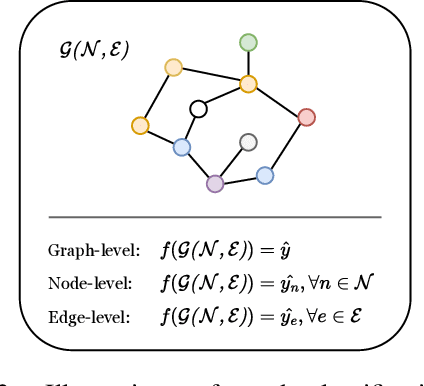
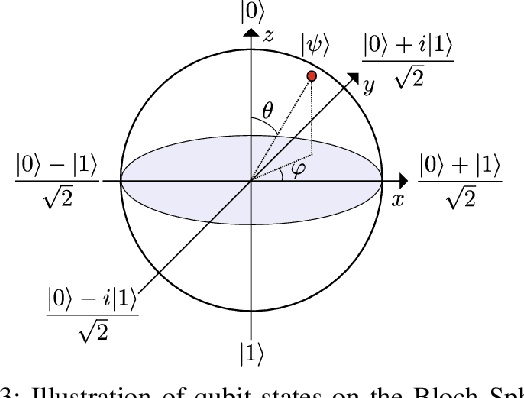

Quantum Graph Neural Networks (QGNNs) represent a novel fusion of quantum computing and Graph Neural Networks (GNNs), aimed at overcoming the computational and scalability challenges inherent in classical GNNs that are powerful tools for analyzing data with complex relational structures but suffer from limitations such as high computational complexity and over-smoothing in large-scale applications. Quantum computing, leveraging principles like superposition and entanglement, offers a pathway to enhanced computational capabilities. This paper critically reviews the state-of-the-art in QGNNs, exploring various architectures. We discuss their applications across diverse fields such as high-energy physics, molecular chemistry, finance and earth sciences, highlighting the potential for quantum advantage. Additionally, we address the significant challenges faced by QGNNs, including noise, decoherence, and scalability issues, proposing potential strategies to mitigate these problems. This comprehensive review aims to provide a foundational understanding of QGNNs, fostering further research and development in this promising interdisciplinary field.
Quanv4EO: Empowering Earth Observation by means of Quanvolutional Neural Networks
Jul 24, 2024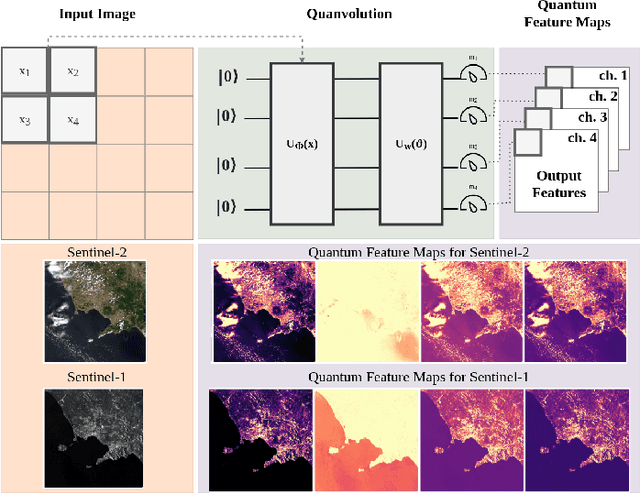
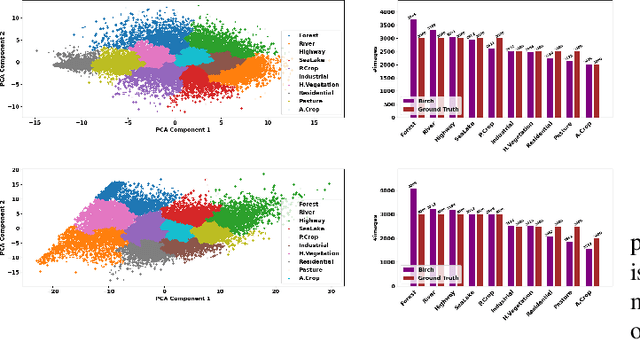
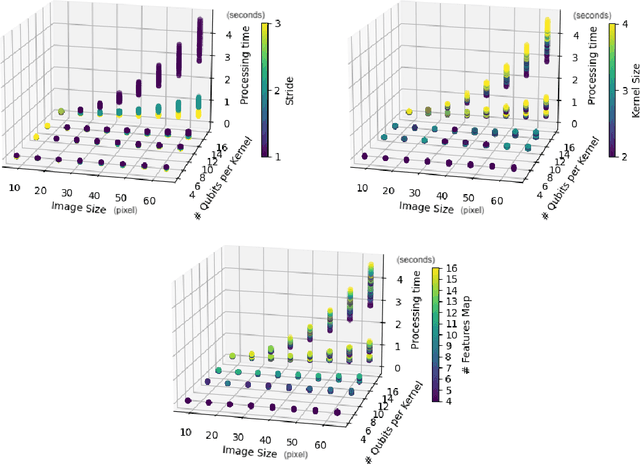
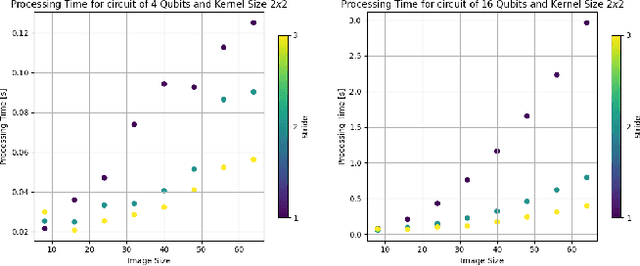
A significant amount of remotely sensed data is generated daily by many Earth observation (EO) spaceborne and airborne sensors over different countries of our planet. Different applications use those data, such as natural hazard monitoring, global climate change, urban planning, and more. Many challenges are brought by the use of these big data in the context of remote sensing applications. In recent years, employment of machine learning (ML) and deep learning (DL)-based algorithms have allowed a more efficient use of these data but the issues in managing, processing, and efficiently exploiting them have even increased since classical computers have reached their limits. This article highlights a significant shift towards leveraging quantum computing techniques in processing large volumes of remote sensing data. The proposed Quanv4EO model introduces a quanvolution method for preprocessing multi-dimensional EO data. First its effectiveness is demonstrated through image classification tasks on MNIST and Fashion MNIST datasets, and later on, its capabilities on remote sensing image classification and filtering are shown. Key findings suggest that the proposed model not only maintains high precision in image classification but also shows improvements of around 5\% in EO use cases compared to classical approaches. Moreover, the proposed framework stands out for its reduced parameter size and the absence of training quantum kernels, enabling better scalability for processing massive datasets. These advancements underscore the promising potential of quantum computing in addressing the limitations of classical algorithms in remote sensing applications, offering a more efficient and effective alternative for image data classification and analysis.
QSpeckleFilter: a Quantum Machine Learning approach for SAR speckle filtering
Feb 02, 2024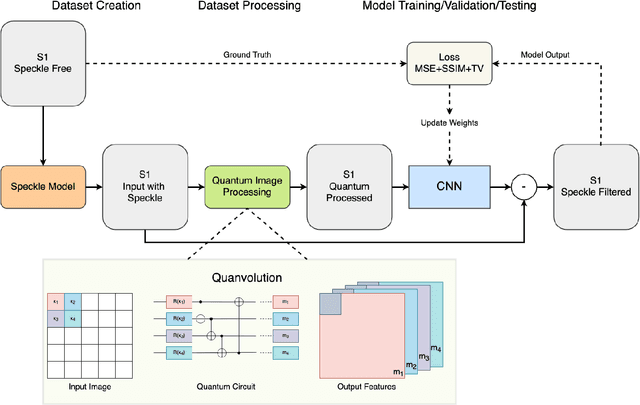
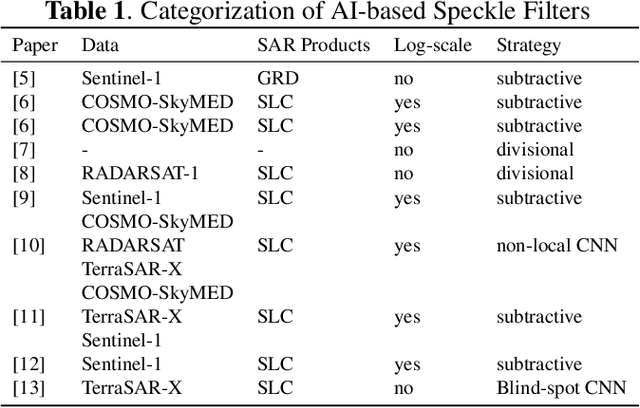
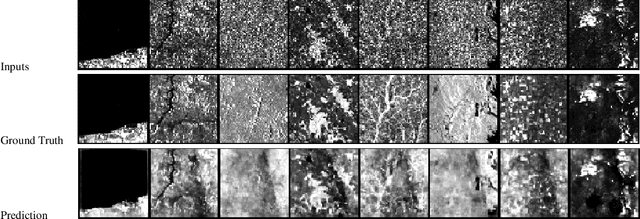
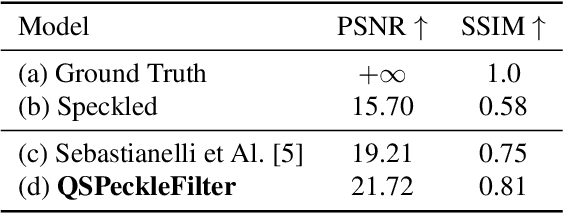
The use of Synthetic Aperture Radar (SAR) has greatly advanced our capacity for comprehensive Earth monitoring, providing detailed insights into terrestrial surface use and cover regardless of weather conditions, and at any time of day or night. However, SAR imagery quality is often compromised by speckle, a granular disturbance that poses challenges in producing accurate results without suitable data processing. In this context, the present paper explores the cutting-edge application of Quantum Machine Learning (QML) in speckle filtering, harnessing quantum algorithms to address computational complexities. We introduce here QSpeckleFilter, a novel QML model for SAR speckle filtering. The proposed method compared to a previous work from the same authors showcases its superior performance in terms of Peak Signal-to-Noise Ratio (PSNR) and Structural Similarity Index Measure (SSIM) on a testing dataset, and it opens new avenues for Earth Observation (EO) applications.
A Hybrid MLP-Quantum approach in Graph Convolutional Neural Networks for Oceanic Nino Index prediction
Jan 29, 2024This paper explores an innovative fusion of Quantum Computing (QC) and Artificial Intelligence (AI) through the development of a Hybrid Quantum Graph Convolutional Neural Network (HQGCNN), combining a Graph Convolutional Neural Network (GCNN) with a Quantum Multilayer Perceptron (MLP). The study highlights the potentialities of GCNNs in handling global-scale dependencies and proposes the HQGCNN for predicting complex phenomena such as the Oceanic Nino Index (ONI). Preliminary results suggest the model potential to surpass state-of-the-art (SOTA). The code will be made available with the paper publication.
Estimation of Ground NO2 Measurements from Sentinel-5P Tropospheric Data through Categorical Boosting
Apr 08, 2023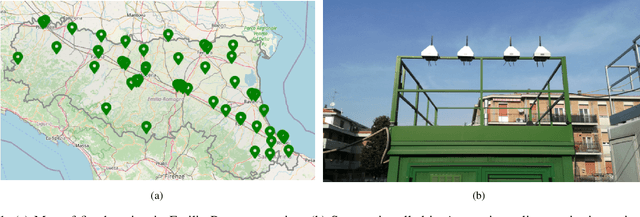
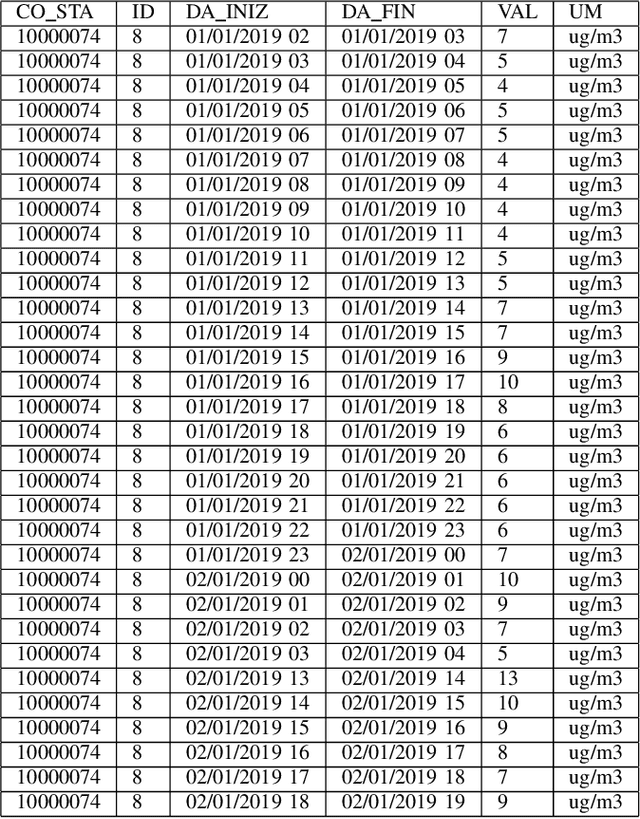
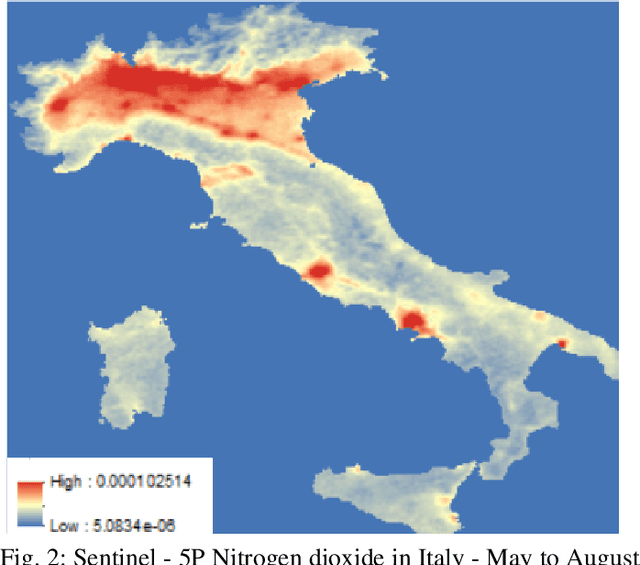
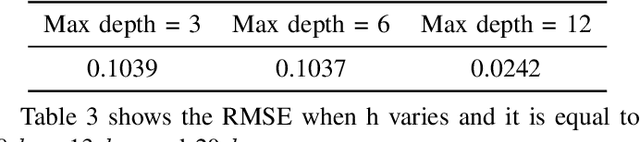
Atmospheric pollution has been largely considered by the scientific community as a primary threat to human health and ecosystems, above all for its impact on climate change. Therefore, its containment and reduction are gaining interest and commitment from institutions and researchers, although the solutions are not immediate. It becomes of primary importance to identify the distribution of air pollutants and evaluate their concentration levels in order to activate the right countermeasures. Among other tools, satellite-based measurements have been used for monitoring and obtaining information on air pollutants, and over the years their performance has increased in terms of both resolution and data reliability. This study aims to analyze the NO2 pollution in the Emilia Romagna Region (Northern Italy) during 2019, with the help of satellite retrievals from the {\nobreak Sentinel\nobreak-5P} mission of the European Copernicus Programme and ground-based measurements, obtained from the ARPA site (Regional Agency for the Protection of the Environment). The final goal is the estimation of ground NO2 measurements when only satellite data are available. For this task, we used a Machine Learning (ML) model, Categorical Boosting, which was demonstrated to work quite well and allowed us to achieve a Root-Mean-Square Error (RMSE) of 0.0242 over the 43 stations utilized to get the Ground Truth values. This procedure, applicable to other areas of Italy and the world and on longer timelines, represents the starting point to understand which other actions must be taken to improve its final performance.