 Add to Chrome
 Add to Firefox
 Add to Edge
FLUID: From Ephemeral IDs to Multimodal Semantic Codes for Industrial-Scale Livestreaming Recommendation
May 20, 2026
Modern recommender systems rely heavily on ID-based collaborative filtering: each item is represented by a unique ID embedding that accumulates collaborative signals from user interactions. Livestreaming recommendation, however, faces a unique challenge in this paradigm: a live room typically broadcasts for only tens of minutes, so its item ID remains poorly learned in a persistent cold-start state and ID-centric ranking models fail to generalize. We present FLUID, the first framework to fully retire the candidate-side item ID from a production-scale livestreaming ranker. FLUID couples a cross-domain multimodal encoder, jointly trained on short videos and livestreams to produce discrete hierarchical codes (LUCID), with a late-fusion, ID-free design that injects slice-level and room-level LUCID as independent tokens, stabilized by a staged warmup under online incremental training. Deployed on our industrial livestreaming recommenders with a cross-platform combined user base of over one billion globally, FLUID delivers significant online gains of +0.55% Quality Watch Duration, +2.05% Cold-Start Room Views, and +0.05% Active Hours.

FARTrack: Fast Autoregressive Visual Tracking with High Performance
Feb 03, 2026Inference speed and tracking performance are two critical evaluation metrics in the field of visual tracking. However, high-performance trackers often suffer from slow processing speeds, making them impractical for deployment on resource-constrained devices. To alleviate this issue, we propose FARTrack, a Fast Auto-Regressive Tracking framework. Since autoregression emphasizes the temporal nature of the trajectory sequence, it can maintain high performance while achieving efficient execution across various devices. FARTrack introduces Task-Specific Self-Distillation and Inter-frame Autoregressive Sparsification, designed from the perspectives of shallow-yet-accurate distillation and redundant-to-essential token optimization, respectively. Task-Specific Self-Distillation achieves model compression by distilling task-specific tokens layer by layer, enhancing the model's inference speed while avoiding suboptimal manual teacher-student layer pairs assignments. Meanwhile, Inter-frame Autoregressive Sparsification sequentially condenses multiple templates, avoiding additional runtime overhead while learning a temporally-global optimal sparsification strategy. FARTrack demonstrates outstanding speed and competitive performance. It delivers an AO of 70.6% on GOT-10k in real-time. Beyond, our fastest model achieves a speed of 343 FPS on the GPU and 121 FPS on the CPU.
FLAME: Frozen Large Language Models Enable Data-Efficient Language-Image Pre-training
Nov 18, 2024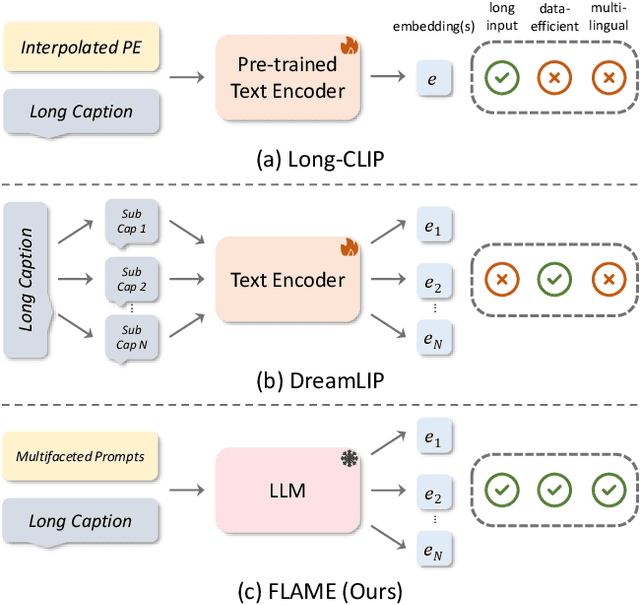
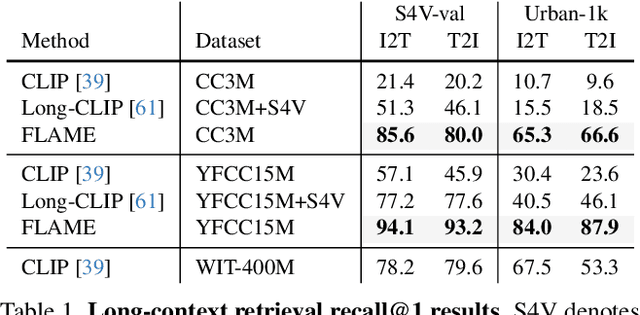
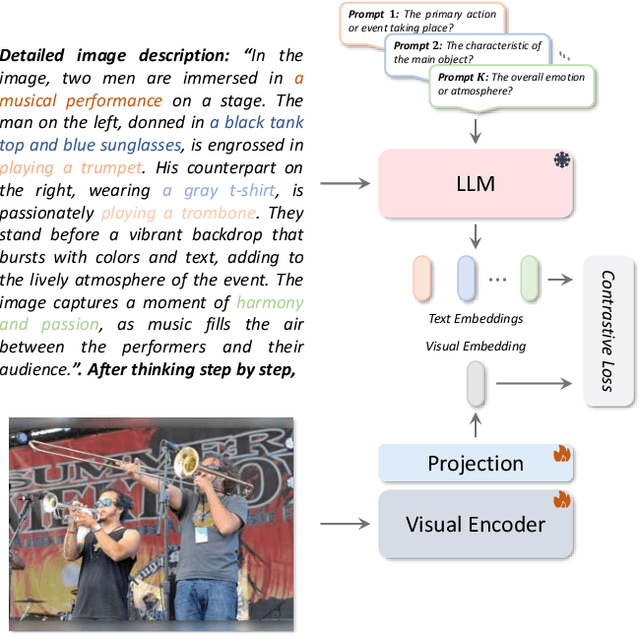
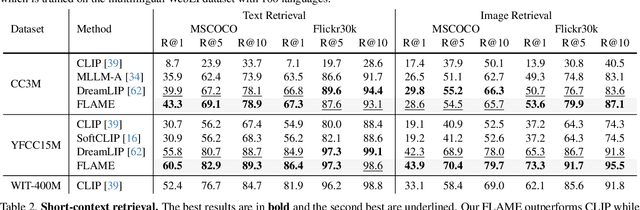
Language-image pre-training faces significant challenges due to limited data in specific formats and the constrained capacities of text encoders. While prevailing methods attempt to address these issues through data augmentation and architecture modifications, they continue to struggle with processing long-form text inputs, and the inherent limitations of traditional CLIP text encoders lead to suboptimal downstream generalization. In this paper, we propose FLAME (Frozen Large lAnguage Models Enable data-efficient language-image pre-training) that leverages frozen large language models as text encoders, naturally processing long text inputs and demonstrating impressive multilingual generalization. FLAME comprises two key components: 1) a multifaceted prompt distillation technique for extracting diverse semantic representations from long captions, which better aligns with the multifaceted nature of images, and 2) a facet-decoupled attention mechanism, complemented by an offline embedding strategy, to ensure efficient computation. Extensive empirical evaluations demonstrate FLAME's superior performance. When trained on CC3M, FLAME surpasses the previous state-of-the-art by 4.9\% in ImageNet top-1 accuracy. On YFCC15M, FLAME surpasses the WIT-400M-trained CLIP by 44.4\% in average image-to-text recall@1 across 36 languages, and by 34.6\% in text-to-image recall@1 for long-context retrieval on Urban-1k. Code is available at \url{https://github.com/MIV-XJTU/FLAME}.
Curriculum Dataset Distillation
May 15, 2024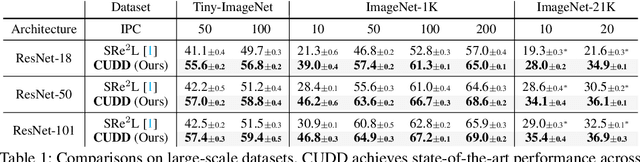


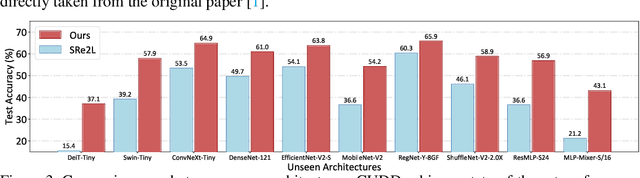
Most dataset distillation methods struggle to accommodate large-scale datasets due to their substantial computational and memory requirements. In this paper, we present a curriculum-based dataset distillation framework designed to harmonize scalability with efficiency. This framework strategically distills synthetic images, adhering to a curriculum that transitions from simple to complex. By incorporating curriculum evaluation, we address the issue of previous methods generating images that tend to be homogeneous and simplistic, doing so at a manageable computational cost. Furthermore, we introduce adversarial optimization towards synthetic images to further improve their representativeness and safeguard against their overfitting to the neural network involved in distilling. This enhances the generalization capability of the distilled images across various neural network architectures and also increases their robustness to noise. Extensive experiments demonstrate that our framework sets new benchmarks in large-scale dataset distillation, achieving substantial improvements of 11.1\% on Tiny-ImageNet, 9.0\% on ImageNet-1K, and 7.3\% on ImageNet-21K. The source code will be released to the community.