 Add to Chrome
 Add to Firefox
 Add to Edge
FARTrack: Fast Autoregressive Visual Tracking with High Performance
Feb 03, 2026
Inference speed and tracking performance are two critical evaluation metrics in the field of visual tracking. However, high-performance trackers often suffer from slow processing speeds, making them impractical for deployment on resource-constrained devices. To alleviate this issue, we propose FARTrack, a Fast Auto-Regressive Tracking framework. Since autoregression emphasizes the temporal nature of the trajectory sequence, it can maintain high performance while achieving efficient execution across various devices. FARTrack introduces Task-Specific Self-Distillation and Inter-frame Autoregressive Sparsification, designed from the perspectives of shallow-yet-accurate distillation and redundant-to-essential token optimization, respectively. Task-Specific Self-Distillation achieves model compression by distilling task-specific tokens layer by layer, enhancing the model's inference speed while avoiding suboptimal manual teacher-student layer pairs assignments. Meanwhile, Inter-frame Autoregressive Sparsification sequentially condenses multiple templates, avoiding additional runtime overhead while learning a temporally-global optimal sparsification strategy. FARTrack demonstrates outstanding speed and competitive performance. It delivers an AO of 70.6% on GOT-10k in real-time. Beyond, our fastest model achieves a speed of 343 FPS on the GPU and 121 FPS on the CPU.

JanusVLN: Decoupling Semantics and Spatiality with Dual Implicit Memory for Vision-Language Navigation
Sep 26, 2025
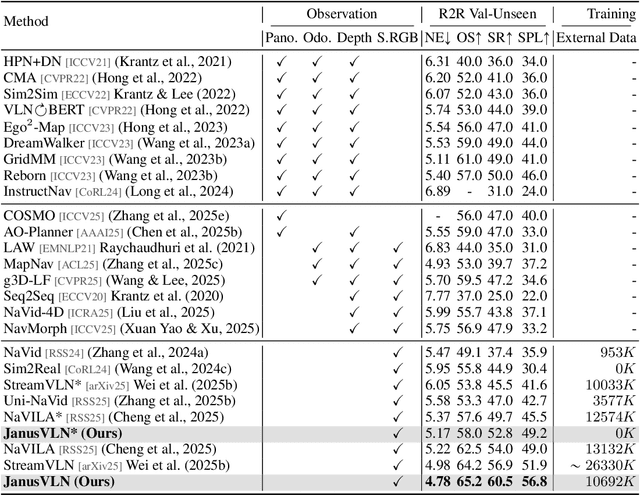
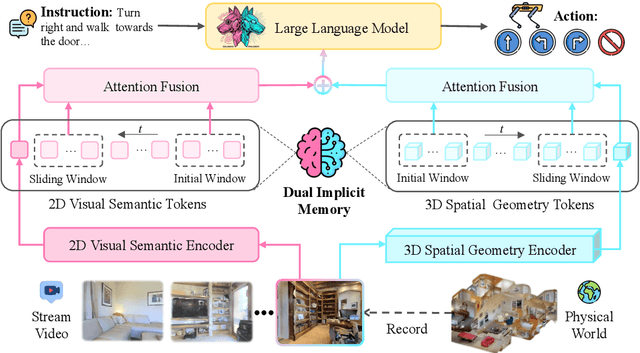
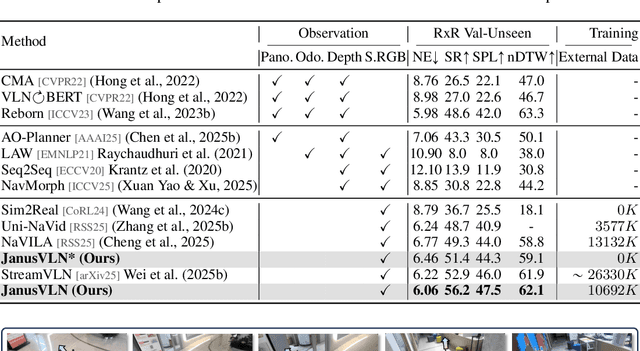
Vision-and-Language Navigation requires an embodied agent to navigate through unseen environments, guided by natural language instructions and a continuous video stream. Recent advances in VLN have been driven by the powerful semantic understanding of Multimodal Large Language Models. However, these methods typically rely on explicit semantic memory, such as building textual cognitive maps or storing historical visual frames. This type of method suffers from spatial information loss, computational redundancy, and memory bloat, which impede efficient navigation. Inspired by the implicit scene representation in human navigation, analogous to the left brain's semantic understanding and the right brain's spatial cognition, we propose JanusVLN, a novel VLN framework featuring a dual implicit neural memory that models spatial-geometric and visual-semantic memory as separate, compact, and fixed-size neural representations. This framework first extends the MLLM to incorporate 3D prior knowledge from the spatial-geometric encoder, thereby enhancing the spatial reasoning capabilities of models based solely on RGB input. Then, the historical key-value caches from the spatial-geometric and visual-semantic encoders are constructed into a dual implicit memory. By retaining only the KVs of tokens in the initial and sliding window, redundant computation is avoided, enabling efficient incremental updates. Extensive experiments demonstrate that JanusVLN outperforms over 20 recent methods to achieve SOTA performance. For example, the success rate improves by 10.5-35.5 compared to methods using multiple data types as input and by 3.6-10.8 compared to methods using more RGB training data. This indicates that the proposed dual implicit neural memory, as a novel paradigm, explores promising new directions for future VLN research. Ours project page: https://miv-xjtu.github.io/JanusVLN.github.io/.
UniMapGen: A Generative Framework for Large-Scale Map Construction from Multi-modal Data
Sep 26, 2025Large-scale map construction is foundational for critical applications such as autonomous driving and navigation systems. Traditional large-scale map construction approaches mainly rely on costly and inefficient special data collection vehicles and labor-intensive annotation processes. While existing satellite-based methods have demonstrated promising potential in enhancing the efficiency and coverage of map construction, they exhibit two major limitations: (1) inherent drawbacks of satellite data (e.g., occlusions, outdatedness) and (2) inefficient vectorization from perception-based methods, resulting in discontinuous and rough roads that require extensive post-processing. This paper presents a novel generative framework, UniMapGen, for large-scale map construction, offering three key innovations: (1) representing lane lines as \textbf{discrete sequence} and establishing an iterative strategy to generate more complete and smooth map vectors than traditional perception-based methods. (2) proposing a flexible architecture that supports \textbf{multi-modal} inputs, enabling dynamic selection among BEV, PV, and text prompt, to overcome the drawbacks of satellite data. (3) developing a \textbf{state update} strategy for global continuity and consistency of the constructed large-scale map. UniMapGen achieves state-of-the-art performance on the OpenSatMap dataset. Furthermore, UniMapGen can infer occluded roads and predict roads missing from dataset annotations. Our code will be released.