 Add to Chrome
 Add to Firefox
 Add to Edge
GRACE: Generative Recommender Acceleration Engine for Real-Time Ads Retrieval
Aug 02, 2026
Productionizing generative recommenders for high-volume, real-time ads retrieval creates two serving challenges: eligibility, ensuring that each generated ad is eligible for the request under the advertiser's audience targeting rules, and compute, which requires meeting strict latency and GPU cost requirements while remaining capable of generating thousands of ads per request with wide-beam decoding. This paper presents GRACE, a serving system for ads generative retrieval that addresses both challenges. For eligibility, GRACE introduces Generative Target Matching (GTM), which extends catalog-valid constrained decoding with personalized filtering over Semantic ID (SID) prefixes using bitmask and Bloom filter matchers derived from targeting rules. SID-level GTM improves final ad-level target matching pass rate from 23.55% to 40.42% over constrained decoding alone. For compute-cost and latency, GRACE targets encoder-decoder Transformers, which are more lightweight than LLMs. It redesigns the decoder around the wide-beam, short-sequence regime, covering attention kernels, KV cache, and beam search optimizations. On NVIDIA GH200, compared with the faster of FlashAttention-2 and FlashAttention-3 baselines, GRACE improves cross-attention latency by 68.0 times and self-attention latency by 23.4-25.8 times across decode steps. Together, these changes reduce decoder latency by 11.1 times, keeping ads generative retrieval within latency and compute requirements.

Controlling Pivoting Gait using Graph Model Predictive Control
Apr 19, 2021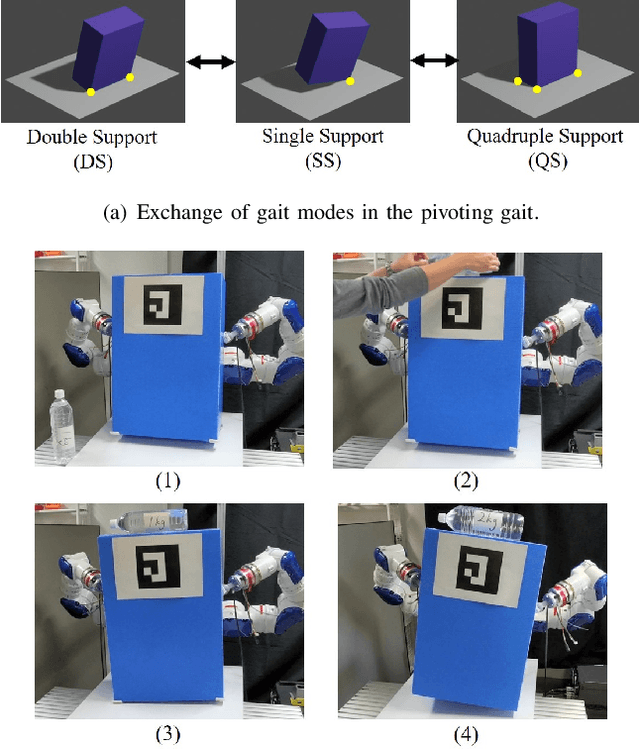
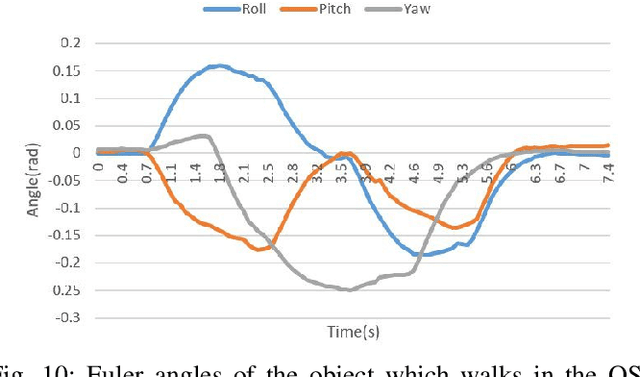


Pivoting gait is efficient for manipulating a big and heavy object with relatively small manipulating force, in which a robot iteratively tilts the object, rotates it around the vertex, and then puts it down to the floor. However, pivoting gait can easily fail even with a small external disturbance due to its instability in nature. To cope with this problem, we propose a controller to robustly control the object motion during the pivoting gait by introducing two gait modes, i.e., one is the double-support mode, which can manipulate a relatively light object with faster speed, and the other is the quadruple-support mode, which can manipulate a relatively heavy object with lower speed. To control the pivoting gait, a graph model predictive control is applied taking into account of these two gait modes. By adaptively switching the gait mode according to the applied external disturbance, a robot can stably perform the pivoting gait even if the external disturbance is applied to the object.