 Add to Chrome
 Add to Firefox
 Add to Edge
When Compression Scores Cannot Decide: Information Boundaries for Group-Robust LLM Pruning
Aug 06, 2026
A stable compression score can still select the worse model. In our dense study, a split-half reliable path-quadratic score predicted a 16.1\% gain, while the selected endpoints were 6.0--7.7% worse than two controls. We ask what a compression statistic can justify when deployment cares about the worst supplied group. We treat each statistic as an information interface. Its observation leaves a fiber of compatible endpoint-risk tables, and only orders fixed across that fiber are identified. Cone and fiber identities quantify the remaining uncertainty, while matched observations reverse endpoint order for pooled moments, group-local moments, and reference-path curvature. Sequential composition adds one state variable: the slack from each group risk to the current maximum. This vector determines every unrestricted one-step response, and a margin condition keeps the active group fixed along paths with bounded relative drift. The experiments follow the same ladder. Across three dense LLMs, an early-preserving allocation reduces worst-group perplexity inflation by 12.6--20.9%; target-matched complete-menu selection improves over its references by 2.7--8.0%. Across all 16 routed layers of OLMoE, pooled endpoint refresh lowers held-out worst-group teacher KL by 15.8% over the best static score. A compute-matched hard-max trajectory ends 32.7% worse than pooled, and neither adaptive trajectory improves excess NLL. Local evidence can narrow a menu. Complete endpoints rank that menu, while multistep claims also require control of the evolving active face and future candidates.

Agent Step Value: Auditing Evaluator-Channel Reversals in Black-Box Agent Traces
Jul 13, 2026When evaluator-derived step rewards are pooled or compared across scoring channels, their sign is treated as transportable. Yet the same frozen transition can change sign with the scoring channel. Process rewards vary agent states, while evaluator audits vary scoring configurations; neither first difference isolates their interaction. We define Agent Step Value (ASV) as channel-indexed target-margin gain and identify the missing state-by-channel interaction by replaying complete faces. Of 1,100 PubMed open question-answering transitions, 1,004 were complete across four cyclic layouts. Their mean update is positive under direct scoring (+0.163 [0.102, 0.218]) and negative with an externally generated view (-0.160 [-0.244, -0.079]), giving an interaction of -0.323 [-0.418, -0.232]. Across paired transitions, 507/1,004 cross zero in one direction or the other. Matched templates isolate a generated-minus-quote interaction of -1.121 [-1.534, -0.703]. Its direction remains negative after the readout and evaluator-stack changes, and quote yields a higher paired area under the receiver operating characteristic curve (AUC) for stored success at all three bridge vertices. Because the two views preserve the same task information conditional on the retained state, a representation-invariance null predicts equal responses and success rankings across them. ASV provides a transport audit for evaluator-derived step measurements; causal actor credit lies outside its estimand.
Agent Step Value: State-Transition Measurement with State-Grounded LLM Evaluators
Jul 05, 2026Most agent evaluations collapse a multi-step trace into a final answer, a success flag, or a trajectory-level score. These aggregates obscure the diagnostic question developers need most: which action changed the state in a useful direction? We introduce Agent Step Value (ASV), a state-transition measurement framework that scores each observed action by the change it induces in a state-grounded evaluator's distribution over fixed candidate outcomes. ASV renders redacted before/after state projections, uses a stateless LLM evaluator to assign candidate log scores, and reports both gold-free belief diagnostics and offline oracle validation metrics. A label-free rationale pass separates evaluator deliberation from one-token option scoring, preserving candidate likelihoods while exposing leakage and floor-score events. On 100 reviewed open-QA evidence-seeking tasks with live PubMed retrieval, a partially live DeepSeek actor, and DeepSeek log-probability scoring, ASV evaluates 1,100 steps and 2,200 states. Under the fixed-layout rationale-conditioned protocol, mean gold-margin gain is -2.335 (trajectory-bootstrap 95\% CI [-3.395, -1.272]), entropy movement is 0.000, and mean Bayesian surprise is 2.693. ASV therefore localizes constructive and destructive belief pivots that final-answer scores and entropy-only step metrics miss. We release the standalone ASV Eval toolkit.
Posterior-Aware Differential Channel Tracking for Reliable Single-Stream DAB+ Passive Radar
May 23, 2026Digital audio broadcasting plus (DAB+) is an attractive illuminator for passive radar because it provides persistent, high-power, and geographically widespread very high frequency (VHF) orthogonal frequency-division multiplexing (OFDM) signals. A channel state information (CSI) sensing approach can convert a single received DAB+ stream into a CSI sequence for radar sensing, avoiding the need for a separately received reference signal in conventional passive radars. However, CSI estimation in DAB+ is challenging due to the differentially encoded communication symbols across time. A wrong symbol transition estimation leads to a persistent multiplicative error in the sequential CSI sequence within a DAB+ frame. This paper formulates single-stream DAB+ passive radar as a posterior-probability-aware differential CSI tracking problem. The proposed method uses the previously tracked CSI as a channel prior, performs prediction-aided maximum a posteriori detection of current symbol, converts posterior transition reliability into observation uncertainty, and applies linear minimum mean squared error fusion to obtain a stable tracking CSI. A reliability-informed CSI fusion strategy is also introduced to preserve weak target information. Theoretical analysis is provided, showing guaranteed performance again in symbol and CSI estimation. Simulation results show that the proposed method can reduce CSI estimation error by over 15~dB compared with prior art. It also improves median target-to-background ratio by more than 11~dB in random fading scenes. Experiments in Sydney, Australia demonstrate improved range-Doppler maps for commercial aircraft sensing.
A multimodal and temporal foundation model for virtual patient representations at healthcare system scale
Apr 21, 2026Modern medicine generates vast multimodal data across siloed systems, yet no existing model integrates the full breadth and temporal depth of the clinical record into a unified patient representation. We introduce Apollo, a multimodal temporal foundation model trained and evaluated on over three decades of longitudinal hospital records from a major US hospital system, composed of 25 billion records from 7.2 million patients, representing 28 distinct medical modalities and 12 major medical specialties. Apollo learns a unified representation space integrating over 100 thousand unique medical events in our clinical vocabulary as well as images and clinical text. This "atlas of medical concepts" forms a computational substrate for modeling entire patient care journeys comprised of sequences of structured and unstructured events, which are compressed by Apollo into virtual patient representations. To assess the potential of these whole-patient representations, we created 322 prognosis and retrieval tasks from a held-out test set of 1.4 million patients. We demonstrate the generalized clinical forecasting potential of Apollo embeddings, including predicting new disease onset risk up to five years in advance (95 tasks), disease progression (78 tasks), treatment response (59 tasks), risk of treatment-related adverse events (17 tasks), and hospital operations endpoints (12 tasks). Using feature attribution techniques, we show that model predictions align with clinically-interpretable multimodal biomarkers. We evaluate semantic similarity search on 61 retrieval tasks, and moreover demonstrate the potential of Apollo as a multimodal medical search engine using text and image queries. Together, these modeling capabilities establish the foundation for computable medicine, where the full context of patient care becomes accessible to computational reasoning.
Persona Vectors in Games: Measuring and Steering Strategies via Activation Vectors
Mar 22, 2026Large language models (LLMs) are increasingly deployed as autonomous decision-makers in strategic settings, yet we have limited tools for understanding their high-level behavioral traits. We use activation steering methods in game-theoretic settings, constructing persona vectors for altruism, forgiveness, and expectations of others by contrastive activation addition. Evaluating on canonical games, we find that activation steering systematically shifts both quantitative strategic choices and natural-language justifications. However, we also observe that rhetoric and strategy can diverge under steering. In addition, vectors for self-behavior and expectations of others are partially distinct. Our results suggest that persona vectors offer a promising mechanistic handle on high-level traits in strategic environments.
SteerVLM: Robust Model Control through Lightweight Activation Steering for Vision Language Models
Oct 30, 2025This work introduces SteerVLM, a lightweight steering module designed to guide Vision-Language Models (VLMs) towards outputs that better adhere to desired instructions. Our approach learns from the latent embeddings of paired prompts encoding target and converse behaviors to dynamically adjust activations connecting the language modality with image context. This allows for fine-grained, inference-time control over complex output semantics without modifying model weights while preserving performance on off-target tasks. Our steering module requires learning parameters equal to 0.14% of the original VLM's size. Our steering module gains model control through dimension-wise activation modulation and adaptive steering across layers without requiring pre-extracted static vectors or manual tuning of intervention points. Furthermore, we introduce VNIA (Visual Narrative Intent Alignment), a multimodal dataset specifically created to facilitate the development and evaluation of VLM steering techniques. Our method outperforms existing intervention techniques on steering and hallucination mitigation benchmarks for VLMs and proposes a robust solution for multimodal model control through activation engineering.
Maximal Matching Matters: Preventing Representation Collapse for Robust Cross-Modal Retrieval
Jun 26, 2025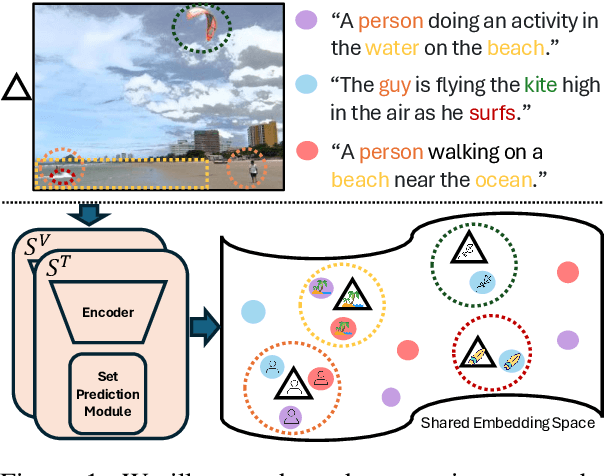
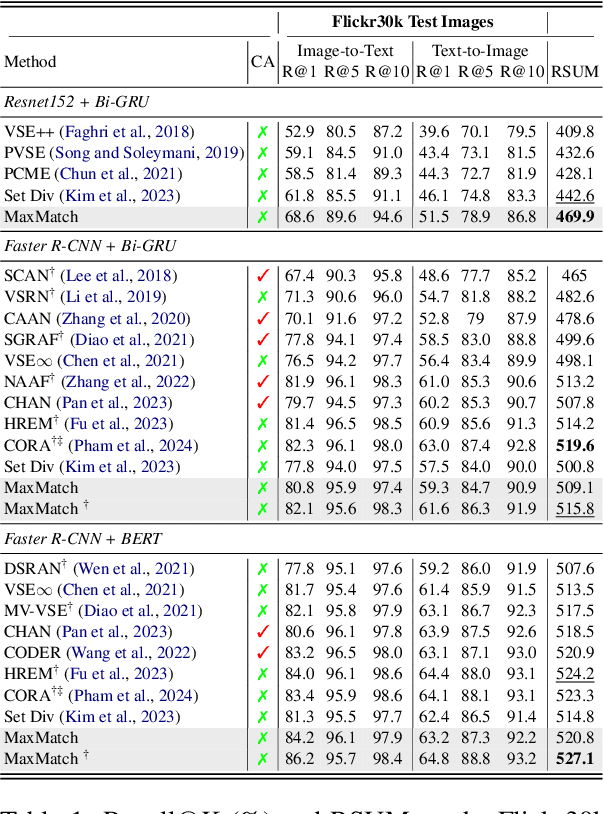
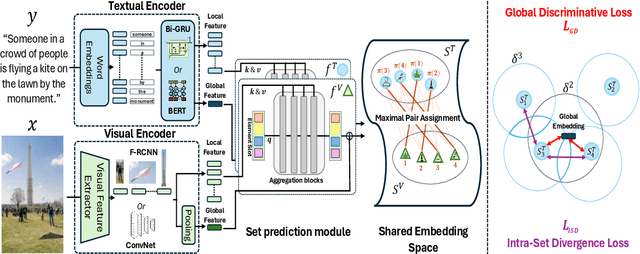
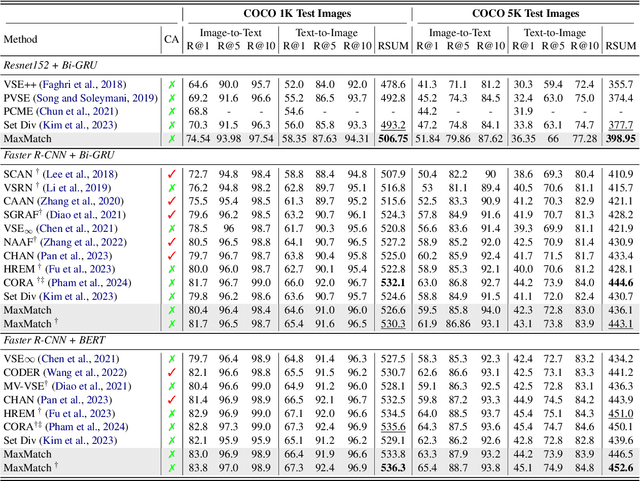
Cross-modal image-text retrieval is challenging because of the diverse possible associations between content from different modalities. Traditional methods learn a single-vector embedding to represent semantics of each sample, but struggle to capture nuanced and diverse relationships that can exist across modalities. Set-based approaches, which represent each sample with multiple embeddings, offer a promising alternative, as they can capture richer and more diverse relationships. In this paper, we show that, despite their promise, these set-based representations continue to face issues including sparse supervision and set collapse, which limits their effectiveness. To address these challenges, we propose Maximal Pair Assignment Similarity to optimize one-to-one matching between embedding sets which preserve semantic diversity within the set. We also introduce two loss functions to further enhance the representations: Global Discriminative Loss to enhance distinction among embeddings, and Intra-Set Divergence Loss to prevent collapse within each set. Our method achieves state-of-the-art performance on MS-COCO and Flickr30k without relying on external data.
Flexible-length Text Infilling for Discrete Diffusion Models
Jun 16, 2025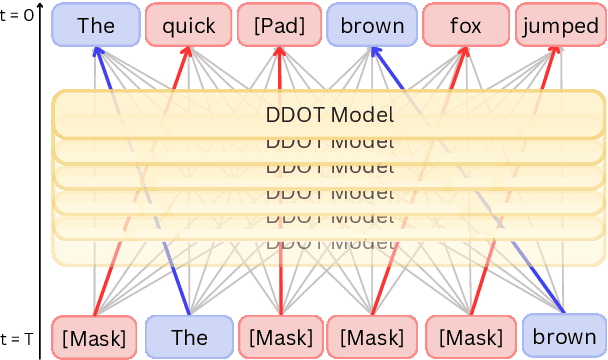
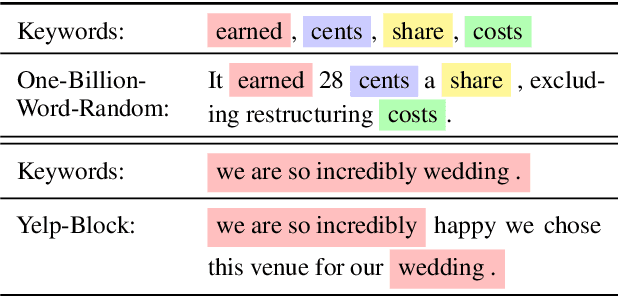
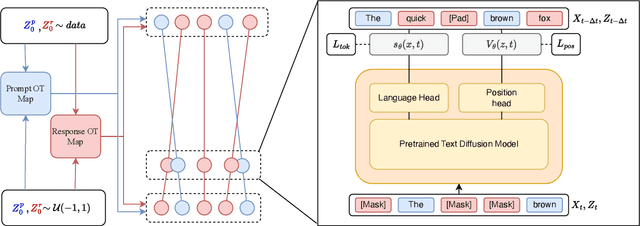

Discrete diffusion models are a new class of text generators that offer advantages such as bidirectional context use, parallelizable generation, and flexible prompting compared to autoregressive models. However, a critical limitation of discrete diffusion models is their inability to perform flexible-length or flexible-position text infilling without access to ground-truth positional data. We introduce \textbf{DDOT} (\textbf{D}iscrete \textbf{D}iffusion with \textbf{O}ptimal \textbf{T}ransport Position Coupling), the first discrete diffusion model to overcome this challenge. DDOT jointly denoises token values and token positions, employing a novel sample-level Optimal Transport (OT) coupling. This coupling preserves relative token ordering while dynamically adjusting the positions and length of infilled segments, a capability previously missing in text diffusion. Our method is orthogonal to existing discrete text diffusion methods and is compatible with various pretrained text denoisers. Extensive experiments on text infilling benchmarks such as One-Billion-Word and Yelp demonstrate that DDOT outperforms naive diffusion baselines. Furthermore, DDOT achieves performance on par with state-of-the-art non-autoregressive models and enables significant improvements in training efficiency and flexibility.
MAISY: Motion-Aware Image SYnthesis for Medical Image Motion Correction
May 08, 2025Patient motion during medical image acquisition causes blurring, ghosting, and distorts organs, which makes image interpretation challenging. Current state-of-the-art algorithms using Generative Adversarial Network (GAN)-based methods with their ability to learn the mappings between corrupted images and their ground truth via Structural Similarity Index Measure (SSIM) loss effectively generate motion-free images. However, we identified the following limitations: (i) they mainly focus on global structural characteristics and therefore overlook localized features that often carry critical pathological information, and (ii) the SSIM loss function struggles to handle images with varying pixel intensities, luminance factors, and variance. In this study, we propose Motion-Aware Image SYnthesis (MAISY) which initially characterize motion and then uses it for correction by: (a) leveraging the foundation model Segment Anything Model (SAM), to dynamically learn spatial patterns along anatomical boundaries where motion artifacts are most pronounced and, (b) introducing the Variance-Selective SSIM (VS-SSIM) loss which adaptively emphasizes spatial regions with high pixel variance to preserve essential anatomical details during artifact correction. Experiments on chest and head CT datasets demonstrate that our model outperformed the state-of-the-art counterparts, with Peak Signal-to-Noise Ratio (PSNR) increasing by 40%, SSIM by 10%, and Dice by 16%.