 Add to Chrome
 Add to Firefox
 Add to Edge
Reasoning-Guided Part-Level Visual Grounding via Reinforcement Learning
Jul 16, 2026
Multimodal large language models (MLLMs) ground whole objects well from free-form language queries, but they struggle when the query names a part rather than the object. We trace this to a missing object-part hierarchy, since parts are localized in the same single step used for objects. We propose Object-Part Hierarchical Reflective Grounding (OP-HRG), a coarse-to-fine reasoning-guided grounding strategy that first localizes the parent object and then the part within it. A self-check then reflects on the result, with an extension to re-encode the predicted crop to inspect the region it is correcting. We introduce a part-aware GRPO framework to train our pipeline with stage-wise rewards. A 4B model trained this way outperforms 7B grounding LLMs and SAM3 across PascalPart, PartImageNet, and InstructPart, and transfers to reasoning segmentation.

NEST: Narrative Event Structures in Time for Long Video Understanding
Jun 18, 2026Recent progress in vision-language models has enabled the processing of increasingly long video sequences, but the ability to handle extended token streams does not translate to understanding of narrative structure in long videos. Existing long video benchmarks focus on needle-in-a-haystack retrieval rather than evaluating how low-level actions form events, how events interact across time, and how narratives progress, for example, whether a model can connect an early setback, such as a job loss to a later relationship breakup, despite long gaps, intervening scenes, or flashbacks that reframe what occurred. We introduce NEST (Narrative Event Structures in Time for Long Video Understanding), a dataset of 1005 full-length movies (avg. 98 minutes), each annotated with 102 multimodal narrative events grounded in visual content, dialogue, and audio. NEST captures multimodal narrative events with structured annotations grounded in visual content, dialogue, and audio, and links them through relations that reflect narrative structure, including temporal ordering, hierarchical composition, and long-range dependencies. We introduce baselines for event trigger detection (ETD), event localization (EL), event argument extraction (EAE), and event relation extraction (ERE). The benchmark is highly challenging for grounded event discovery, with ETD below 8%, EL under 6%, and EAE below 11%. In contrast, ERE is more tractable once events are given, reaching 35.45% F1 zero-shot and 44.42% F1 after fine-tuning.
Maximal Matching Matters: Preventing Representation Collapse for Robust Cross-Modal Retrieval
Jun 26, 2025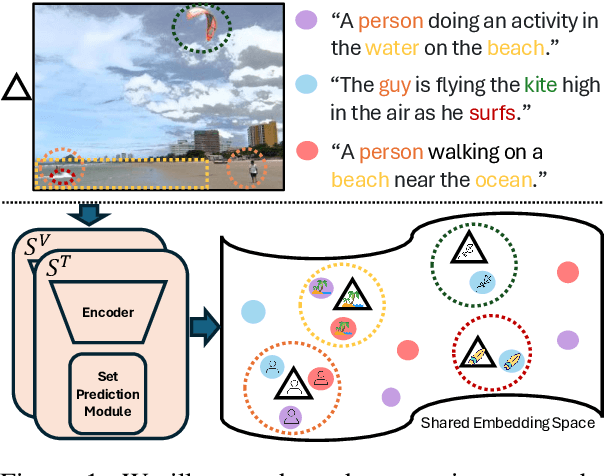
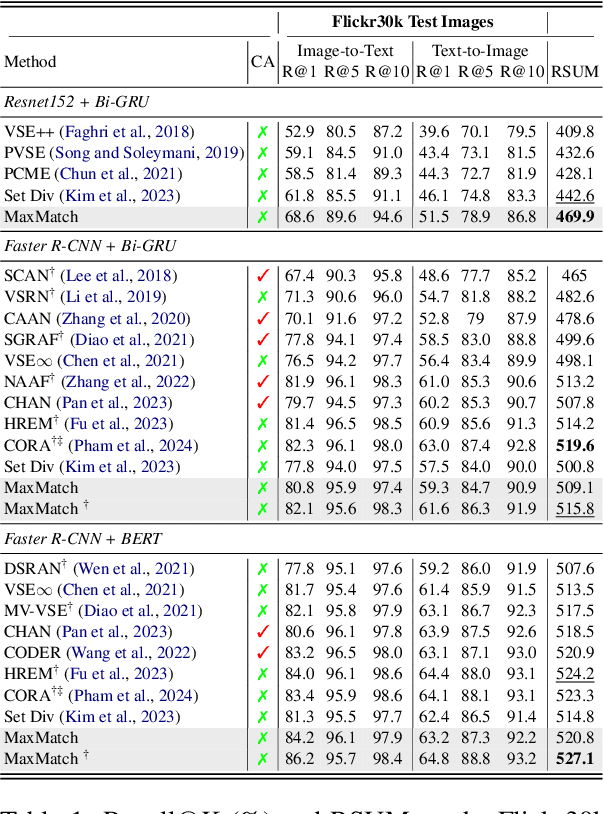
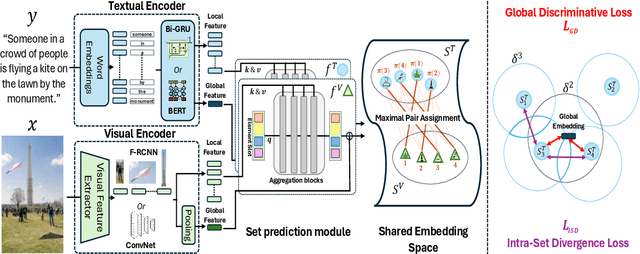
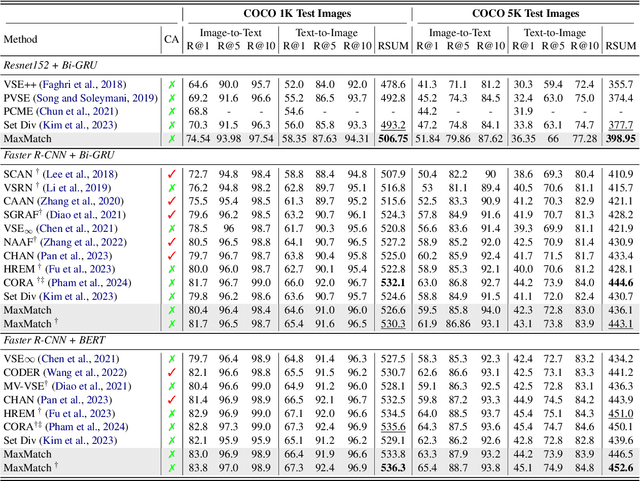
Cross-modal image-text retrieval is challenging because of the diverse possible associations between content from different modalities. Traditional methods learn a single-vector embedding to represent semantics of each sample, but struggle to capture nuanced and diverse relationships that can exist across modalities. Set-based approaches, which represent each sample with multiple embeddings, offer a promising alternative, as they can capture richer and more diverse relationships. In this paper, we show that, despite their promise, these set-based representations continue to face issues including sparse supervision and set collapse, which limits their effectiveness. To address these challenges, we propose Maximal Pair Assignment Similarity to optimize one-to-one matching between embedding sets which preserve semantic diversity within the set. We also introduce two loss functions to further enhance the representations: Global Discriminative Loss to enhance distinction among embeddings, and Intra-Set Divergence Loss to prevent collapse within each set. Our method achieves state-of-the-art performance on MS-COCO and Flickr30k without relying on external data.
ENTER: Event Based Interpretable Reasoning for VideoQA
Jan 24, 2025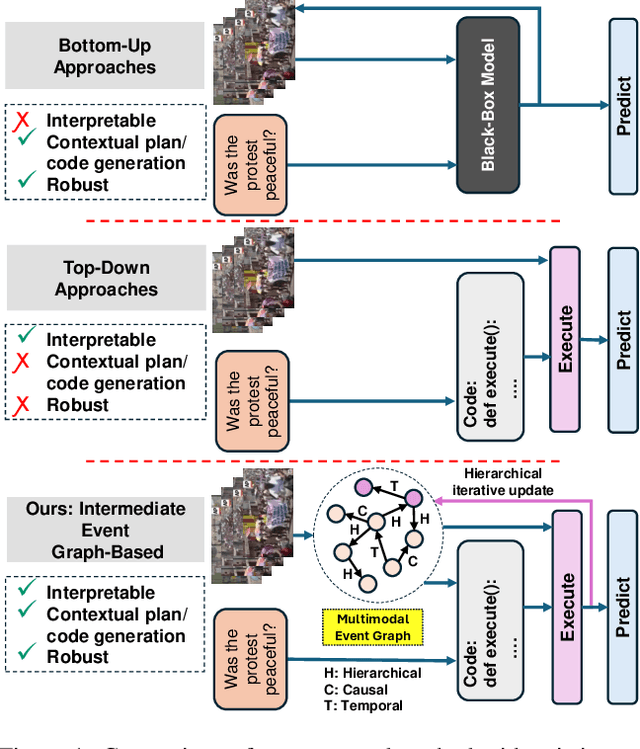
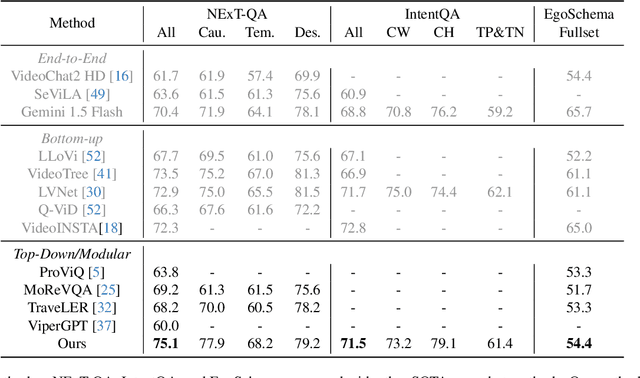
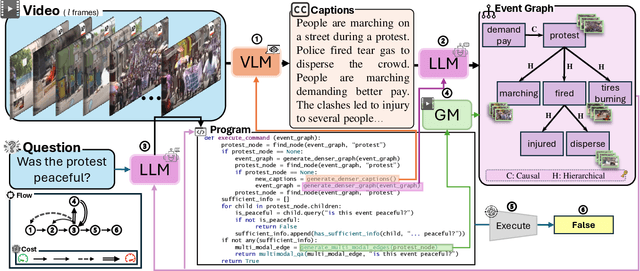
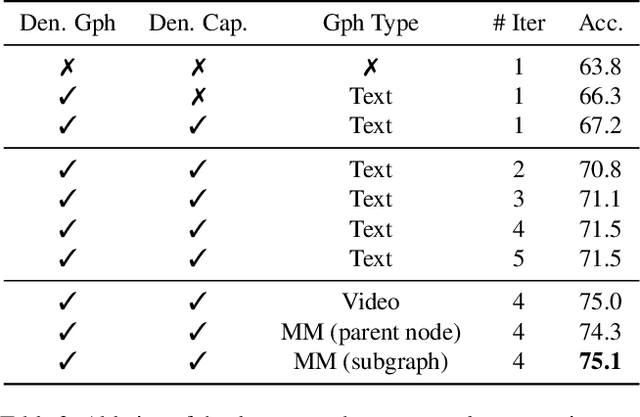
In this paper, we present ENTER, an interpretable Video Question Answering (VideoQA) system based on event graphs. Event graphs convert videos into graphical representations, where video events form the nodes and event-event relationships (temporal/causal/hierarchical) form the edges. This structured representation offers many benefits: 1) Interpretable VideoQA via generated code that parses event-graph; 2) Incorporation of contextual visual information in the reasoning process (code generation) via event graphs; 3) Robust VideoQA via Hierarchical Iterative Update of the event graphs. Existing interpretable VideoQA systems are often top-down, disregarding low-level visual information in the reasoning plan generation, and are brittle. While bottom-up approaches produce responses from visual data, they lack interpretability. Experimental results on NExT-QA, IntentQA, and EgoSchema demonstrate that not only does our method outperform existing top-down approaches while obtaining competitive performance against bottom-up approaches, but more importantly, offers superior interpretability and explainability in the reasoning process.