 Add to Chrome
 Add to Firefox
 Add to Edge
TESSERA v2: Scaling Pixel-wise Earth Foundation Models
Jul 04, 2026
Pixel-wise Earth-observation (EO) foundation models are now achieving state-of-the-art performance via generated spatial embeddings. However, how these models scale and how best to spend a pretraining budget remain poorly understood. We present the largest controlled scaling study for EO to date: 395 training runs on 1,024 GH200 superchips within a fixed pixel-wise Barlow Twins family, each evaluated on 15 downstream tasks. We find that pretraining loss barely predicts downstream performance (|Pearson r| < 0.2), so selecting models by loss wastes a large share of the compute. We also find that, as the training budget grows, the encoder and the data should grow together while the projector stays fixed, which gives a simple rule for allocating compute. Using this rule, we train a family of pixel-wise models (0.5B and 1B, with a 2B model in training) and distill them into compact students for embeddings-as-data deployment. The 21-million-parameter distilled TESSERA v2-1B-M in aggregate outperforms all open and proprietary models tested, some of which are orders of magnitude larger. These students produce Matryoshka representations that are inexpensive to serve: a 16-dimensional prefix keeps 92% of the full 128-dimensional performance at 1/8 of the storage. Upon completion of training we plan to release v2 global embeddings covering 2017-2025. Together, these results give a concrete, empirically grounded recipe for scaling pixel-wise EO foundation models: train large encoders, select by downstream performance, and distil into flexible student models. All code will be released at https://github.com/ucam-eo/tessera.

Embedding -based Crop Type Classification in the Groundnut Basin of Senegal
Jan 23, 2026Crop type maps from satellite remote sensing are important tools for food security, local livelihood support and climate change mitigation in smallholder regions of the world, but most satellite-based methods are not well suited to smallholder conditions. To address this gap, we establish a four-part criteria for a useful embedding-based approach consisting of 1) performance, 2) plausibility, 3) transferability and 4) accessibility and evaluate geospatial foundation model (FM) embeddings -based approaches using TESSERA and AlphaEarth against current baseline methods for a region in the groundnut basin of Senegal. We find that the TESSERA -based approach to land cover and crop type mapping fulfills the selection criteria best, and in one temporal transfer example shows 28% higher accuracy compared to the next best method. These results indicate that TESSERA embeddings are an effective approach for crop type classification and mapping tasks in Senegal.
MAGIC: Modular Auto-encoder for Generalisable Model Inversion with Bias Corrections
May 29, 2024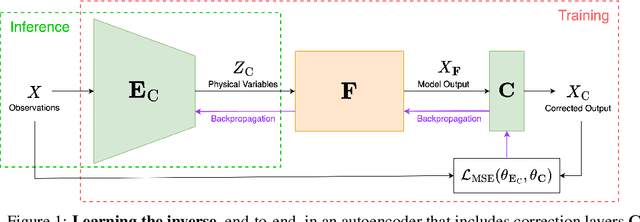


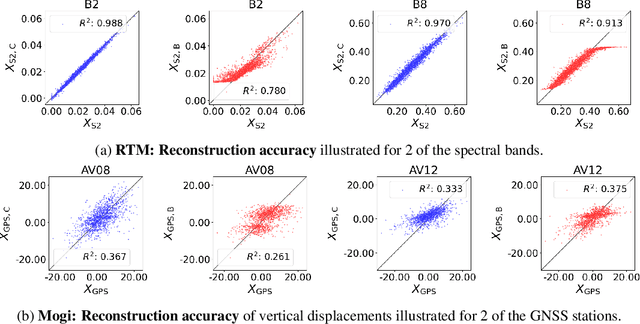
Scientists often model physical processes to understand the natural world and uncover the causation behind observations. Due to unavoidable simplification, discrepancies often arise between model predictions and actual observations, in the form of systematic biases, whose impact varies with model completeness. Classical model inversion methods such as Bayesian inference or regressive neural networks tend either to overlook biases or make assumptions about their nature during data preprocessing, potentially leading to implausible results. Inspired by recent work in inverse graphics, we replace the decoder stage of a standard autoencoder with a physical model followed by a bias-correction layer. This generalisable approach simultaneously inverts the model and corrects its biases in an end-to-end manner without making strong assumptions about the nature of the biases. We demonstrate the effectiveness of our approach using two physical models from disparate domains: a complex radiative transfer model from remote sensing; and a volcanic deformation model from geodesy. Our method matches or surpasses results from classical approaches without requiring biases to be explicitly filtered out, suggesting an effective pathway for understanding the causation of various physical processes.
From Spectra to Biophysical Insights: End-to-End Learning with a Biased Radiative Transfer Model
Mar 05, 2024
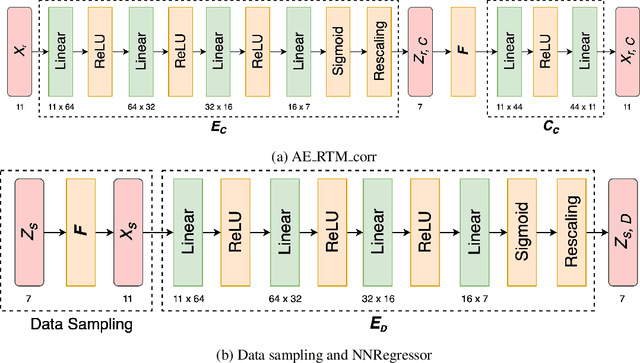

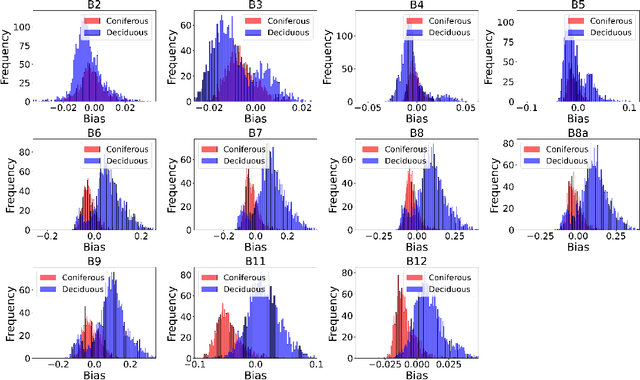
Advances in machine learning have boosted the use of Earth observation data for climate change research. Yet, the interpretability of machine-learned representations remains a challenge, particularly in understanding forests' biophysical reactions to climate change. Traditional methods in remote sensing that invert radiative transfer models (RTMs) to retrieve biophysical variables from spectral data often fail to account for biases inherent in the RTM, especially for complex forests. We propose to integrate RTMs into an auto-encoder architecture, creating an end-to-end learning approach. Our method not only corrects biases in RTMs but also outperforms traditional techniques for variable retrieval like neural network regression. Furthermore, our framework has potential generally for inverting biased physical models. The code is available on https://github.com/yihshe/ai-refined-rtm.git.
Imagining the Unseen: Learning a Distribution over Incomplete Images with Dense Latent Trees
Aug 14, 2018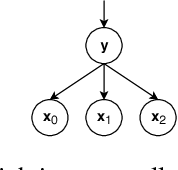
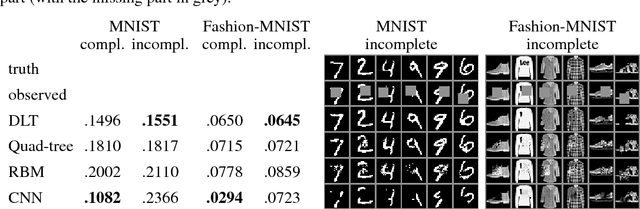
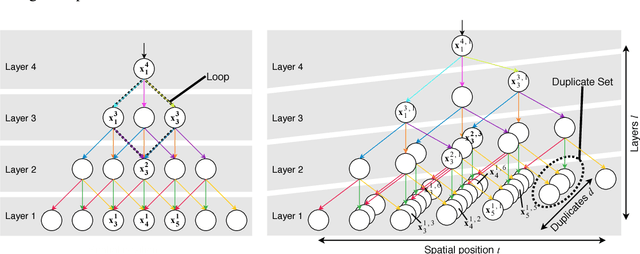
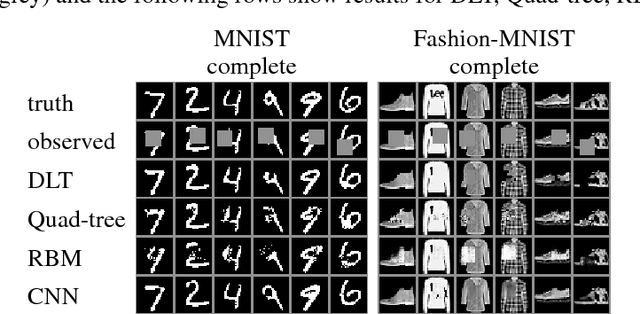
Images are composed as a hierarchy of object parts. We use this insight to create a generative graphical model that defines a hierarchical distribution over image parts. Typically, this leads to intractable inference due to loops in the graph. We propose an alternative model structure, the Dense Latent Tree (DLT), which avoids loops and allows for efficient exact inference, while maintaining a dense connectivity between parts of the hierarchy. The usefulness of DLTs is shown for the example task of image completion on partially observed MNIST and Fashion-MNIST data. We verify having successfully learned a hierarchical model of images by visualising its latent states.
Efficient Computation of Collision Probabilities for Safe Motion Planning
Apr 15, 2018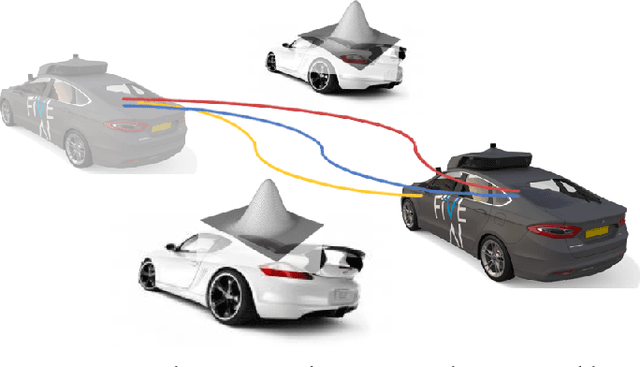
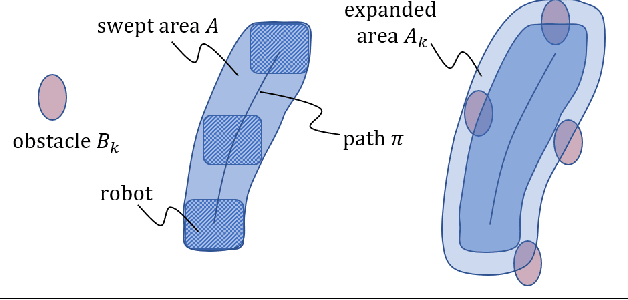
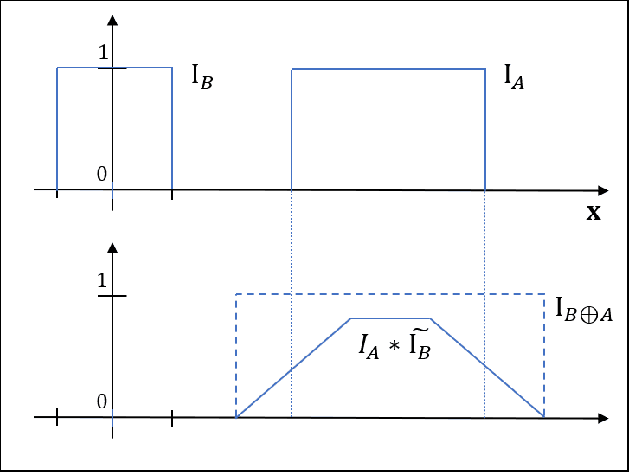
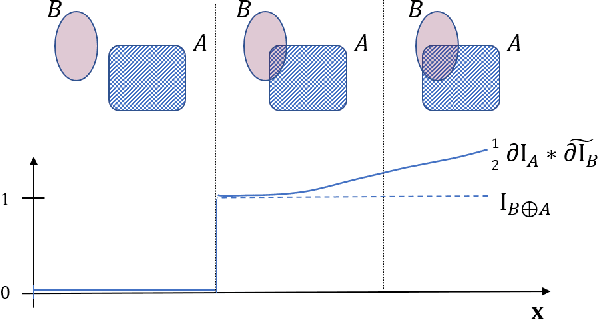
We address the problem of safe motion planning. As mobile robots and autonomous vehicles become increasingly more prevalent in human-centered environments, the need to ensure safety in the sense of guaranteed collision free behaviour has taken renewed urgency. Achieving this when perceptual modules provide only noisy estimates of objects in the environment requires new approaches. Working within a probabilistic framework for describing the environment, we present methods for efficiently calculating a probabilistic risk of collision for a candidate path. This may be used to stratify a set of candidate trajectories by levels of a safety threshold. Given such a stratification, based on user-defined thresholds, motion synthesis techniques could optimise for secondary criteria with the assurance that a primary safety criterion is already being satisfied. A key contribution of this paper is the use of a `convolution trick' to factor the calculation of integrals providing bounds on collision risk, enabling an $O(1)$ computation even in cluttered and complex environments.
Bayesian Inference for NMR Spectroscopy with Applications to Chemical Quantification
Feb 24, 2014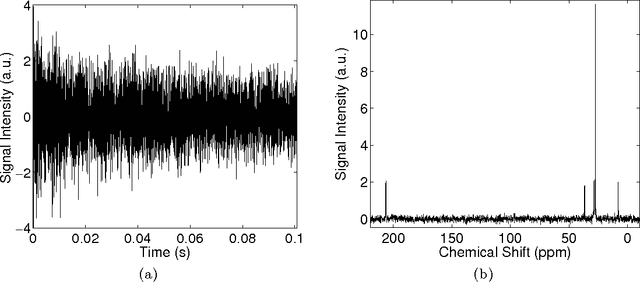
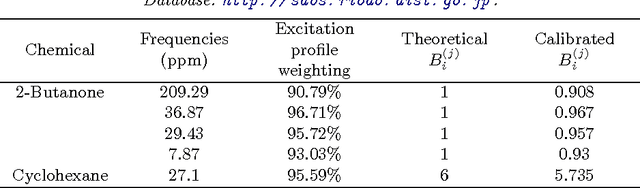
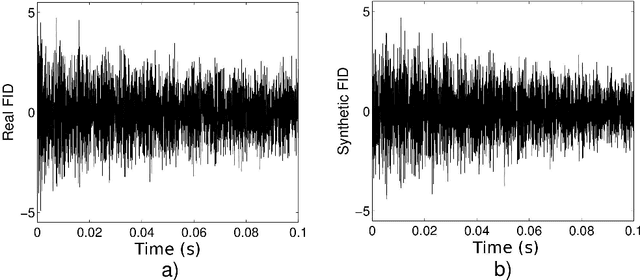
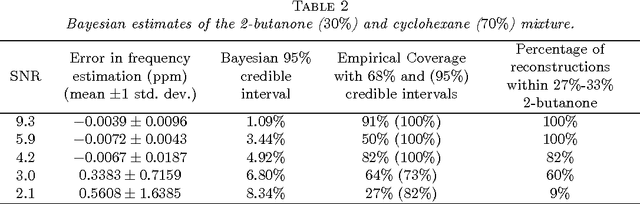
Nuclear magnetic resonance (NMR) spectroscopy exploits the magnetic properties of atomic nuclei to discover the structure, reaction state and chemical environment of molecules. We propose a probabilistic generative model and inference procedures for NMR spectroscopy. Specifically, we use a weighted sum of trigonometric functions undergoing exponential decay to model free induction decay (FID) signals. We discuss the challenges in estimating the components of this general model -- amplitudes, phase shifts, frequencies, decay rates, and noise variances -- and offer practical solutions. We compare with conventional Fourier transform spectroscopy for estimating the relative concentrations of chemicals in a mixture, using synthetic and experimentally acquired FID signals. We find the proposed model is particularly robust to low signal to noise ratios (SNR), and overlapping peaks in the Fourier transform of the FID, enabling accurate predictions (e.g., 1% sensitivity at low SNR) which are not possible with conventional spectroscopy (5% sensitivity).