 Add to Chrome
 Add to Firefox
 Add to Edge
3D Reconstruction and Knowledge Distillation to Improve Multi-View Image Models to Explore Spike Volume Estimation in Wheat
May 20, 2026
Accurate estimation of wheat spike volume is important for yield component analysis and stress resilience assessment, yet field-based measurement remains challenging. Active 3D sensing methods such as Light Detection and Ranging (LiDAR) or time-of-flight (ToF) are sensitive to plant motion or poorly suited to outdoor conditions, while 3D reconstructions are computationally expensive. Direct 2D image processing would offer computational advantages, but image-based models lack explicit geometric information. We therefore propose a hybrid 2D-3D approach with knowledge distillation during training while enabling efficient image-only inference. First, we train a rigid-invariant point cloud network using distance-based histogram features to obtain pose-robust geometric representations. We then combine the 3D model with a proposed multi-view image-based regulated Transformer (RT) in an ensemble architecture. Finally, we distill the ensemble knowledge into a purely image-based student model using either feature-based or label-based distillation. The two distilled RTs reduce the mean absolute error (MAE) from 654.31 mm$^3$ of the non-distilled RT to 639.93 mm$^3$ and 644.62 mm$^3$, and increase correlation from 0.76 to 0.77 and 0.82, respectively. At the same time, inference time is reduced from 160 ms to 1.4 ms per spike. Distillation further mitigates volume-dependent bias and reshapes the latent representation of the image model toward a geometry-aware shape. Our results demonstrate that 3D-informed training of a 2D Transformer allows for scalable and efficient spike volume estimation for high-throughput field phenotyping.

FoMo4Wheat: Toward reliable crop vision foundation models with globally curated data
Sep 08, 2025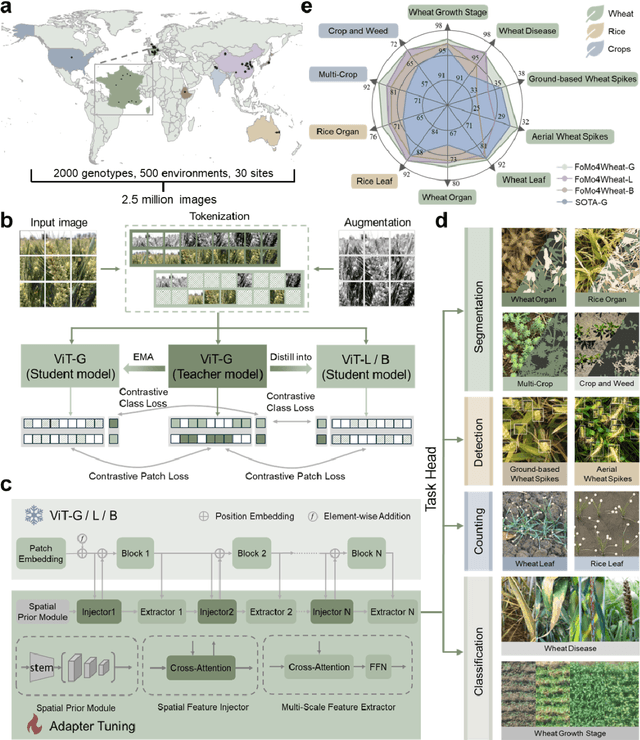

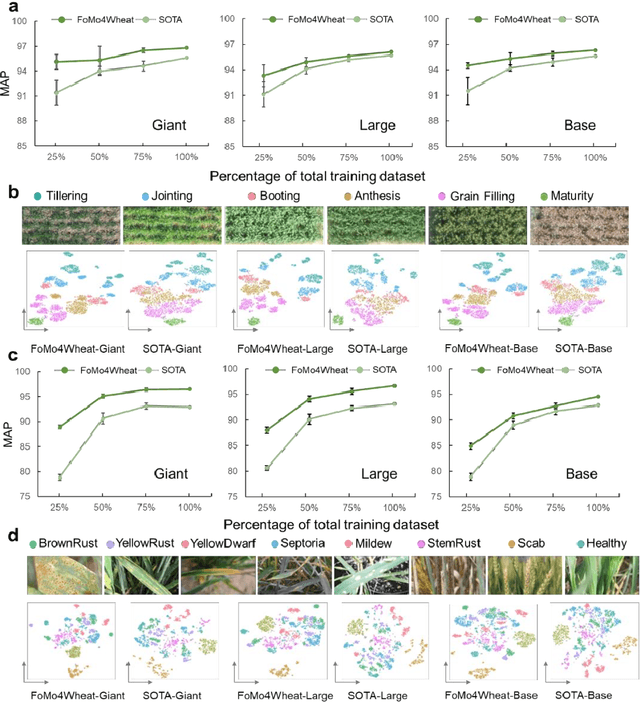
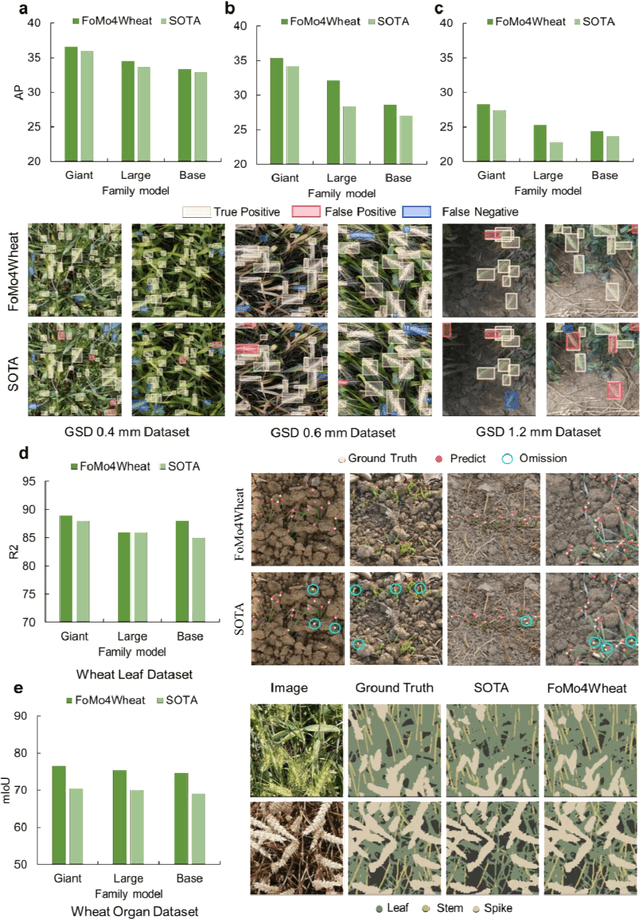
Vision-driven field monitoring is central to digital agriculture, yet models built on general-domain pretrained backbones often fail to generalize across tasks, owing to the interaction of fine, variable canopy structures with fluctuating field conditions. We present FoMo4Wheat, one of the first crop-domain vision foundation model pretrained with self-supervision on ImAg4Wheat, the largest and most diverse wheat image dataset to date (2.5 million high-resolution images collected over a decade at 30 global sites, spanning >2,000 genotypes and >500 environmental conditions). This wheat-specific pretraining yields representations that are robust for wheat and transferable to other crops and weeds. Across ten in-field vision tasks at canopy and organ levels, FoMo4Wheat models consistently outperform state-of-the-art models pretrained on general-domain dataset. These results demonstrate the value of crop-specific foundation models for reliable in-field perception and chart a path toward a universal crop foundation model with cross-species and cross-task capabilities. FoMo4Wheat models and the ImAg4Wheat dataset are publicly available online: https://github.com/PheniX-Lab/FoMo4Wheat and https://huggingface.co/PheniX-Lab/FoMo4Wheat. The demonstration website is: https://fomo4wheat.phenix-lab.com/.
Global Wheat Head Dataset 2021: more diversity to improve the benchmarking of wheat head localization methods
Jun 03, 2021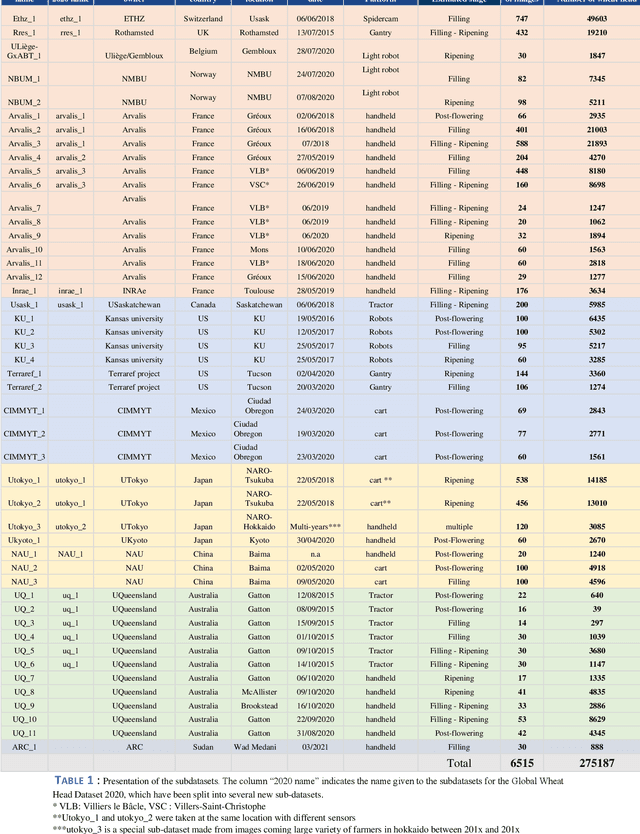
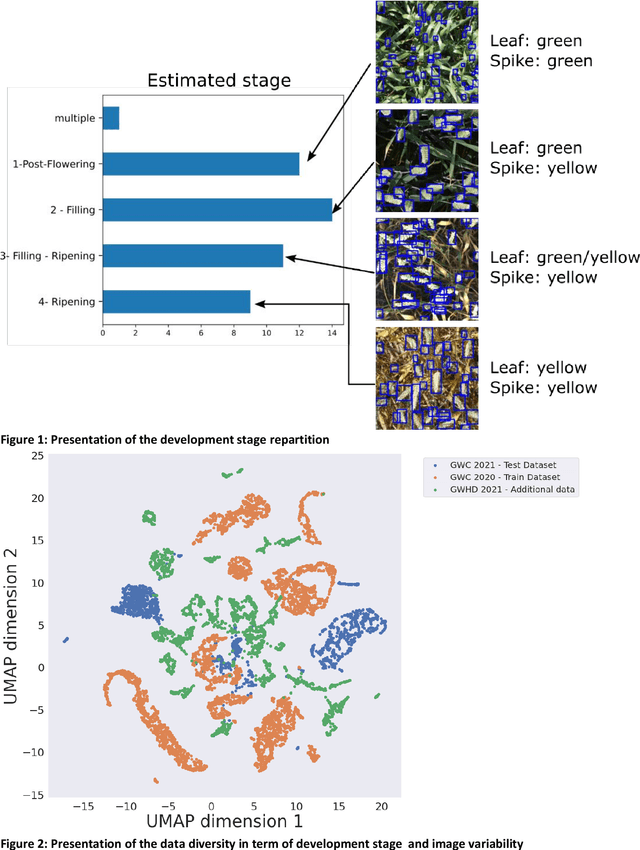
The Global Wheat Head Detection (GWHD) dataset was created in 2020 and has assembled 193,634 labelled wheat heads from 4,700 RGB images acquired from various acquisition platforms and 7 countries/institutions. With an associated competition hosted in Kaggle, GWHD has successfully attracted attention from both the computer vision and agricultural science communities. From this first experience in 2020, a few avenues for improvements have been identified, especially from the perspective of data size, head diversity and label reliability. To address these issues, the 2020 dataset has been reexamined, relabeled, and augmented by adding 1,722 images from 5 additional countries, allowing for 81,553 additional wheat heads to be added. We now release a new version of the Global Wheat Head Detection (GWHD) dataset in 2021, which is bigger, more diverse, and less noisy than the 2020 version. The GWHD 2021 is now publicly available at http://www.global-wheat.com/ and a new data challenge has been organized on AIcrowd to make use of this updated dataset.