 Add to Chrome
 Add to Firefox
 Add to Edge
3D Reconstruction and Knowledge Distillation to Improve Multi-View Image Models to Explore Spike Volume Estimation in Wheat
May 20, 2026
Accurate estimation of wheat spike volume is important for yield component analysis and stress resilience assessment, yet field-based measurement remains challenging. Active 3D sensing methods such as Light Detection and Ranging (LiDAR) or time-of-flight (ToF) are sensitive to plant motion or poorly suited to outdoor conditions, while 3D reconstructions are computationally expensive. Direct 2D image processing would offer computational advantages, but image-based models lack explicit geometric information. We therefore propose a hybrid 2D-3D approach with knowledge distillation during training while enabling efficient image-only inference. First, we train a rigid-invariant point cloud network using distance-based histogram features to obtain pose-robust geometric representations. We then combine the 3D model with a proposed multi-view image-based regulated Transformer (RT) in an ensemble architecture. Finally, we distill the ensemble knowledge into a purely image-based student model using either feature-based or label-based distillation. The two distilled RTs reduce the mean absolute error (MAE) from 654.31 mm$^3$ of the non-distilled RT to 639.93 mm$^3$ and 644.62 mm$^3$, and increase correlation from 0.76 to 0.77 and 0.82, respectively. At the same time, inference time is reduced from 160 ms to 1.4 ms per spike. Distillation further mitigates volume-dependent bias and reshapes the latent representation of the image model toward a geometry-aware shape. Our results demonstrate that 3D-informed training of a 2D Transformer allows for scalable and efficient spike volume estimation for high-throughput field phenotyping.

Wheat3DGS: In-field 3D Reconstruction, Instance Segmentation and Phenotyping of Wheat Heads with Gaussian Splatting
Apr 09, 2025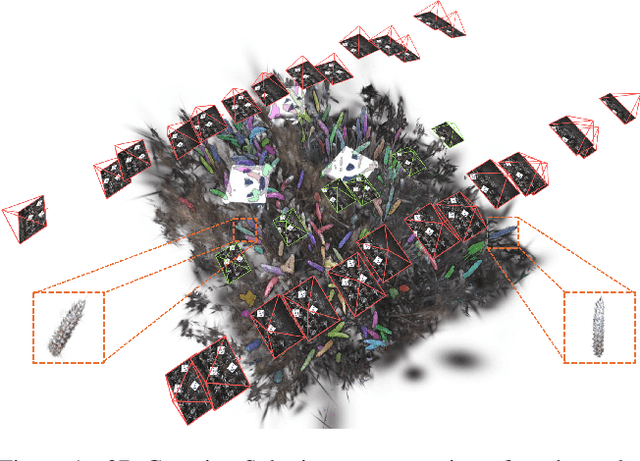
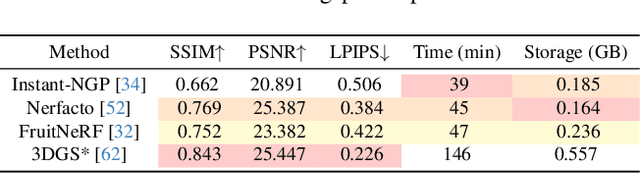
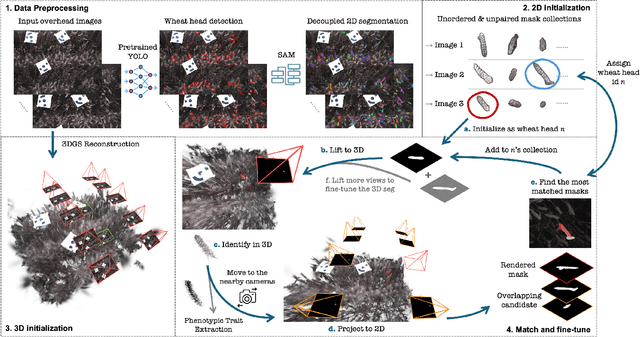

Automated extraction of plant morphological traits is crucial for supporting crop breeding and agricultural management through high-throughput field phenotyping (HTFP). Solutions based on multi-view RGB images are attractive due to their scalability and affordability, enabling volumetric measurements that 2D approaches cannot directly capture. While advanced methods like Neural Radiance Fields (NeRFs) have shown promise, their application has been limited to counting or extracting traits from only a few plants or organs. Furthermore, accurately measuring complex structures like individual wheat heads-essential for studying crop yields-remains particularly challenging due to occlusions and the dense arrangement of crop canopies in field conditions. The recent development of 3D Gaussian Splatting (3DGS) offers a promising alternative for HTFP due to its high-quality reconstructions and explicit point-based representation. In this paper, we present Wheat3DGS, a novel approach that leverages 3DGS and the Segment Anything Model (SAM) for precise 3D instance segmentation and morphological measurement of hundreds of wheat heads automatically, representing the first application of 3DGS to HTFP. We validate the accuracy of wheat head extraction against high-resolution laser scan data, obtaining per-instance mean absolute percentage errors of 15.1%, 18.3%, and 40.2% for length, width, and volume. We provide additional comparisons to NeRF-based approaches and traditional Muti-View Stereo (MVS), demonstrating superior results. Our approach enables rapid, non-destructive measurements of key yield-related traits at scale, with significant implications for accelerating crop breeding and improving our understanding of wheat development.